
 The 5-4 decision upholds a Mississippi law that had permitted the counting of mail-in ballots./SCREENGRAB
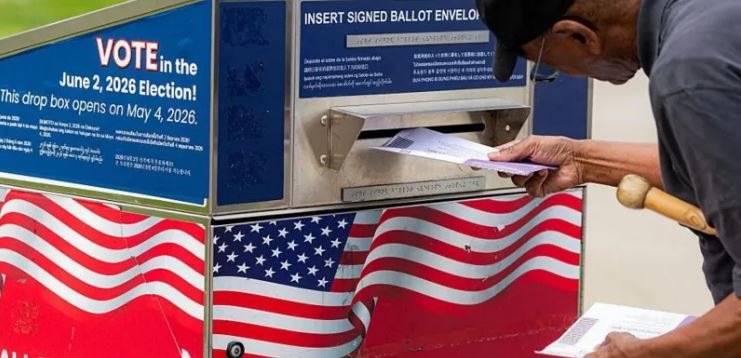
The Supreme Court has ruled that states may count postal ballots received late if they were postmarked by election day, rejecting the Trump administration's push to block it.
The 5-4 decision upholds a Mississippi law that had permitted the counting of mail-in ballots that were postmarked before election day but arrived up to five days afterwards.
The ruling marks a significant political defeat for Donald Trump, who called the decision a "tremendous loss". The president has repeatedly stated that mail-in ballots are vulnerable to fraud.
The states that allow late-arriving postal ballots are mostly Democratic-leaning, although a few Republican-led jurisdictions also allow a grace period.
The top court's ruling could affect voting deadlines in more than a dozen states that will be pivotal in deciding which party controls Congress after this November's midterm elections.
The court's majority opinion was written by Justice Amy Coney Barrett, joined by Chief Justice John Roberts and the court's three liberal justices.
In the opinion, Justice Barrett wrote that the ruling does not conflict with existing federal law, which stipulates that the "Tuesday next after the 1st Monday in November" is the "day for the election".
"The election-day statutes say nothing about ballot receipt, and we cannot add to the words Congress chose," she wrote.
In his written dissent, conservative Justice Samuel Alito said that the "acceptance of these late-arriving ballots effectively postpones the date on which the electorate's choice is made, and federal law precludes that postponement.
"Today's decision leaves open opportunities for voter fraud that may further undermine Americans' faith in the integrity of this country's election," he wrote. "Diverse sources have recognized that mail-in ballots increase the potential for fraud."
President Trump has repeatedly criticised mail-in ballots and said - with no evidence - that the practice prevented him from winning the 2020 election against Joe Biden.
In a post on Truth Social, Trump called on lawmakers to pass the Save America Act, which would mandate photo ID and proof of citizenship for voters.
It would also ban mail-in ballots, with exceptions made only in cases of illness, disability, travel or military deployments.
"There is no excuses for a politician, or otherwise, to be against the above three requirements," Trump said of the Save America Act. "There is only one reason to oppose - cheating."
Just last week, Trump cancelled the signing of a bipartisan housing bill, saying that he would only make it law if the Save America Act is passed.
In March, Trump's lawyer argued before the Supreme Court in support of the Republican National Committee-led lawsuit against Mississippi's mail ballot deadline.
The challenge focused on an 1845 congressional statute that defines election day as the first Tuesday after the first Monday in November.
Republicans argued that the law requires ballots to be not just postmarked but received by that date.
"Election-day receipt promotes election integrity and voter confidence as much today as it did when Congress passed that law," the Trump administration told the Supreme Court in a legal brief.
More than a dozen states allow mail-in ballots to be received after election day, including Alaska, Texas, Nevada, Virginia and Nevada.
Despite President Trump's claims of rampant fraud in mail-in ballots, studies have shown that confirmed cases of fraud are exceedingly rare.
One study, released by the Brookings Institution in November last year, found that the last five US elections had an average of four cases of mail voting fraud out of every 10m votes.
Trump himself used a mail-in ballot to vote in a Florida special election earlier this year.
The White House dismissed the vote as a "non-story" and noted that the president has long voted in Florida, but lives in Washington.