
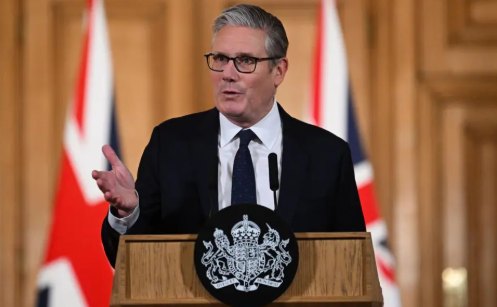
Prime Minister Keir Starmer is expected to ban under-16s from major social media platforms including TikTok, Snapchat and Instagram.
Children will also stop being able to livestream on "safer" sites and stop being able to talk to strangers on gaming apps, the prime minister is set to announce.
Ministers are considering whether to impose social media curfews for children, but further details will not be unveiled until next month.
Australia introduced the world's first outright ban on social media for under-16s in December 2025 and Whitehall sources are describing the UK's scheme, to be unveiled by Starmer on Monday morning, as "Australia-plus".
"This is a choice about whose side we're on: families across the country, or a status quo that isn't working," he has said.
He added he would "call time on a system that's failing our kids".
Snapchat, TikTok, YouTube, Instagram, Facebook and X are among the platforms affected - but not WhatsApp or Signal, the government says.
England’s children’s commissioner has said a social media ban should be extended to all children – including those up to the age of 18 rather than stopping at 16.
"A full ban is the right choice... I am not prepared to compromise on the safety and happiness of our children," Starmer says in a televised statement.
At a school in Wythenshawe, Manchester, Year 8 and 9 pupils have their say on social media: Sean, 13, says "it's a bad place" while Isaac, also 13, says he's "disappointed" ministers opted for a ban instead of trying to make platforms "safer".
Dame Rachel de Souza said while the ban is “positive”, the debate must be reset “from banning children to banning the companies who fail to show that their services protect children’s safety and wellbeing”.
She said today’s announcement was "positive" but the measures are only as strong as their enforcement, which she added she would be "watching closely."
She said that any online service using harmful features - including gaming and other platforms - should be banned from being accessed by under-18s unless they can prove it's safe.
“This is a decision that will define childhood – we must listen to young people and put their interests first. Children tell me that digital spaces are where they learn, connect and find community.
“But they want an end to the harms: addictive design that keeps them scrolling, the explicit content they wish they’d never seen, and the strangers who should never be able to contact them.”
How are 8- to 14-year-olds spending time online? Ofcom data offers some insight
Children in the UK aged eight to 14 are online for an average of nearly three hours each day, at least two hours of which are spent using types of social media, survey data suggests.
Media regulator Ofcom has been drilling down on the figures, external and has found that YouTube accounts for the largest share of time spent online by young people in the eight to 14 age group, at 23%.
Snapchat is responsible for 18% of time online, with WhatsApp on 9%, TikTok accounting for 7%, Roblox also for 7% and other platforms accounting for 36%.
The use of these services varies according to age, Ofcom found. It says it is ready to work with the government to help “"build on this progress with new measures to protect children".
In its survey, Ofcom found that the youngest age group, eight to nine-year-olds, are likely to spend an average of 53 minutes each day using YouTube (45% of time online) and 10 to 12-year-olds spend 55 minutes (31%), but among 13 to 14-year-olds the average drops to 31 minutes (13%).
The opposite pattern is true for Snapchat, which accounts for six minutes of time online spent by eight to nine-year-olds (5% of the total), rising to 36 minutes for 10 to 12-year-olds (20%) and one hour and 37 minutes for 13 to 14-year-olds (40%).
And use of TikTok increases gradually, from an average of six minutes a day among eight to nine-year-olds (5% of time online) to 17 minutes for 10 to 12-year-olds (9%) and 21 minutes for 13 to 14-year-olds (9%).