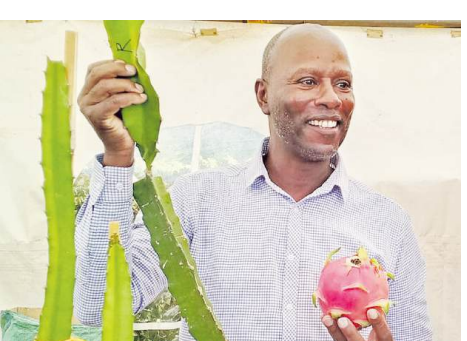
Meet Anthony Mugambi, an engineer by profession, but famously
known as the king of dragon fruit
farming in Meru county.
The Kathuura village in Imenti Central farmer has earned recognition far
and wide for the trade.
The Star met with him at Kalro’s
open week for Food Crops Research
Institute in Kabete, where he was
showcasing his dragon fruit products.
Dragon fruit, a member of the cactus family, grows in arid and semi-arid
areas.
“It’s a fruit which is super rich in
antioxidants and vitamins. It is good
for health as much as it is good for
wealth,” Mugambi said.
The farmer’s introduction to dragon fruit was unexpected.
“I first encountered it in China in 2003. At the
time, I didn’t know what it was, but I
found it calming and refreshing when
I ate it. Later, a Chinese friend introduced me to it and I learnt about its
fascinating origins as a cactus family
plant,” he recalls.
Mugambi grows the fruit on approximately 20 acres of his Gravity
Farm in Central Imenti.
“I grow three varieties; the red-flesh,
white and yellow dragon fruits. Each
has its own unique flavour,” he says.
His background as an engineer has
been beneficial. “Being an engineer
gives me the ability to approach farming with a problem-solving mindset, which is crucial for success,” Mugambi says.
This logical approach has allowed
him to optimise his farming practices,
combining technical skills with the
details of agriculture.
Dragon fruit’s origins trace back
to South America, before Portuguese
and Spanish explorers introduced it
to Asia, where it became a symbol of
royalty and power.
“In Asia, it was
associated with the mythical dragon
Long, a symbol of strength and grace
and was traditionally consumed by
emperors and high priests,” Mugambi
says.
“There’s a lot of arid land in Kenya
that is perfect for growing dragon
fruit.”
Mugambi’s farming process begins
with setting up plant supports.
“Dragon fruit plants have shallow roots, so
you don’t need to dig deep pits. Just
set up posts, add some manure and
plant. Guide the plant up the post and
in about a year or a year and a half,
you can start harvesting.”
In just one acre, Mugambi plants
around 2,000 dragon fruit plants.
About 500 posts support the plants.
Depending on the care given, each
acre can yield between five and 15
tonnes during a single fruiting cycle,
which typically lasts from November
to June.
“What’s interesting about the fruit
is that you can also grow it off-season with proper management,” the
farmer says.
Looking ahead, Mugambi hopes
to expand his operation to 50 acres within the next two to three years to
meet the growing demand.
“Kenya is already on the global map
of dragon fruit producers and in 20
years, I believe we will be one of the
top three global producers,” he says.
A kilo of dragon fruit sells for
Sh1,000 and there is demand for it
locally and internationally.
On average, one can easily make
between Sh5 million to Sh10 million
per year per acre with good husbandry, Mugambi says.
It will also cost an average of Sh1.5
million and Sh2.5 million to set up
dragon farming on an acre of land.
Despite meeting all the export
requirements, Mugambi currently
focuses on satisfying local demand.
“We’ve had to suspend exports because we can’t meet the local demand.
It’s growing fast and it’s exciting,” he
says. Prices for dragon fruits vary. The
yellow variety fetches higher prices
due to its sweetness, despite being smaller in size.”