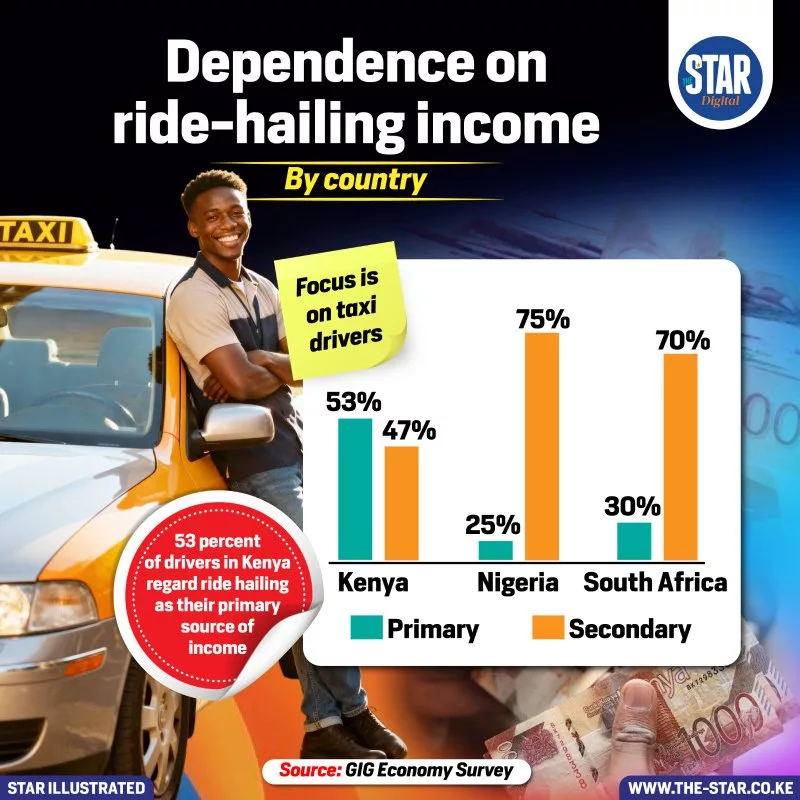
A recent GIG Economy Survey reveals stark differences in how taxi drivers rely on ride-hailing income across Kenya, Nigeria, and South Africa.
According to data, 53 per cent of drivers in Kenya regard ride-hailing as their primary source of income, leaving exactly 47 per cent who utilise it for secondary earnings.
This contrasts sharply with Nigeria and South Africa, where the focus is heavily on supplementary work.
In Nigeria, a significant 75 per cent of drivers treat ride-hailing strictly as a secondary income, with only 25 per cent relying on it primarily.
South Africa reflects a remarkably similar trend; 70 per cent of its taxi drivers earn secondary income through the sector, while just 30 per cent claim it as their primary job.
These precise statistics emphasise the vastly varying levels of economic dependence on gig economy taxi driving work today.