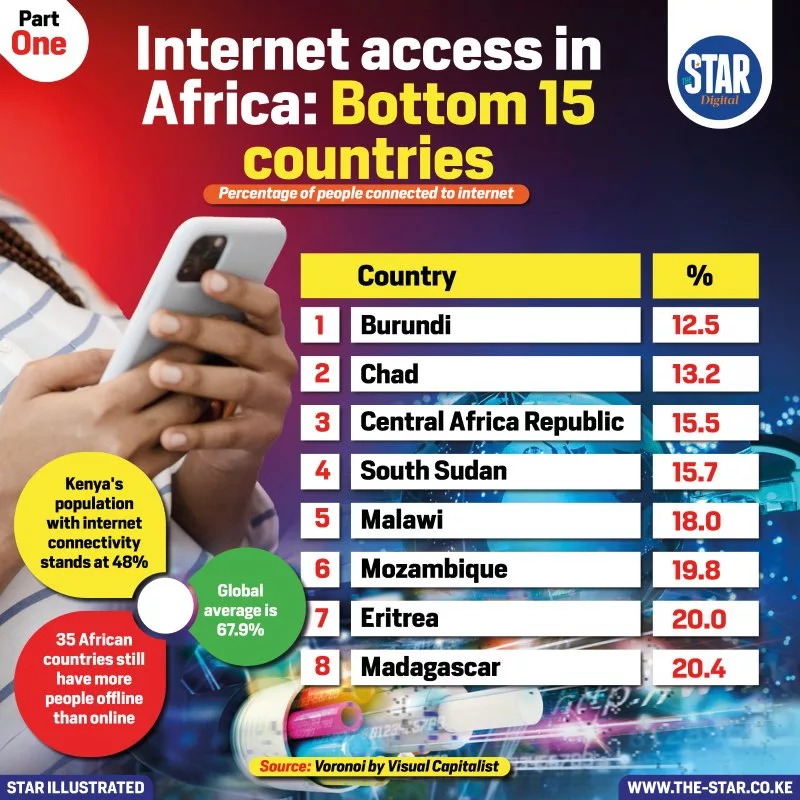
Africa continues to face a significant digital divide, with 35 countries on the continent still having more of their population offline than online. This stark reality places much of the region well below the global internet connectivity average, which currently stands at 67.9 per cent.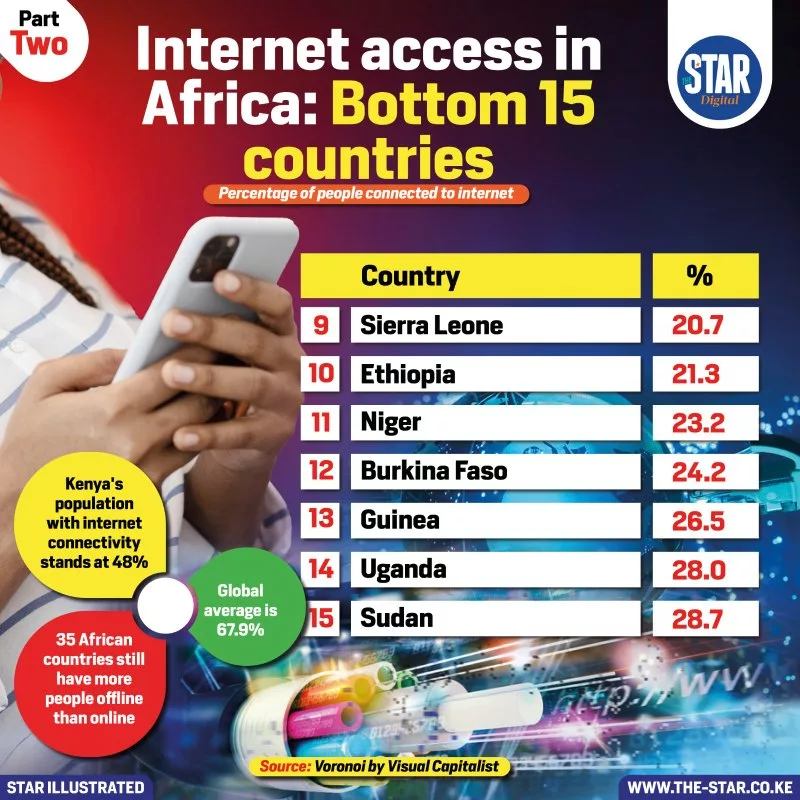
At the bottom of the connectivity scale, Burundi has the lowest internet penetration rate in Africa, with only 12.5 per cent of its population connected.
Chad follows closely with 13.2 per cent, while the Central African Republic and South Sudan register access rates of 15.5 per cent and 15.7 percent, respectively.
Malawi also remains deeply disconnected, with just 18.0 per cent of its citizens online, followed by Mozambique at 19.8 per cent and Eritrea at exactly 20.0 per cent.
In Madagascar, 20.4 per cent of the population has access, while Sierra Leone and Ethiopia record connectivity rates of 20.7 per cent and 21.3 percent.
Further up the bottom fifteen list, Niger stands at 23.2 per cent, Burkina Faso at 24.2 per cent, and Guinea at 26.5 per cent. Rounding out the lowest-ranked nations are Uganda at 28.0 per cent and Sudan at 28.7 per cent.
Even relatively stronger regional economies struggle to close the digital gap. Kenya, often viewed as a regional technology hub, has an internet connectivity rate of 48 per cent, meaning the majority of its population still lacks access to the online world.
These figures underscore the massive infrastructure and accessibility hurdles that remain across the continent as nations struggle to catch up with global digital integration standards.