It was in 2016, inside a modest laboratory at Mudhiora Secondary
School, that chemistry teacher Richard Arwa, who is passionate about
innovation, first noticed the damage potential of a local menace.
Together with his students, he began experimenting with the
invasive water hyacinth plant that was choking nearby Lake Victoria.
Their goal was to find out if it could produce ethanol, a
clean-burning fuel.
“We had spent years participating in science congress
competitions, but this time we wanted something more practical,” Arwa tells the
Star.
“We were tired of watching the lake suffocate. So, we asked,
‘Can this weed actually be useful?’ ”
After several failed attempts, they managed to extract a few
millilitres of ethanol, enough to ignite a small blue flame.
That flicker sparked a vision that eventually would transcend
the school walls and inspire a transformative business idea.
Science project
lives on
The student-led project quickly gained attention during national
science congress competitions, drawing praise and recommendations for further
development.
For Arwa, the experiment was more than a one-off academic
showcase; it planted a durable seed of innovation.
“When the National Environment Trust Fund put out a call for
green innovations, I knew we had something worth submitting,” he says.
His successful entry earned him a spot in Netfund’s two-year
incubation programme.
During that time, Arwa refined the concept and developed a new
process for producing ethanol from non-traditional, cellulose-rich
feedstock – primarily water
hyacinth and sugarcane bagasse.
By using enzymes to break down plant fibres into fermentable
sugars, he bypassed the need for costly molasses, on which most ethanol
producers rely.
The success of the incubation marked the formal birth of Centre
for Innovation, Science and Technology (Cist) East Africa, a clean energy
company producing affordable, sustainable cooking fuel. Former science teacher
Arwa is now proprietor and CEO of family-owned business.
From lab bench to
market shelves
Introducing a new fuel into the market came with numerous
challenges.
Arwa had to prove not only that his ethanol could be produced
affordably, but also that it could compete with conventional fuels such as
charcoal, firewood and kerosene.
“We didn’t know whether customers would embrace it,” he admits.
With research support and technical backing, however, they scaled up from
lab-level production to 2,000 litres.”
To ensure usability, Arwa imported ethanol-compatible cooking stoves
from Tanzania. The response was positive, especially in informal settlements,
where residents were desperate for cleaner and safer alternatives to smoky
fuels.
Encouraged by the feedback, Cist East Africa took the next big
step building one of Kenya’s few small-scale ethanol distilleries, equipped
with triple distillation and molecular filtration systems to achieve fuel-grade
purity of 99 per cent.
In 2020, the company relocated operations to Kisumu, setting up
in an area with better access to raw materials, a skilled workforce and a ready
market.
Today, Cist East Africa produces about 3,000 litres of ethanol daily,
with ambitions to hit 5,000 litres in the coming year.
Energy for the
people, by the people
Arwa’s focus has always been on accessibility. While a litre of
ethanol retails at Sh100, the company has installed custom-built dispensers in
low-income areas, such as Manyatta, Obunga and Nyalenda in Kisumu.
These dispensers allow customers to purchase as little as Sh20
worth of ethanol, making clean cooking fuel accessible to those on daily wages.
“This model gives people flexibility. You don’t have to save up
Sh100. If you have Sh20, you still get clean energy. That’s where the
transformation lies,” Arwa says.
This innovation has positioned ethanol as a viable competitor in
the clean cooking fuel sector, traditionally dominated by LPG and charcoal.
With the World Health Organization linking indoor air pollution
to more than 21,000 deaths in Kenya annually, it is more urgent than ever to
use cleaner fuels.
Ethanol for
transport?
Arwa is not stopping in the kitchen.
In what could be a gamechanger for informal transport in
Kenya, Cist East Africa is now testing ethanol as a fuel for boda bodas and
tuk-tuks. Preliminary trials have shown promising results, with the first
vehicles already running on ethanol blends.
“We’re finalising regulatory compliance. Our goal is to roll
this out commercially by September. Fuel is one of the biggest costs for boda
boda riders and if we can offer them something cheaper and cleaner, it changes
everything.”
Cist East Africa has secured land in Rabuor, Kadibo subcounty,
where it plans to expand its production facility.
However, Arwa envisions a franchise-based model for wider
growth, enabling micro-distillers in rural and per urban areas to replicate the
ethanol production process under Cist’s guidance.
“Instead of building massive ethanol plants like the ones sugar
factories use, we’ll accredit small-scale producers who can operate in their
communities,” he says.
“That way, we create jobs, cut costs, and keep the supply chain
local.”
The company is also working on converting ethanol production
byproducts into animal feed, creating an additional revenue stream while
ensuring a zero-waste model.
While the private sector has made impressive strides, Arwa is
calling on the government to do more to support clean fuels.
He urges policymakers to create a dedicated distribution and
pricing framework for ethanol, similar to the one for kerosene.
“Kerosene distribution is widespread, even in the remotest
villages, despite being expensive and polluting,” Arwa says.
“If we want to truly transition to clean energy, we need similar
support systems for ethanol licensing, infrastructure, and subsidies.”
He says such investments would not only accelerate the country’s
transition to clean energy but also reduce dependence on fossil fuels and help
combat climate change.
Fueling a cleaner future
For now, the ethanol flames that started in a rural school lab
are lighting up homes across Kisumu and possibly soon, engines too.
From creating safer cooking environments for families to opening
new frontiers in biofuel transport, Arwa’s journey is proof that grassroots
innovation can power national transformation.
“We’re not just selling fuel,” he reflects. “We’re reimagining
energy, how it’s made, how it’s accessed, and who benefits from it.”


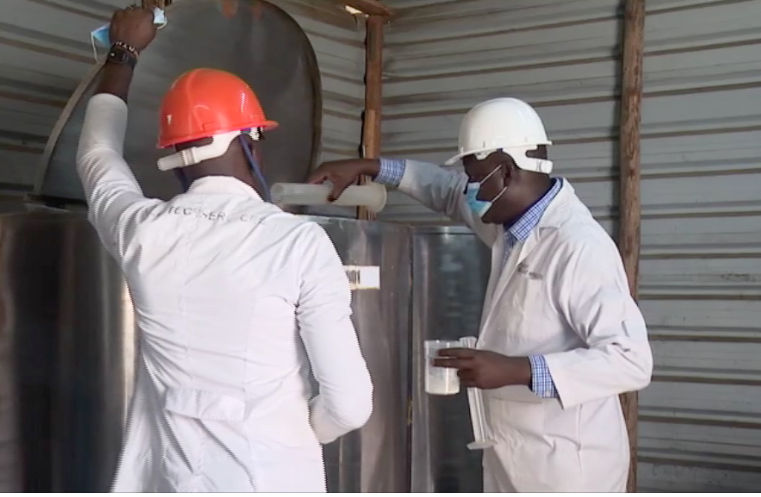 Richard Arwa at the distillery at Car Wash area in Kisumu City /FAITH MATETE