The number has doubled over past five years and now stands at over 120
by ELIUD KIBII
Audio By Vocalize
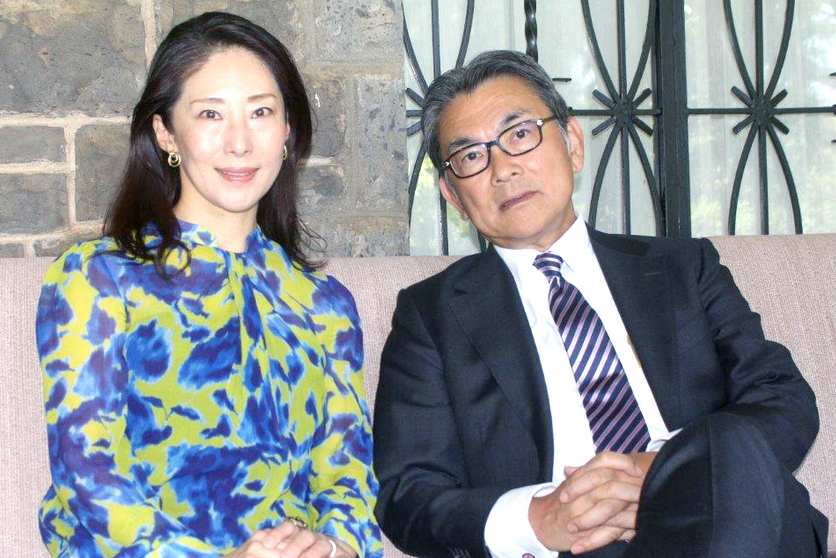
Japanese Ambassador Hiroshi Matsuura and his wife Yuka Matsuura during a past interview at his residence /MOSES MWANGI
Japan Ambassador Hiroshi Matsuura
presented his credentials to President William Ruto on December 4, 2024.
Since then, Amb Hiroshi has undertaken courtesy calls and meetings with
various Kenyan officials and organisations, including Parliament, ministries,
the East African Community and county governments.
In this interview with theStar’s Eliud Kibii, the envoy speaks Japan
relations with Kenya, the various joint initiatives and Japan’s interests in
the country.
The Tokyo International
Conference on African Development VI was held for the first time in Africa in
Nairobi in August 2016, almost 10 years ago. Could you update us on what
progress has been made since then?
TICAD is an international conference on African development, which has
been held eight times since 1993. It draws participation from the entire
African continent, and has set the tone for Japan-Africa relations for over 30
years. The ninth conference (TICAD IX) is scheduled to be held in Yokohama from
August 20-22, 2025.
TICAD VI, which was held here in Nairobi, has historical significance as
the first TICAD on the African continent. Furthermore, the participation of
many Japanese business leaders in TICAD VI has given impetus to investment and
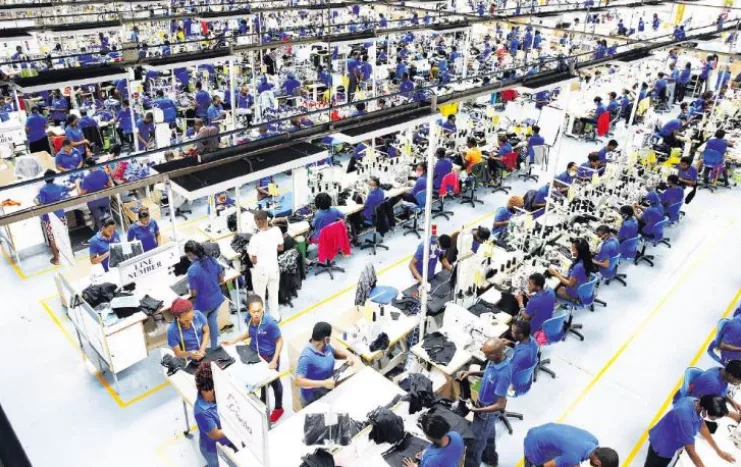
business interest in Kenya. As a result, the number of Japanese companies doing
business in Kenya has doubled over the past five years and now stands at over
120.
In addition, the Progress Report on Japan’s Contribution to Africa after
TICAD VIII, submitted at the TICAD Ministerial Conference in August 2024,
highlighted several good examples of Japan’s contribution, including the
expansion of geothermal power plants in Kenya and regional development
assistance integrating transport facilities such as ports, roads, etc.
At this year’s TICAD IX, I expect heated discussions on how Japan and
Africa can cooperate in light of the turbulent international situation and with
a long-term perspective. I hope that young Kenyans will be aware of TICAD and
understand that Japan and Africa are partners in learning from each other and
growing together.
There is the Osaka Expo, which
is to be held in the middle of this year, and in which Kenya will participate.
What can you tell us about this expo?
Expo 2025 Osaka, Kansai, Japan is currently being held on the man-made
island of Yumeshima in Osaka. It is a major event for Japan to present its
vision of the future to the world and work with countries around the world to
address common human challenges.
The theme is ‘Designing Future Society for Our Lives’, with sub-themes —‘Saving
Lives’, ‘Empowering Lives’ and ‘Connecting Lives’.
Kenya is also exhibiting a pavilion and will host the Kenya National Day
at the Expo on June 24. Japan has strong hopes that Kenya will be able to
showcase the attractions of its country to the world, leading to increased
tourism, business, investment and human resource exchange.
Both Japan and Kenya are working individually and sometimes in
cooperation on how human life should be enriched. By introducing and learning
from each other’s efforts to utilise culture, technology and industry, we hope
to build a new era of enriched humanity together. In particular, I hope that
the Expo will serve as a platform for furthering industrial cooperation between
Japan and Kenya.
Japan is helping Kenya set up a
Special Economic Zone at the Coast. This is expected to be an economic game
changer, given what has happened elsewhere, especially in East Asia, where such
SEZs now have a long history. How do you think Kenya will benefit from
Mombasa’s Dongo Kundu SEZ?
The Port of Mombasa is Kenya’s premier international trading port and a
key logistics hub as the starting point of the Northern East Africa Corridor.
Because of this importance, the development of a free trade port and special
economic zone in Dongo Kundu, Mombasa, is a priority national development
project in Kenya.
The Government of Japan is assisting in the formulation of the master
plan and supporting the development of necessary infrastructure such as ports,
power facilities, roads and water supply and drainage facilities.
Once completed, it is expected that the favourable investment climate
will lead to a large number of companies moving into the area, which will
create jobs, stimulate the local economy, strengthen exports and improve living
infrastructure, thereby raising the standard of living in Kenya as a whole.
When this happens, the Dongo Kundu SEZ will long be remembered by Kenyans as a
symbol of Kenya-Japan industrial cooperation.
At one point a few years ago,
there was the geopolitical concept called the ‘Free and Open Indo Pacific’,
which was promoted by Japan, along with India, the US and other countries. We
do not hear much about it anymore. What happened with FOIP?
The Free and Open Indo-Pacific initiative was proposed by former Prime
Minister Shinzo Abe at TICAD VI in Nairobi in 2016. The initiative aims to
consolidate a rules-based international order by establishing principles such
as free trade, freedom of navigation and the rule of law, which are essential
for stability and prosperity in the Indo-Pacific region.
Both Japan and Kenya sustain the livelihoods of their citizens by
enjoying the rich benefits of peace, free navigation and free trade in the
Indian Ocean. The benefits of the Indian Ocean extend not only to both
countries but also to the whole world. Both countries, together with other
like-minded countries, should strengthen FOIP cooperation to safeguard and
promote the benefits of the Indian Ocean for the benefit of their interests and
those of the world.
Kenya was one of the first countries to endorse the FOIP vision at TICAD
VI and a few years later co-hosted the Sustainable Blue Economy Conference with
Japan and Canada. Since then, Kenya has remained a key partner of Japan in
promoting FOIP and the blue economy.
To support the promotion of maritime security in Kenya, Japan has
provided 17 patrol vessels to the Kenya Coast Guard Service in 2019, as well as
two high-speed patrol vessels and four rigid-hull inflatable boats to the Kenya
Fisheries Authority in 2023, to help combat illegal and unreported and unregulated
fishing in Kenyan waters, helping to promote the blue economy and maritime
security.
Furthermore, Kenya’s importance in the FOIP is reflected in the hosting
of the FOIP for Peace and Development in East Africa Symposium in 2023, as well
as the port calls of the third Mine Warfare Force’s mine countermeasure vessel
‘Bungo’ and minesweeper ‘Etajima’ in Mombasa in 2025.
What are the outcomes of the
Kenya-Japan Business Forum that was held in January, and what are the areas of
focus for Japanese companies in trade and investment?
From January 15-17, 2025, a joint public-private mission of about 50
Japanese business persons, led by State Minister for Foreign Affairs Fujii,
visited Kenya. State Minister Fujii, together with some Japanese companies,
paid a courtesy call on Musalia Mudavadi, the Prime Cabinet Secretary and CS
for Foreign and Diaspora Affairs, and Salim Mvurya, then acting CS for
Investment, Trade and Industry. On January 16, a business forum was jointly
organised by the relevant ministries of both countries, where active
discussions were held on trade and investment promotion.
The discussions further increased the momentum for business cooperation
between Kenya and Japan, and some of the participating companies made plans for
the formation of concrete partnerships in the future. It is hoped that these
results will gradually bear fruit. More than 120 Japanese companies are
extensively active in Kenya, with particular focus on the infrastructure,
agriculture, healthcare, energy and digital sectors.
The inaugural
Military-to-Military Dialogue was held in January 2024, and in February this
year, you held talks with Defence CS Soipan Tuya. We see a deepening of defence
ties. What are the objectives?
Located on the western edge of the Indian Ocean and gateway to Africa,
Kenya, like Japan, is committed to a free and open international order based on
the rule of law and is an important partner country of Japan. This is well
illustrated by its support for the FOIP vision, ahead of other countries.
As the international situation becomes increasingly uncertain, the need
for and potential for defence cooperation between Kenya and Japan, as
like-minded countries and partners, is growing rapidly. The aim is to promote
and consolidate the rule of law, freedom of navigation and free trade, pursue
economic prosperity and ensure peace and stability.
Toward this aim Japan and Kenya have deepened our defence cooperation
through various means, including peace-building assistance and exchanges
between the Japan Self-Defence Forces and the Kenyan Defence Forces.
In the field of peace-building, for example, since 2008, Japan and
Kenya, through the UN and UNDP, have been cooperating in PKO (peacekeeping
operation) training, humanitarian assistance and disaster relief, conflict
prevention, protection of women and children in conflict situations, maritime
security, etc, at the International Peace Support Training Centre. We will
further enhance our cooperation.
Japan has been visible in terms
of cultural diplomacy and education through scholarships. What is the status of
these relations in promoting people-to-people relations?
Human resource development has always been a major pillar of Japanese
development cooperation with Kenya. This is because Kenya’s development can
ultimately only be achieved by competent Kenyans, and through human resource
development, friendship between Japan and Kenya can be fostered.
As a result, many Kenyans educated in Japan have played a leading role
in nation building and in promoting cultural exchange between Japan and Kenya.
I am very proud of this.
For example, more than 350 Kenyans have studied in Japan on the Japanese
government scholarships. The programme offers scholarships at master’s and
doctoral level, undergraduate level and vocational school level, and the embassy
recruits and selects recipients every year.
Other programmes include a short-term study visit to Japan for
outstanding Japanese language learners, a study visit to Japan for Kenyan civil
servants and various other purpose-driven programmes, each contributing to
Kenya’s human resource development.
Japan will continue to support Kenya’s development through human
resource development for Kenyans and foster friendship between Japan and Kenya.
Finally, Japan decided to fund Unesco
through Supplementary Budget to assist tackle flood risks in Kenya. These
floods have been attributed to climate change. In which areas are Japan and
Kenya cooperating in handling the climate change crisis?
Both Japan and Kenya are deeply concerned about the serious impacts of
climate change on the global environment and have played leading roles in the
Paris Agreement and other UN frameworks to mitigate climate change and adapt to
changes resulting from its impacts.
The international political landscape on climate change is undergoing
rapid change and Japan and Kenya will work together to ensure that this rapid
change does not set back global climate action.
Examples of Japan’s cooperation with climate change action in Kenya include
the promotion of breeding and planting of drought-tolerant tree varieties
through Jica, the dissemination of superior decarbonisation technologies
through investment and support for the introduction of flood control systems
through Unesco. We support Kenya’s efforts through both mitigation and
adaptation.
This is premium content
Subscribe to Continue Reading
Help us continue bringing you unbiased news, in-depth investigations, and diverse perspectives. Your subscription keeps our mission alive and empowers us to provide high-quality, trustworthy journalism. Join us today to make a difference!