He was born in the sprawling slum of
Dandora Phase II in Kenya’s capital,
Nairobi.
His mother worked for the defunct
Nairobi City Council and raised her
three children on the modest paychecque.
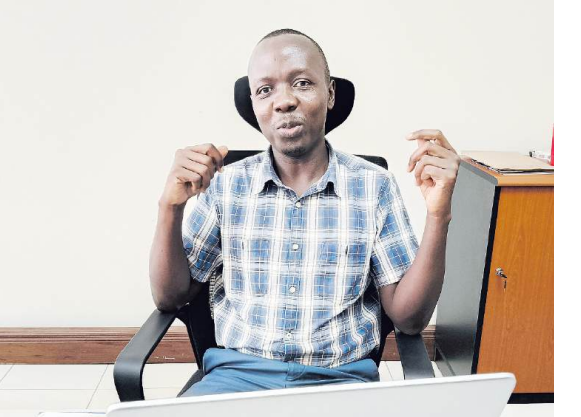
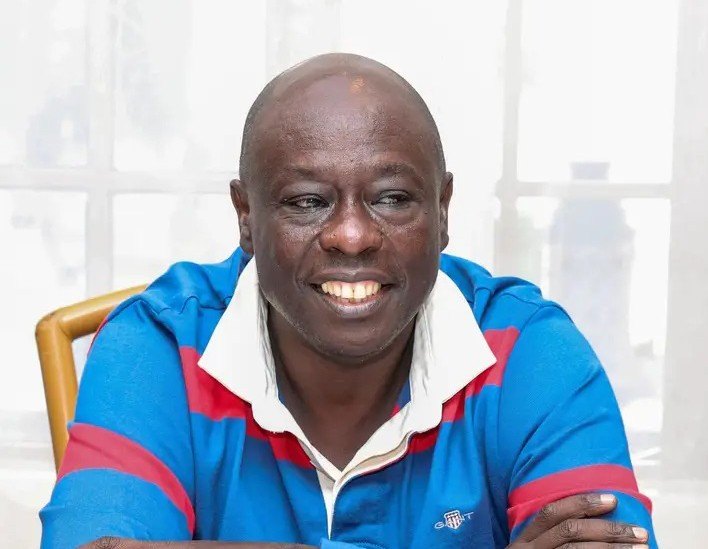
Dr Abidan Mwachi, the chairperson of the Kenya Medical Practitioners and Dentists Union, says
despite growing up in a slum, he
always aspired to be a doctor.
He clears his throat and begins the
interview from behind his desk at his
home office in Nyali, Mombasa.
“My mother was a cleaner at the
municipal council markets. That job
is how she raised the three of us—my
elder brother, myself and my younger
sister. We all went to Wangu Primary
School, which borders the dumpsite,
fence,” he recalls.
A bright student, Mwachi scored
565 marks out of a possible 700 in his
Kenya Certificate of Primary Education exams and was set to join Starehe
Boys’ Centre, a national school.
Now a consultant general and laparoscopic surgeon at Coast General
Teaching and Referral Hospital in
Mombasa, he still doesn’t understand
how he missed the opportunity to
join Starehe, where he would have
received a fully sponsored education.
“I remember walking from Dandora
to Starehe Boys’ Centre to meet the
then director, Geoffrey Griffin. While
waiting at the reception, a firm-looking man stepped out. He seemed busy
and there were many people waiting
for him,” he says.
“He asked what had brought us
there and I explained my situation.
Unfortunately, he said there was nothing he could do. I think my spot had
already been given to someone else.”
A few weeks later, Mwachi received
an admission letter for Sunshine Secondary School, a newly established
institution then.
“At that time, my mother had only
Sh20,000, while Sunshine required
Sh80,000 per term. But with that
Sh20,000 and armed with hope and
faith, she still took me to Sunshine,”
he says.
“I joined Sunshine Secondary School
with Sh20,000 from my mother and
most importantly, prayers and determination. I had joined late—probably
a few weeks before the end-term exams—but I still outperformed many
students,” he recalls.
The school management, recognising his potential, decided not to send
him home for fees.
“By the second term, they allowed
me to continue. I kept excelling, becoming the top student in my class.”
A few months later, Mwachi was
awarded a full presidential bursary for
the rest of his high school education.
“I never paid a single cent afterward. I was the best student in my class and
overall index three in KCSE. Eventually, I became the head school captain,
leading until 2003,” he says.
Mwachi was among the top students in the country when he sat his
KCSE exams, scoring an A.
“I sat for eight subjects, scoring seven A’s and one A-minus. When applying for university, I was intentional—I wanted to study medicine,” he says.
“I remember having to walk from
Dandora Phase II to a Catholic-run
dispensary in Kariobangi when my
tonsillitis flared up. I could barely
swallow anything. I passed by so
many private clinics that could have
easily administered a simple painkiller, but none did. That experience
inspired me to pursue medicine.”
While waiting to join the university,
Mwachi returned to Sunshine Secondary School, where he worked as a
computer lab assistant for two years,
earning Sh7,000 per month.
“I had little knowledge of computers beyond basic packages, but I
was determined to learn. I saved most
of my earnings and in 2005, joined
the University of Nairobi to study
medicine.”
To finance his education, Mwachi
relied on loans from the Higher Education Loans Board.
“HELB would give us Sh16,000 per
semester and I had to budget carefully,
borrowing where necessary,” he says.
In his fourth year, Mwachi ventured into student politics and was
elected to the Student Organisation of
Nairobi University national executive
committee as a senate representative.
“I was voted as the campus rep for
the College of Health Sciences.”
He later interned at the Coast General Hospital in Mombasa.
“During
my final year at university, we founded what is now the KMPDU with
like-minded doctors,” he says.
In its formative years, KMPDU
faced opposition from the Kenya
Union of Civil Servants, which argued that doctors, as civil servants,
should remit union fees.
“However, we managed to overcome that. As they say, the rest is
history. In 2011, while I was still an
intern at Coast General, we organised
our first national doctors’ strike. Our
grievances boiled down to one major
issue—doctors were poorly paid and
overworked,” he says.
At the time, the public hospitals
had only 2,500 doctors.
“Many doctors didn’t want to work
for the government. That strike raised
doctors’ salaries from Sh40,000 to over Sh100,000, making government
jobs more competitive. More doctors
moved from private practice to the
public sector, just as devolution was
taking shape.”
Mwachi grew within the union,
serving as a NEC member, deputy
secretary general and later as acting
national secretary general when Dr
Sultani Matendechero resigned.
“I held the acting SG position for
a year, organised elections, then returned to the Coast in 2016 to serve
as the branch secretary,” he says.
He pursued postgraduate studies
in surgery, completing the program
in 2021.
During this time, he established
Montana Hospital in Kisauni, Mombasa, a lower-middle-class area.
“My experiences in Dandora taught
me that chasing money is futile. My
priority was providing healthcare,
knowing that money would follow.”
The hospital grew from a small
outpatient clinic with one consultation room to a Level 3 facility with
40 beds, a fully functional theater, a
laboratory and a pharmacy.
“Now, around 25-30 boda boda
operators work near the hospital,
shops have sprung up and security
has improved,” he says.
In 2022, Mwachi vied for the position of national chairman of KMPDU.
“Coming in as a person with institutional history, I had seen the
challenges I had experienced in my
arms...and I was obstinate that I was
the person to lead the union in the
capacity of chairman.”
Reflecting on the union’s growth,
Mwachi says KMPDU has filled big
shoes and is now “the most influential union in Kenya. When we speak,
the nation listens.”
Mwachi, now married with three
children, believes Kenya’s public
health sector can be transformed, but
corruption remains a major obstacle.
“The rushed transition from the
National Hospital Insurance Fund
to the Social Health Insurance Fund
and Social Health Authority failed to
address the root issues with NHIF.”
Programmes should be well piloted,
he says, with meaningful stakeholder
engagement, not to tick the boxes
but with a view of strengthening the
system.
The challenges with SHIF and SHA
was the manner in which it was drastically implemented,” he says.
Mwachi harbours ambitions of
joining national politics one day.
“I won’t reveal much now, but
the aspirations are there. 2027? Absolutely not. I believe in planning.
Having led KMPDU, I want a leadership role that influences society in
a meaningful way.”