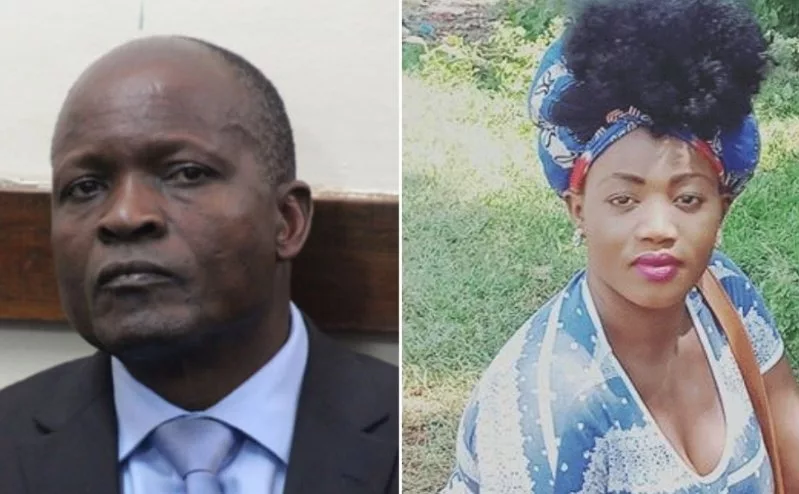
Judgment is due on Thursday in the long-running murder trial of former Migori Governor Okoth Obado, bringing to a close nearly eight years of investigations and courtroom proceedings arising from the 2018 killing of Rongo University student Sharon Otieno.
The High Court is expected to determine whether the prosecution has proved beyond a reasonable doubt that Obado, his former personal assistant Michael Oyamo and former Migori County clerk Caspal Obiero were responsible for Sharon's murder.
The case traces its roots to the night of September 3 and 4, 2018, when Sharon, who was about seven months pregnant, was allegedly abducted alongside Nation Media Group journalist Barrack Oduor after the two left a hotel in Rongo.
Oduor is alleged to have escaped by jumping from the moving vehicle, but Sharon was later found dead near Kodera Forest in Uriri, Homa Bay county.
Chief Government pathologist Johansen Oduor concluded her death was caused by strangulation and excessive bleeding as a result of stab wounds.
The gruesome killing triggered nationwide outrage and prompted a multi-agency investigation that quickly focused on senior officials in Migori county.
Obado first appeared before the High Court on September 24, 2018, where he was jointly charged with the murder of Sharon and her unborn child alongside Oyamo and Obiero.
All three denied the charges.
The former governor spent a month in remand before securing his release on bond, while the murder trial itself commenced in July 2021 after numerous pre-trial applications and delays.
Throughout the trial, the prosecution assembled an extensive circumstantial case, calling 42 witnesses in an effort to demonstrate that Obado orchestrated Sharon's killing to conceal their relationship and her pregnancy.
Prosecutors relied on witness testimony, mobile phone records, forensic evidence, and movements of the accused persons before and after the murder.
They argued that the evidence, taken as a whole, established a coordinated plan that culminated in Sharon's death and urged the court to convict all three accused persons.
The defence consistently rejected those allegations.
Obado maintained that he neither participated in nor planned the killing and insisted he was at former Prime Minister Raila Odinga's Karen residence on the day Sharon was murdered.
He argued that investigators targeted him because of public pressure generated by the high-profile nature of the case and maintained that he fully cooperated with police throughout the investigations.
His lawyers further challenged the prosecution's reliance on circumstantial evidence, arguing it failed to establish guilt beyond reasonable doubt.
A major turning point came in January 2025 when trial Judge Cecilia Githua ruled that the prosecution had established a prima facie case on the charge relating to Sharon's murder, requiring Obado and his co-accused to defend themselves.
However, the judge found there was insufficient evidence to place them on their defence over the separate count concerning the murder of Sharon's unborn child.
The defence case concluded earlier this year before both sides filed lengthy written submissions.
In March, Justice Githua initially fixed judgment for May 29, noting the voluminous proceedings and exhibits required considerable time to analyse before preparing the verdict.
The judgment was later deferred to July 23.