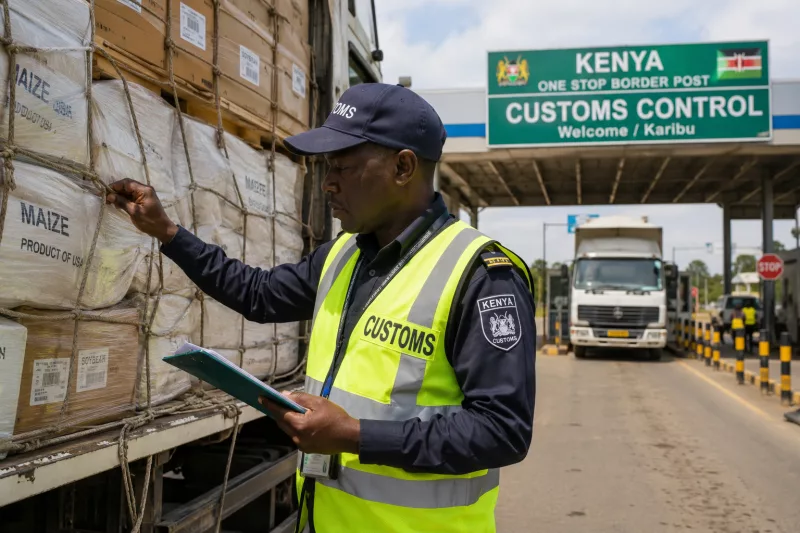
 Customs inspection at Kenya border post. /AI ILLUSTRATION
The National Biosafety Authority (NBA) has published a list of genetically modified plants, animals, microorganisms, veterinary vaccines and their derived products approved for commercial use.
The authority has directed that all imports of such products must be cleared by the regulator before entering the Kenyan market.
The move is intended to strengthen oversight of genetically modified organisms (GMOs) at the country's ports of entry and exit.
Government agencies involved in customs, health, standards, agriculture and environmental regulation have been instructed to ensure the products receive NBA approval before they are released.
“These products are traded globally between and among countries. The authority has already profiled the relevant Harmonized System (HS) codes of these products, and we request the cooperation and assistance of your officers at various entry and exit points to ensure that these products are cleared by NBA before their release,” acting NBA chief executive officer Ann Karimi said.
HS code is internationally recognised six-digit code system used by customs authorities worldwide to classify traded goods.
The code helps customs and border agencies to identify the approved products during import and export processes.
Karimi added that NBA officers are stationed at entry and exit points and will advise on the appropriate enforcement measures where products fail to comply with the Biosafety Act.
Among the genetically modified crops approved for cultivation are Bt cotton, which is commercially grown in Kenya alongside Sudan, South Africa, Ethiopia, Eswatini, Nigeria and Malawi.
The crop is also cultivated in several countries outside Africa, including Argentina, Australia, Brazil, China, Colombia, India, Mexico, Pakistan and the United States.
The authority also noted that Bt cotton has been approved for food, feed, processing and other uses in dozens of countries, including members of the European Union, Japan, South Korea, Singapore, Canada, the United Kingdom and Vietnam.
GM maize has been approved for cultivation in South Africa, Nigeria and Ethiopia.
The directive is contained in a letter dated June 29, 2026, addressed to agencies operating at Kenya's ports of entry and exit.
They include the Kenya Ports Authority, Kenya Revenue Authority, Kenya Plant Health Inspectorate Service, Kenya Bureau of Standards, National Environment Management Authority, Directorate of Veterinary Services, Kenya Wildlife Service, Department of Public Health, Pest Control Products Board and Kenya Industrial Property Institute.
The publication of the approved GMO list comes as debate over genetically modified organisms remains deeply divisive in Kenya.
The government has argued that biotechnology can improve food security by increasing crop yields and enhancing resilience against drought and pests.
owever, civil society organisations, farmers' groups and consumer rights advocates have continued to oppose wider adoption of GMOs, citing concerns over food safety, environmental impacts and the control of seeds by multinational corporations.
The issue has also been the subject of prolonged court battles.
Although the government lifted a decade-long ban on the importation and cultivation of GM crops to address food shortages, implementation has repeatedly been delayed following legal challenges seeking greater public participation and scientific review.
The National Biosafety Authority is a state corporation established under the Biosafety Act to regulate the transfer, handling and use of genetically modified organisms in Kenya.
It is also the country's National Focal Point for the Cartagena Protocol on Biosafety, an international treaty governing the safe movement and use of living modified organisms.