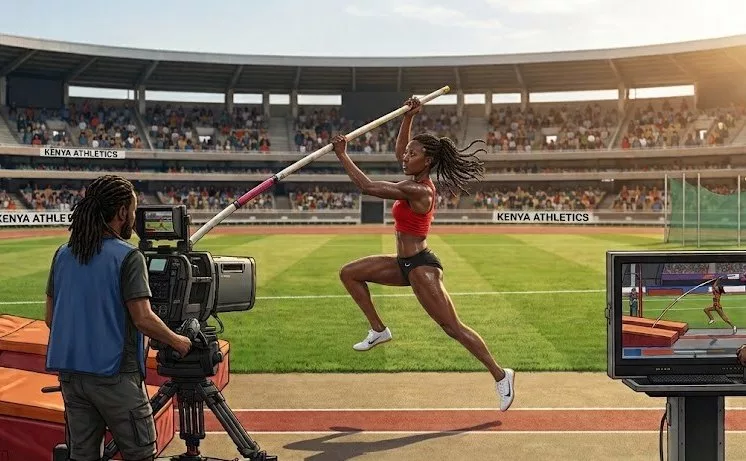
 Broadcast of a woman athlete/AI
The European Broadcasting Union (EBU), in collaboration with European Athletics, has unveiled new guidelines aimed at tackling the sexualisation of women athletes during live sports broadcasts.
The new guidance encourages broadcasters to use camera angles and production techniques that prioritise sporting performance over athletes' appearance.
Titled 'Raising the Bar', the 23-page document recommends editing techniques that help audiences better understand athletic performances.
It encourages broadcasters to ask a simple question before selecting a shot: Does this camera angle help viewers understand the performance?
Under the recommendations, broadcasters are advised to avoid tight shots from behind athletes, low-angle camera positions and slow-motion replays that do not contribute to explaining the technical aspects of an event.
Instead, wider shots that capture the full sequence of movement—from approach to execution and landing—are encouraged.
The guidelines apply to several athletics disciplines, including high jump, pole vault, long jump, triple jump and running events.
EBU Sport Executive Director Glen Killane said camera choices play a significant role in shaping how audiences perceive women in sport.
"The sexualisation of women athletes through selective camera angles and editing choices continues to be a significant concern across many sports broadcasts," Killane said in the report.
He added that such production decisions can shift viewers' attention away from athletes' achievements and technical excellence while reinforcing harmful stereotypes about women in sport.
The document includes illustrated examples demonstrating recommended broadcasting practices.
For high jump competitions, it suggests wider camera angles that capture an athlete's run-up, take-off and clearance over the bar rather than zoomed-in slow-motion footage that may create compromising images without providing meaningful insight into the performance.
Similarly, for long jump and triple jump, broadcasters are advised to capture the athlete's entire performance (approach, take-off board, stride pattern and landing), while avoiding prolonged shots filmed from behind or below athletes.
In track events, the guidance recommends steering clear of close-up shots from low or rear angles, particularly during athletes' preparations at the starting blocks or moments of physical exhaustion after crossing the finish line.
British Olympic pole vaulter Holly Bradshaw welcomed the initiative, saying broadcasting choices can have lasting consequences beyond competition.
She said the way women's athletics is presented during live broadcasts can be both influential and harmful, noting that she has personally experienced online abuse after slow-motion competition footage was shared on social media in inappropriate contexts.
Bradshaw also revealed that the placement of cameras around competition areas can affect athletes' concentration, with some competitors becoming aware of where cameras are positioned during events.
The EBU and European Athletics hope the recommendations will encourage broadcasters to showcase women's sport in a way that highlights athletic skill, strength and determination while reducing opportunities for footage to be misused or taken out of context.