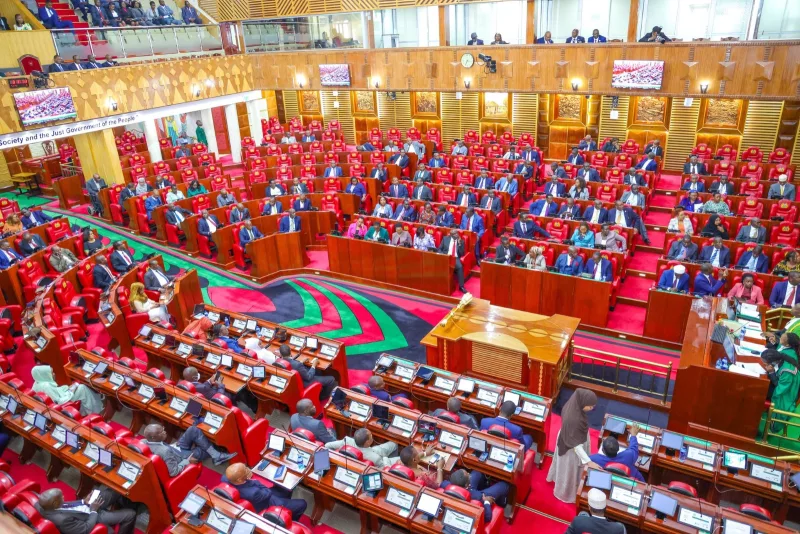
 The National Assembly in session/ FILE
Parliament has moved to reassure millions of Savings and Credit Cooperative Organisations (Saccos) members that their savings are safe, dismissing as false claims circulating on social media that the government intends to tap more than Sh1 trillion held by cooperatives to finance the proposed National Infrastructure Fund.
The clarification comes amid growing public concern over the proposed Sacco Societies (Amendment) Bill, 2025, with misinformation online alleging the legislation would give the government sweeping powers over members' deposits and governance of cooperative societies.
The National Assembly released a detailed explanation of the proposed law, urging Kenyans to "beware of misinformation" and clarifying what the Bill does and does not provide.
According to Parliament, the Bill has not been rushed through the legislative process as claimed online.
The House said the Bill was published on June 30, 2025, more than a year ago, and is still before the National Assembly's Departmental Committee on Trade, Industry and Cooperatives, where it is undergoing public participation.
The National Assembly explained that after public participation concludes, the committee will prepare a report and consider amendments informed by submissions from stakeholders before the Bill returns to the House for debate.
The National Assembly said the primary objective of the Bill is to strengthen the cooperative sector by improving regulation, enhancing financial stability and protecting members' savings.
Among its key proposals are measures to reduce operational costs for smaller Saccos, subject certain cooperatives to liquidity requirements supervised by the Central Bank of Kenya, strengthen oversight by the Sacco Societies Regulatory Authority (SASRA), eliminate fraudulent pyramid schemes masquerading as cooperatives and promote innovation and financial inclusion through technology.
One of the biggest concerns raised online is that the Bill creates a government-controlled "super SACCO" through which members' money can be accessed.
Parliament says this is false.
Instead, the Bill proposes establishing a secondary SACCO society whose membership will be limited to primary SACCOs.
The institution is intended to provide shared payment infrastructure, investment opportunities and easier fund disbursement services for member SACCOs.
The House stressed that the Bill does not permit the President or the government to appoint management committees for SACCOs. Management committees will continue to be elected by members of individual cooperative societies as is currently the case.
Similarly, Parliament rejected claims that the government would gain powers to alter or reject management committees or interfere with the internal governance of SACCOs.
The National Assembly also dismissed allegations that the proposed secondary Sacco would be allowed to lend money to the government or private individuals.
"There is no such provision in the Bill," Parliament said, adding that the proposed entity would instead be prohibited from lending directly to natural persons.
Other viral claims addressed include allegations that members would lose access to their savings upon resignation from a Sacco and that compensation following the collapse of a Sacco would be capped at Sh100,000.
Parliament said neither claim appears in the Bill.
Instead, the proposed law seeks to strengthen depositor protection by enabling members to make claims for reimbursement of deposits where a Sacco licence has been revoked.
The House also clarified that the Bill does not give the proposed secondary Sacco powers to determine liquidity requirements for other cooperative societies.
Those requirements will continue to be prescribed by SASRA and remain subject to provisions under the Central Bank of Kenya Act governing statutory liquidity reserves.
The clarifications come amid heightened public interest in reforms targeting Kenya's cooperative movement following the introduction of the Kenya Cooperatives Bill, which the government is also seeking to enact as part of broader efforts to modernise the sector.
Kenya's Sacco movement is among the largest in Africa, mobilising trillions of shillings in member savings and playing a critical role in providing affordable credit, promoting financial inclusion and supporting millions of households and businesses.
The government has maintained that the ongoing legislative
reforms are aimed at strengthening governance, improving financial stability
and enhancing protection of members' deposits, rather than giving the State
access to cooperative funds.