
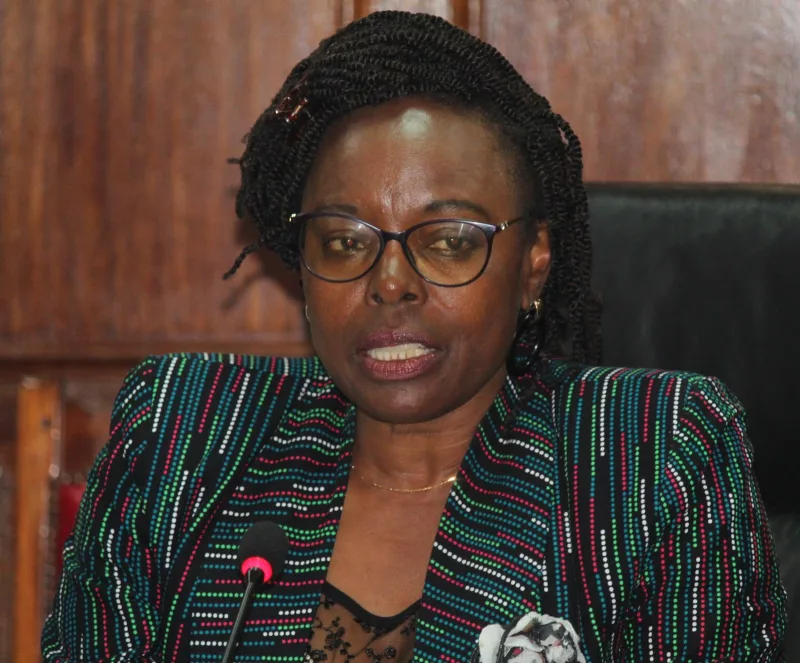
The Controller of Budget has flagged the government’s
growing reliance on domestic borrowing to finance its budget, warning that it
has become a double-edged sword.
CoB Margaret Nyakang’o warns that while domestic borrowing
has helped plug financing gaps, it is also piling pressure on public finances
and reducing the resources available for development.
In her latest National Government Budget Implementation
Review Report for the first nine months of the 2025-26 financial year,
Nyakang’o says domestic borrowing emerged as the government's
strongest-performing financing source. It outperformed tax revenue growth,
grants and external loans.
According to the report, domestic borrowing generated
Sh965.87 billion by the end of March 2026, representing 88 per cent of the
annual target and accounting for 30 per cent of all receipts into the
Consolidated Fund.
In comparison, tax revenue, which remains the largest source
of government income, contributed Sh1.72 trillion, or 54 per cent of total
receipts, achieving only 65 per cent of its annual target.
Overall, receipts into the Consolidated Fund reached Sh3.21
trillion, representing 72 per cent of the annual target.
The Controller notes that improved government receipts
compared with the previous financial year were largely driven by increased
domestic borrowing rather than stronger revenue mobilisation.
"Receipts into the Consolidated Fund grew by 14 per
cent in the first nine months of FY2025-26 compared with the same period in
FY2024-25," the report states.
“This was attributed to increased domestic borrowing, which
grew by 24 per cent.”
This marks a significant shift from the previous financial
year, when domestic borrowing stood at Sh731.6 billion during the same period.
Within a year, Treasury borrowed an additional Sh234.3
billion from the domestic market, underscoring its growing dependence on
Treasury bills and Treasury bonds to finance government operations.
The borrowing trend is also reflected in Kenya's debt
profile. The report says the country's public debt rose from Sh11.8 trillion
in June 2025 to Sh12.82 trillion by the end of March 2026, an
increase of more than Sh1 trillion in just nine months.
The increase was "largely driven by additional domestic
borrowing".
Treasury bonds increased by Sh688.21 billion, rising from
Sh5.11 trillion to Sh5.80 trillion, while Treasury bills grew by Sh155.52
billion, increasing from Sh1.04 trillion to Sh1.19 trillion during the review
period.
The move is, however, aligned to the 2025 Medium-Term Debt
Strategy, which seeks to reduce exposure to expensive external borrowing and
foreign exchange risks by relying more heavily on the domestic market.
However, while the strategy reduces exchange-rate risks
associated with foreign debt, economists have long warned that excessive
domestic borrowing can crowd out private sector credit by encouraging banks and
institutional investors to lend more to government than businesses.
The Africa Finance Corporation has warned that uncontrolled
domestic borrowing by African governments chokes capital markets, crowding out
vital infrastructure investment.
According to the AFC State of Africa's Infrastructure
Report, domestic debt issuance has surged over the past decade.
This has been driven largely by short-term bills, resulting
in high nominal yields but negative real returns in high-inflation
environments, pointing to the need for longer-term instruments and greater
real-economy allocation.
The CoB warns that rising domestic borrowing is increasingly
straining public finances.
In its concluding observations, the Controller says
Consolidated Fund Services, which include debt repayments, pensions and
constitutional office expenses, continue to exert "significant
pressure" on the national budget.
"Notably, the Consolidated Fund Services expenditure
continues to exert significant pressure on the national budget and fiscal
space, largely driven by rising public debt obligations, increased domestic
borrowing and growing pension liabilities," the report states.
"Overall, CFS expenditure and debt-servicing costs
remain high, constraining the resources available for development
programmes."
The warning comes as debt servicing continues to consume a
substantial share of public resources.
During the first nine months of FY2025-26, the government
spent Sh1.35 trillion servicing public debt — 72 per cent of the annual
allocation. This was up from Sh1.20 trillion during the same period in
FY2024-25.
The increase was largely attributed to higher principal
repayments on external debt, even as domestic borrowing continued to expand.
The report also shows that domestic debt now accounts for
the larger share of Kenya's public debt portfolio.
As of March 2026, domestic debt stood at Sh7.14
trillion, representing 56 per cent of total public debt, compared with external
debt of Sh5.68 trillion, or 44 per cent. Overall public debt has now reached
69.9 per cent of Gross Domestic Product, well above Parliament's approved
threshold of 55 per cent.
Compared with the first nine months of FY2024-25, the latest
report shows the government is increasingly leaning on the domestic market to
finance its budget while facing mounting debt obligations.