
The deal
signed Thursday adds Rome to a growing list of countries partnering
with Nairobi to create structured jobs for Kenyan workers abroad.
Through the
Kazi Majuu initiative, the government has increasingly turned to labour
diplomacy to tackle unemployment and boost diaspora remittances.
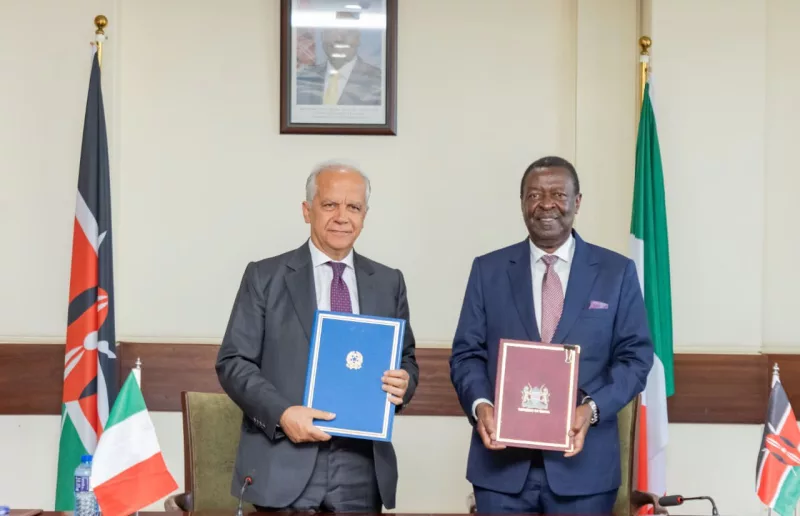
The MoU was
signed in Nairobi by Prime and Foreign Affairs CS Musalia Mudavadi and Italy’s
Interior Minister Matteo Piantedosi.
“The
agreement establishes a government-to-government framework for regular labour
migration, skills development and the protection of migrant workers,” the joint
communiqué said.
The
agreement is the latest in a series of labour mobility partnerships Kenya has
pursued with countries including Canada, Belgium, Denmark, Germany, Armenia and
several Gulf states.
It states
that the framework would create “structured and transparent pathways” for
Kenyans seeking employment in Italy. It will also strengthen worker welfare,
facilitate skills transfer and contribute to Kenya’s economic growth through
increased employment opportunities and diaspora remittances.
Reacting to
the signing, EU Ambassador Henriette Geiger said Italy was the third EU country
to sign the labour mobility agreement with Kenya, after Germany and Austria.
“We have
very high hopes that Kenya will become an even stronger partner in this area
because, if you look at Europe and Kenya, you see two opposite demographic
realities,” the envoy said at her office on Thursday.
“Europe has
an ageing population, while Kenya has a very young, well-educated population.
The European continent needs skilled professionals to support our economies,
and Kenya has exactly that potential.”
She said
she hopes to see significant growth in labour mobility cooperation in the years
ahead.
Facing an
ageing population, declining birth rates and persistent labour shortages across
sectors, the EU is increasingly looking beyond its borders to fill workforce
gaps.
In a recent
policy update, the European Commission said demographic change was reshaping
Europe’s labour market, making non-EU workers increasingly essential to
sustaining economic growth and competitiveness.
“In Europe,
the workforce is facing labour shortages because of demographic change. To
address this, the EU economy increasingly relies on non-EU workers.
Facilitating legal migration is, therefore, crucial for boosting the EU’s
competitiveness,” the commission said.
To support
that strategy, the EU has rolled out two major initiatives designed to make
legal migration easier.
The first
is the updated Single Permit Directive, which became fully operational across
EU member states in May this year.
The revised
rules simplify the process for non-EU nationals seeking employment by providing
a single application covering both residence and work permits.
The reforms
also require member states to process applications within 90 days and
strengthen protections for migrant workers by allowing them to change employers
under certain conditions, while safeguarding them from labour exploitation.
The second
initiative is the EU Talent Pool, the bloc’s first digital recruitment platform
connecting employers across participating EU countries with skilled workers
from outside Europe.
The
platform, which entered into force in June, is expected to become fully
operational by the end of 2027.
It will
allow employers facing labour shortages to recruit qualified workers directly
from third countries based on their skills, experience, qualifications and
language abilities.
The
Italy-Kenya agreement, therefore, fits squarely within Europe’s wider migration
strategy, which seeks to expand legal migration pathways while reducing
irregular migration.
The MoU
also commits both governments to cooperate in combating irregular migration,
promoting awareness of safe migration channels and strengthening collaboration
on the return of nationals found to be living in either country illegally.
It also
provides for enhanced cooperation in vocational and language training to better
prepare Kenyan workers for the Italian labour market.
Mudavadi
said the agreement demonstrates how diplomacy is increasingly delivering direct
economic opportunities for ordinary Kenyans.
“Beyond
labour mobility, we reaffirmed our commitment to expanding cooperation in trade
and investment, education, energy, technology, aerospace and tourism — sectors
that hold immense potential for job creation, innovation and sustainable
development,” he said after the signing ceremony.
He added
that agreements such as the one signed with Italy illustrate how foreign policy
can be translated into practical opportunities that improve livelihoods and
expand economic prospects.
The
agreement builds on renewed relations between Nairobi and Rome following
President William Ruto’s official visit to Italy in April this year.
It also
aligns with Italy’s Mattei Plan for Africa, which seeks deeper partnerships
with African countries on development, investment and migration.
Data from
the Commission for University Education and the Kenya National Bureau of
Statistics shows that between 500,000 and 800,000 graduates enter Kenya’s
labour market every year.
However,
the economy struggles to create enough formal jobs to absorb them.
The
government has, therefore, made overseas employment a central pillar of its
jobs agenda.