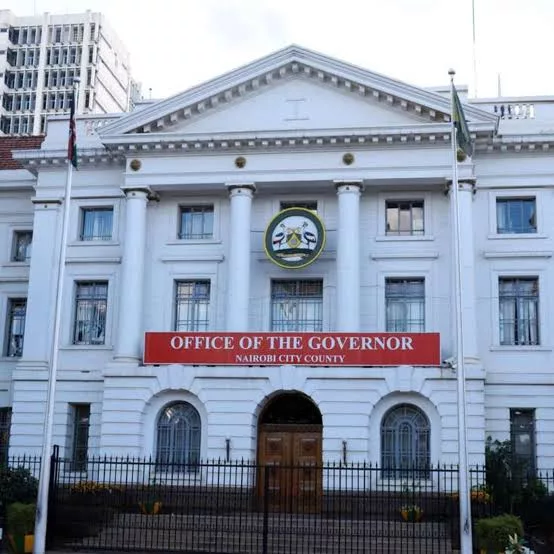
 City Hall./FILE
Nairobi City County has posted its highest-ever own-source revenue collection, raising a record Sh15.4 billion during the 2025/2026 financial year.
The collection has nearly doubled its annual collections from about Sh8 billion four years ago.
The county collected Sh15.399 billion, representing an increase of Sh1.6 billion from the Sh13.8 billion realised in the 2024/2025 financial year.
Compared to the approximately Sh8 billion collected annually before Governor Johnson Sakaja assumed office in 2022, the latest performance marks an increase of Sh7.4 billion, translating to 92.5 per cent growth over four financial years.
The milestone underscores the impact of a series of reforms introduced by the county administration to seal revenue leakages, digitise revenue collection, simplify compliance and expand the revenue base without imposing new taxes.
According to the revenue report, land rates remained the county's largest revenue source, generating Sh3.31 billion, followed by hospital revenue (Sh2.73 billion), Unified Business Permits (Sh2.68 billion), parking fees (Sh1.78 billion) and building plans and inspections (Sh1.56 billion).
Other significant contributors included billboards and advertisements, house and stall rent, liquor licensing, markets, and food handlers' certificates.
A key driver of the improved performance has been the rollout of Nairobi Pay, the county's fully digital revenue collection platform, through which residents can make payments online or by dialling *667#.
The platform has significantly reduced cash handling, enhanced accountability and curtailed revenue leakages by ensuring all county payments are processed through a centralised digital system.
Governor Johnson Sakaja said the platform has transformed revenue collection while making county services more accessible to residents and businesses.
"Nairobi Pay has brought transparency, convenience and accountability to revenue collection. By eliminating cash transactions and digitising payments, we have sealed loopholes, improved efficiency and made it easier for residents and businesses to pay for county services. This is proof that technology can increase revenue without increasing taxes," Sakaja said.
The county has also implemented the Unified Business Permit, which consolidates several business licences into a single permit. The reform has reduced bureaucracy, lowered compliance costs and improved the ease of doing business, encouraging more entrepreneurs to formalise and expand their enterprises in the capital.
In the health sector, the county restructured the management of Level 4 and Level 5 hospitals by placing them under professionally recruited chief executive officers (CEOs) supported by hospital boards.
"The governance model has strengthened accountability, improved financial management and enhanced revenue collection across county health facilities while ensuring better service delivery for Nairobi residents," Sakaja said.
The county has further digitised liquor licensing through the Liquor Pay system, enabling traders to apply and pay for licences online without relying on brokers or middlemen, thereby improving efficiency, transparency and compliance.
Governor Sakaja attributed the record-breaking performance to deliberate reforms anchored on technology, accountability and customer-friendly service delivery.
"This record revenue collection demonstrates that when government embraces technology, seals loopholes and makes compliance easier for wananchi and businesses, revenues grow without introducing new taxes," he said.
"Every shilling collected will go back into improving roads, health services, markets, drainage, street lighting and other essential services that Nairobi residents deserve."
Receiver of Revenue Tiras Njoroge said the county's digital transformation has been instrumental in boosting collections while strengthening public confidence in the revenue system.
"The success we are witnessing is the result of sustained reforms that have digitised revenue collection, eliminated leakages and simplified payment processes," Njoroge said.
"Our focus remains on expanding the revenue base, improving compliance and ensuring every payment is secure, transparent and convenient for residents and businesses alike."
The record collection is expected to strengthen Nairobi's fiscal position, enabling the county to finance critical development projects, improve service delivery and reduce its dependence on transfers from the national government.
The achievement represents the strongest own-source revenue performance in Nairobi City's history and reinforces the county's strategy of growing revenue through efficiency, digitisation and better compliance rather than increasing taxes.