

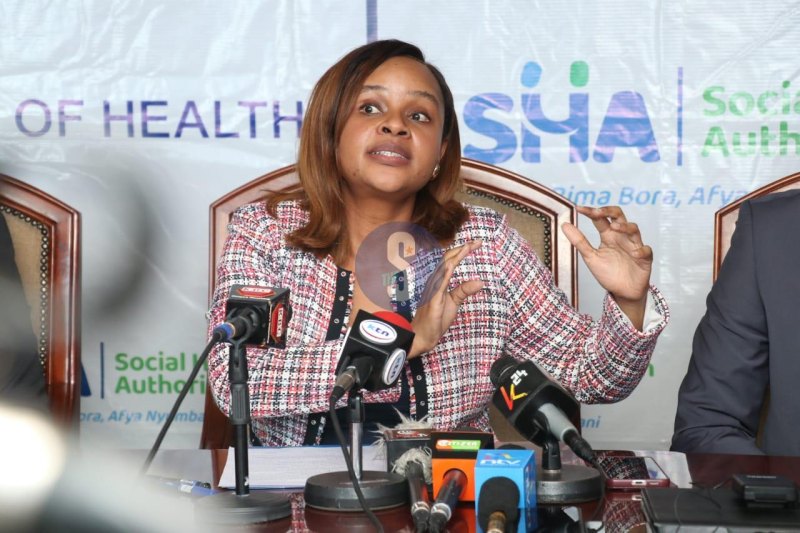
 SHA CEO Mercy Mwangagi
The Social Health Authority is rejecting about one in every five payment claims submitted by county health facilities because they contain errors, missing documents or fail to meet payment rules.
SHA said some claims are still being checked to confirm patient eligibility, the services provided and whether all the required documents have been submitted.
New figures released by SHA show county hospitals had submitted claims worth Sh40.91 billion by June 30.
The authority had paid Sh27.91 billion, but claims worth more than Sh8 billion had either been returned to hospitals for correction, were waiting for supporting documents or had been rejected.
The figures mean roughly 20 per cent of the total value of claims has either been rejected, returned for correction or is awaiting missing documentation, highlighting persistent challenges in how health facilities prepare and submit reimbursement requests.
In a statement issued on Wednesday, SHA said it had received claims from 8,349 county government health facilities across the country.
"As of June 30, 2026, SHA had received claims valued at Sh40.91 billion from 8,349 county government health facilities across the country," the authority said, adding it had "settled about 80 per cent of the claim value that has completed or progressed through adjudication."
The authority explained claims still under review have not yet qualified for payment because they must first undergo verification.
"Claims under review are not yet approved for payment. They are undergoing mandatory verification of patient eligibility, benefit entitlement, applicable tariffs, clinical information and supporting documentation," SHA said.
It also clarified the difference between claims that are returned and those that are rejected.
"Returned claims require action by the healthcare facility to correct coding, complete missing information or provide the required documents. Rejected claims are not payable because they do not meet the applicable legal, regulatory, contractual or benefit-package requirements," the statement said.
SHA said it pays county public health facilities directly into Facility Improvement Financing accounts as provided for under the Facilities Improvement Financing Act, allowing hospitals to retain revenue earned from services and spend it on improving healthcare delivery under approved plans.
The highest county settlement rates were recorded in Tana River at 87 per cent, followed by Laikipia at 86.1 per cent, Baringo and Siaya at 85.4 per cent each and Kisumu at 85 per cent. Nakuru received the largest payout of Sh1.93 billion, followed by Nairobi at Sh1.57 billion, Homa Bay at Sh1.54 billion, Mombasa at Sh1.41 billion and Kiambu at Sh1.27 billion.
To reduce errors, SHA said it has been holding claims clinics across the country to train healthcare providers on proper coding, correct application of benefit packages and submission of complete documentation.
"The clinics guide providers on how to lodge clean and complete claims, correctly apply approved tariffs and benefit packages, submit the required documents and avoid common errors," the authority said.
It said the initiative had already led to an increase in clean claims and a reduction in claims being returned or rejected and pledged to continue working with county governments and healthcare providers to improve claims management.
The latest figures came as the government intensifies efforts to tighten oversight of healthcare payments and curb fraud in the new national health insurance system.
Previous SHA reports have also shown that incomplete documentation is the single biggest reason claims are rejected, with missing forms, inadequate supporting documents and coding errors accounting for most declined submissions.
The problem is not unique to Kenya. Globally, fraudulent activities account for an estimated three to 15 per cent of all healthcare expenditure and about 10 to 15 per cent of insurance claims.
Studies from East Africa estimate that fraudulent claims make up about 3.7 per cent of paid medical insurance claims, contributing to significant underwriting losses and the rapid depletion of insurance funds.