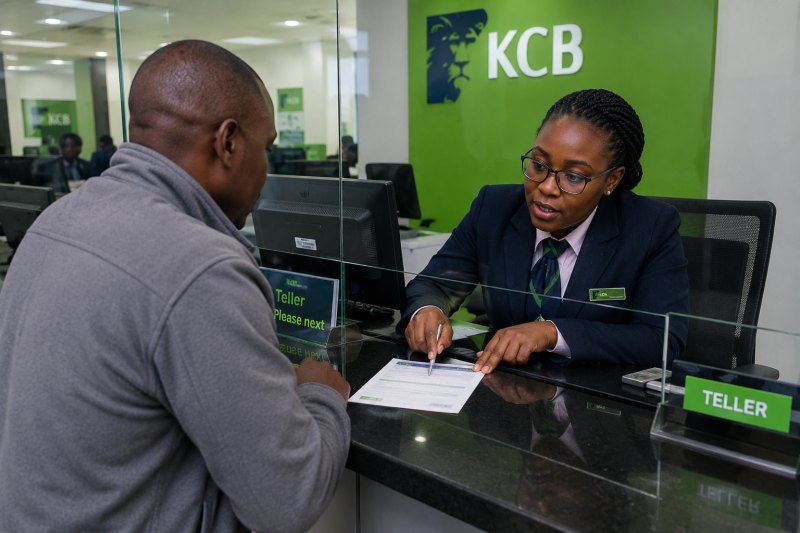
 AI illustration of a bank teller assisting customer at counter
An instant fine is a penalty for a minor offence—such as a traffic violation—that is calculated and issued automatically without the need for a mandatory court appearance.
The National Transport and Safety Authority (NTSA) has rolled out the instant fine system to curb road carnage, eliminate human-to-human corruption and streamline the prosecution of minor traffic offences.
An offender is notified immediately via SMS about the offence, location, the fine amount and is given a seven-day window to pay the fine or face penalties and restrictions.
By design and definition, instant fines are supposed to be paid promptly, preferably through mobile money or the government's digital payment platform, eCitizen.
However, NTSA has been directing offenders caught speeding or running red lights to physically visit a bank to pay their fines, seemingly defeating the very purpose of an instantaneous system for resolving minor traffic offences.
"Important notice on payment: To complete this payment, you must visit your nearest KCB branch or KCB agent," the notification reads.
NTSA director general Nashon Kondiwa has explained the rationale behind what many motorists consider an unusual requirement.
He said while payment through eCitizen would be more convenient, the authority deliberately introduced physical verification to protect Kenyans from fraudsters.
"We are adding physical interaction because even before we launched this, we had a lot of people who were sending SMSs that they are doing fines. So, out of abundance of caution, and just to protect Kenyans, we added the other layer of physical interaction," he said.
The issue came into the spotlight on Monday after city lawyer Donald Kipkorir revealed on X that his younger brother had been flagged for a speeding violation and fined.
According to Kipkorir, his brother verified the claim at a KCB branch in Nairobi before paying the fine and was issued with an official receipt.
However, he questioned why the payment notification indicated that the money had been deposited into a private account.
"Unless NTSA publicly responds to this, then we will assume that they are part of a scheme to defraud Kenyans. Why should public funds be deposited in a private account?" he asked.
Speaking on Citizen TV, Kondiwa was challenged to explain why a physical bank payment would be less susceptible to fraud or corruption than paying electronically through mobile money or eCitizen.
"We are just creating another layer of check because if you go there, you will find a reference reflected in the bank system so that you are not paying money to an account without another check," he said.
He was also asked why similar physical verification is not required when paying for government services such as passports or driving licences.
"For us to choose this route, it means that while introducing this product to the market, we were aware of all the loopholes. When introducing a new product to the market, you design what we call the customer journey and, to protect the customer, you look at the possible fraud elements," he said.
Kondiwa explained that payments for licence-related services do not require an additional layer of verification because applicants first submit identification documents and complete the transaction within a secure government platform.
"In this other one, the initial communication that triggers you to pay is an SMS, totally outside the platform and that's what fraudsters are trying to do. The fraudsters are trying to hijack that process by sending you a fake SMS so that you click and pay. If ours was also click and pay, then we would be playing into the hands of these fraudsters," he said.
Kondiwa said while the NTSA notification SMS contains a payment link, it does not direct recipients to a payment platform.
"You click, you see the details then we have a third eye, which is the physical agent or the teller with the details of the ticket itself with them."
The requirement to pay at a KCB branch or agent is therefore intended as an additional authentication step rather than a payment convenience.
According to NTSA, having bank staff verify the ticket details before accepting payment reduces the risk of motorists falling victim to fake SMS notifications, even as the approach raises questions about whether it undermines the speed and convenience that instant fines were meant to deliver.