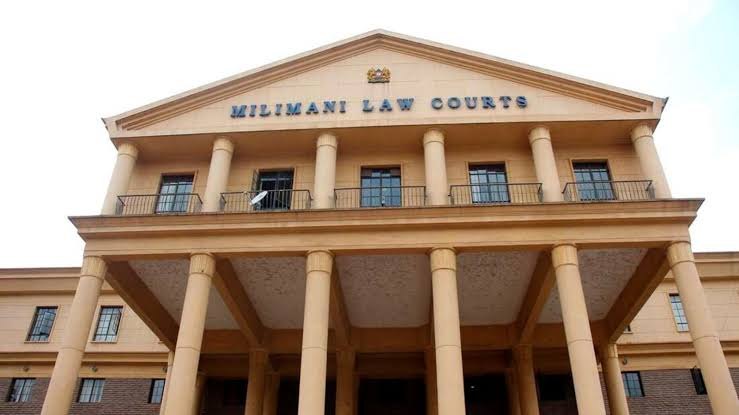
The High Court has ordered President William Ruto to reconstitute the Cabinet within 120 days after finding that its current composition violates the Constitution's two-thirds gender principle.
In a judgement delivered on Tuesday, a three-judge bench directed the appointing authority to ensure future Cabinet appointments comply with Article 27(8) of the Constitution, which bars more than two-thirds of the members of an appointive body from being of the same gender.
"The appointing authority, being the President, is hereby directed to make appointments for Cabinet Secretaries in conformity with Article 27(8) within 120 days from the date of this judgement," Justice Eric Ogola ruled on behalf of the bench.
The court found that the Cabinet, as constituted at the time of the judgement, failed to meet the constitutional gender threshold.
In determining compliance, the judges held that the relevant Cabinet membership for the purposes of Article 27(8) comprises only the offices expressly recognised under Article 152(1) of the Constitution — the President, Deputy President, Attorney General and Cabinet Secretaries.
The judges excluded the Secretary to the Cabinet from the computation and assessed the Cabinet's composition as it stood at the time of the judgement rather than when the petition was initially filed.
According to the court, the Cabinet currently consists of 25 members, of whom seven are women and 18 are men. That translates to approximately 28 per cent female representation, below the constitutional threshold requiring that no more than two-thirds of the members of an appointive body be of the same gender.
The court held that in a 25-member Cabinet, the under-represented gender should occupy at least nine positions.
The bench consequently declared that the current composition falls short of the constitutional requirements under Articles 27 and 10.
At the same time, the judges rejected broader arguments seeking to invalidate Cabinet appointments solely because some Cabinet secretaries returned to office after the July 2024 dissolution.
The petition had challenged President Ruto's decision to dissolve the Cabinet in the aftermath of nationwide protests and later nominate some former Cabinet members back into government.
The petitioners argued that the dissolution had been presented as a response to concerns over governance, accountability, integrity and responsiveness and that reappointing some of the same individuals undermined the rationale for the exercise.
They further argued that the reappointments violated constitutional provisions on leadership and integrity, accountability and national values.
However, the court held that dismissal from the Cabinet does not automatically create constitutional ineligibility for future appointment.
"The text does not prescribe that dismissal under that article creates a permanent or temporary disqualification from future appointments," the judges held while interpreting Article 152.
The bench distinguished between executive reorganisation and removal based on constitutional misconduct.
"A general dismissal under Article 152(5)(b) is not the same thing as removal for contravention of Chapter Six," Justice Ogola stated.
According to the court, constitutional disqualification from public office arises only where removal is founded on specific constitutional violations and not broad political restructuring.
The judges also rejected arguments that the President was constitutionally obligated to publish reasons explaining why former Cabinet members were reappointed.
Nevertheless, the court expressed concern about the constitutional logic behind dismissing ministers and subsequently returning some of them to office.
The judges observed that although the President retains broad appointment powers under Article 152, those powers must still be exercised consistently with constitutional values.
The court noted that where Cabinet dissolution is publicly justified as a response to governance concerns, inefficiency or public dissatisfaction, reinstating the same office holders may raise legitimate questions about the purpose and substance of the earlier decision.
Still, the bench emphasised that political inconsistency and constitutional invalidity are not synonymous.
"The court is not called upon to determine whether the decision to return some former Cabinet Secretaries was politically persuasive or administratively wise. Rather, the court is called upon to determine whether the Constitution prohibited their nomination and appointment," the judges held.
The court also addressed objections to the inclusion of opposition figures in the Cabinet under the broad-based government arrangement, holding that political inclusivity alone does not amount to a constitutional violation.
The judges found that the Constitution does not prohibit the appointment of individuals affiliated with parties outside the government, provided constitutional procedures are followed and the appointments meet the applicable standards.
However, the bench cautioned that broad-based governance cannot excuse non-compliance with constitutional requirements on representation and accountability.
![[PHOTOS] The new Ngong –Naivasha Road viaduct](https://cdn.radioafrica.digital/image/2026/06/64d4f771-4432-4aee-ba3c-2f304c4436ec.jpg)