Hundreds of farmers from Machakos, Kitui and Makueni counties are adopting beekeeping as a reliable climate-change adaptation strategy.
Since apiaries require minimal rainfall compared to traditional crops, beekeeping provides a sustainable, drought-resistant income while supporting local ecosystem regeneration and crop pollination.
The Star has established that in Machakos, Kitui and Makueni, farmers are increasingly adopting beekeeping instead of crop farming and livestock rearing.
Those who spoke to the Star said if embraced by the majority of residents, beekeeping could improve livelihoods and the region’s economy.
They said erratic weather conditions have made it difficult for crops and livestock production to thrive in most parts of the three counties.
However, while some
farmers said they had been keeping bees for decades and making a fortune, others said they have been struggling to keep bees
for lack of technological know-how, despite investing heavily in it.
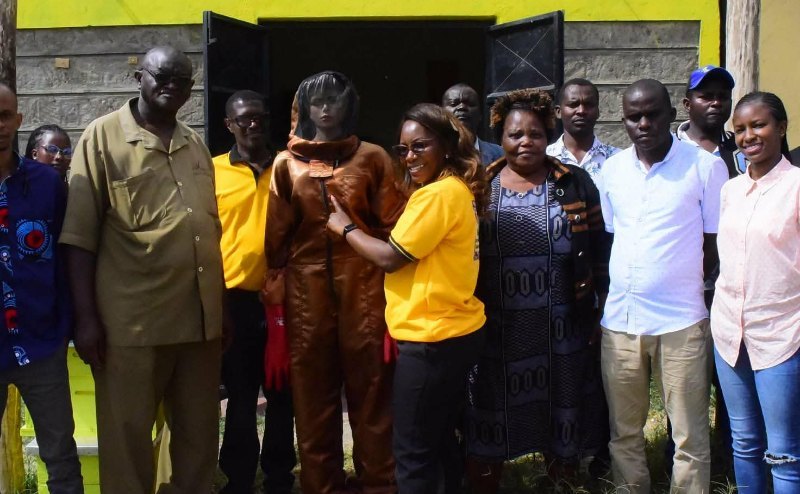
The farmers sought training from NOVALA Bee Works, which specialises in beekeeping, training and retailing of bee products and equipment.
NOVALA Bee Works co-founder Rosemary Ndunge said she developed a passion for beekeeping during the Covid–19 pandemic and has never looked back.
She said the pandemic disrupted her Airbnb business, which was her only source of livelihood. Restrictions on movement cost her clients, most of whom were international foreigners.
“From my experience, I confirm that what a man can do, a woman can do better. Any woman can become a beekeeper,” Ndunge told the Star.
She
spoke to the Star during a farmers training on beekeeping in Athi River,
Machakos county.
"Beekeeping is easy. As long as you have land, you are good to go. You only need a small space. In rural areas, not many farmers can afford lots of capital, you can start with only one beehive and start harvesting honey for both domestic consumption and sale,” Ndunge said.
She encouraged women in villages to venture into beekeeping, saying it was not labour-intensive or as expensive as crop and livestock production.
“Once you place a beehive, you don’t need much to spend on labour, drugs, feeds and fertilisers as required in crop and livestock production. You will continue doing your daily chores as you wait for the honey to be ready for harvesting.”
One needs about Sh5,500 to buy a beehive to practise beekeeping.
“Beekeeping
can help in eliminating relief food in Ukambani. Most residents love free things, including food, which is not sustainable, but if you
invest in beekeeping, you will earn your own money and will not have to go looking
for freebies,” Ndunge said.
She has lived off selling honey for years now and has no regrets.
Despite being raised in a beekeeping family, Ndunge had no passion for it until Covid-19 struck.
“My
grandfather was a beekeeper. My father is a beekeeper. And I’m also a
beekeeper. I didn’t like beekeeping, though. But during Covid-19, I started going to collect my father’s honey for sale because I had no other way to make money due to movement restrictions,” Ndunge said.
She realised that selling honey paid well and that is when she developed an interest in keeping bees.
And now she trains others on beekeeping.
“I have come to NOVALA to learn matters bees. I have been struggling since 2016, trying to keep bees for honey. I long for lots of honey for both domestic and commercial consumption,” Alice Mulei told the Star on Saturday.
The farmer from Mbooni in Makueni said she got into beekeeping without any formal training. She feels this is the reason she has not made any breakthrough in the business.
“I have over 63 beehives on my farm but harvest only two every time. The rest fail to produce honey completely. I had never known the reason for poor production, whether it was the carpenter who made the hives poorly or what happened,” the 60-year-old said.
She,
however, exuded confidence that the training would enable her to improve
production on her farm.
During the training, she learnt that predators and pests could be to blame for the low yields.
“Today, I have learnt that there are ways I can make my beehives productive by using good stands and grease to prevent ants from climbing the hives. There is also need to build rooms and place the beehives inside them for more production of honey,” she said.
“I am going home enlightened and I am sure that the training will be helpful to me and my neighbours. In 2016, together with my husband, we tried making beehives the best way we knew how, but they have no bees. We earn about Sh1,000 from a harvest. This is the first time I have come for such training.”
Mulei said she planted maize and beans on her farm, but they did poorly due to climate change.
Duncan Mutinda, a resident of Kakoia village in Mbooni, Makueni, said he had seen lots of opportunities in beekeeping after the training.
Mutinda said he hoped beekeeping would help him improve his life.
"We experience frequent droughts in Ukambani. We have learnt that beekeeping doesn’t require lots of rain or big land or a huge amount of capital,” he said.
He termed the training as an eye-opener.
“We
have learnt that bees have lots of products, not just honey alone. These include bee
venom, propolis and wax—all of which can help farmers make money. So, as a
farmer, I will start keeping bees in large scale to get a lot of money,”
Mutinda said.
He referred to the opportunities offered by beekeeping as hidden wealth.
A peasant farmer, Mutinda has been growing maize and beans for decades without any benefits due to erratic weather conditions.
“We buy seeds, fertilisers and herbicides to grow crops but beekeeping doesn’t require such. One only needs to buy a beehive, place it on the farm and wait for harvesting. I will educate other residents from my area on best beekeeping methods and practices,” said the casual worker at the County Government of Makueni.
Anthony Kimui from Kitui county said he had learnt how to harvest bee venom, pollen, honey and wax from a beehive.
“We
will go and improve beekeeping in our homes. I have realised that beekeeping
can give us wealth. We have decided to keep bees. NOVALA has helped us, we will
buy beehives and all necessary equipment from them,” he said.
Kimui said he had been keeping bees for 20 years, but without the use of modern technologies.
He hopes to increase his harvest from his 150 kilogrammes of honey to at least 500.
NOVALA Bee Works head of apiculture William Muthama said they established the company in 2022, after observing gaps and numerous problems in beekeeping across the country.
He said farmers invest in the trade but production is low. "We are growing because of the weaknesses we have seen in beekeeping," Muthama said.
He said the company needs bee products, hence the decision to train farmers.
"We saw it fit to provide training to farmers from all over the country to create better quality products and enhance the productivity of beekeepers and the quality of bee products. We have a ready market for these products. We also wanted to uplift lives," Muthama said.
"The feedback we are getting is that many farmers are realising their weaknesses in the way they have been doing their beekeeping."
He said they also conduct training on how to harvest bee products and find a market for them since good-quality bee products have a ready market.
The finance management professional, who worked in several universities for years,
said he resigned to conduct training in beekeeping.
"I was already a beekeeper when I left formal employment. I took beekeeping as a business and have seen growth beyond my expectations. Bees are not resource intensive, unlike livestock, which need drugs, feed, medication and proper shelter. The only thing you need to give your bees is water during the dry season. Bees will find their own food even in the dry season. They can survive drought," Muthama said.