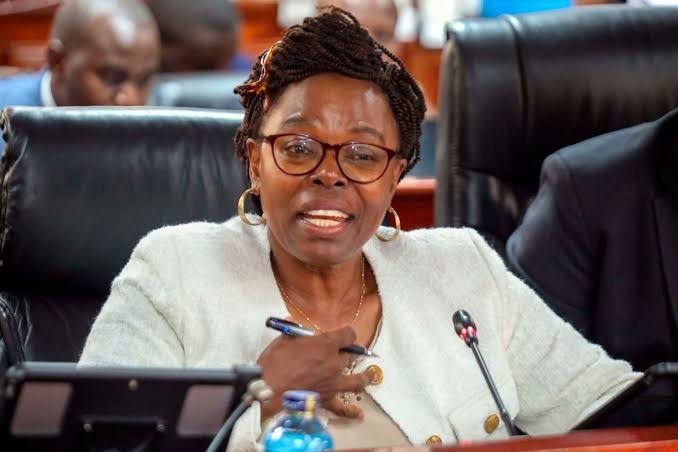
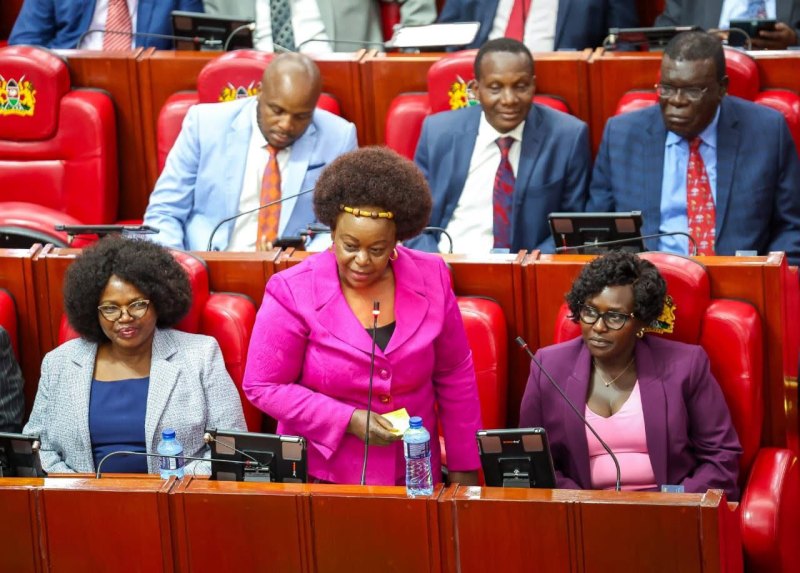
 Suba North MP Millie Odhiambo articulates her points on the floor of the House on Wednesday, June 24, 20206. /PARLIAMENT
The National Assembly has passed the Kenyan Sign Language Bill, 2023, adopting key amendments that seek to expand the rights of persons with hearing impairments and strengthen access to sign language services across education, public institutions and other sectors.
The Bill, co-sponsored by Suba North MP Millie Odhiambo and ODM nominated MP Umulkheir Harun, now paves the way for enhanced recognition, regulation and use of Kenyan Sign Language in schools, courts, media houses, telecommunications services and other public institutions.
It seeks to promote inclusivity and guarantee equal access to information, education and public services for persons who are deaf, hard of hearing and deafblind.
The legislation gives effect to constitutional provisions that recognise Kenyan Sign Language as an official means of communication and affirm the rights of persons with disabilities to access services through appropriate communication formats.
Once enacted into law, the Bill is expected to significantly strengthen access to education, justice, information and public services for Kenya’s deaf and deaf-blind communities while advancing the constitutional principles of equality, inclusion and non-discrimination.
A key pillar of the proposed law is education. The Bill requires the Cabinet Secretary for Education to facilitate sign language lessons for parents, guardians and family members of deaf, hard-of-hearing and deafblind children.
Kenyan Sign Language will also be integrated into early childhood and basic education curricula, while public institutions of higher learning will be required to provide free interpretation services for learners who need them.
Beyond the education sector, the Bill introduces wide-ranging measures aimed at improving accessibility to information and communication.
Television stations will be required to provide closed captioning and a Kenyan Sign Language inset occupying at least one-third of the screen during news broadcasts, educational programmes and national events.
Internet-based video content will also be required to include captions or transcripts.
Telecommunication service providers, meanwhile, will be compelled to establish relay services, including text, video and captioned communication systems, to facilitate communication for persons with hearing disabilities.
To oversee implementation of the law, the Bill establishes the Kenya Sign Language Council, a statutory body mandated to regulate, develop and preserve Kenyan Sign Language in the country.
The council will be responsible for setting standards for training and practice, registering and licensing sign language interpreters, protecting the communication rights of deaf and deafblind persons, and advising the government on matters relating to sign language.
Headquartered in Nairobi, the council will be required to decentralise its services across the country. Its membership will include representatives from government, the deaf community, sign language interpreters and the National Council for Persons with Disabilities.
The Bill also creates a comprehensive framework for the registration and regulation of professional sign language interpreters. Practitioners will be required to register with the council, obtain annual practising certificates and undertake continuous professional development.
Only duly registered practitioners will be allowed to use the title “Professional Sign Language Interpreter”.
To enhance accountability, the legislation establishes financial and governance safeguards for the council, including annual audits by the auditor general, mandatory annual reporting requirements and strict conflict-of-interest provisions for council members.
![[PHOTOS] Raila Odinga Stadium construction enters home stretch](https://cdn.radioafrica.digital/image/2026/06/45f6990c-4882-4cd2-b83c-8fc730dcdce5.jpg)