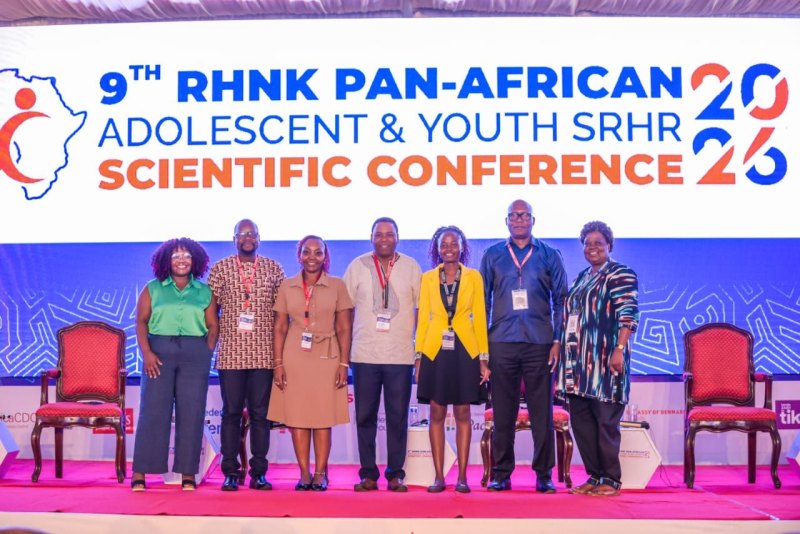
 Leaders during the 9th Pan African Adolescent and Youth Sexual and Reproductive Health and Rights Scientific Conference in Mombasa / HANDOUT
Delegates have called for increased domestic financing and stronger legal and policy reforms to improve access to Sexual and Reproductive Health and Rights (SRHR) services for young people across Africa.
They warned that despite ongoing interventions, adolescent and youth SRHR outcomes in Africa continue to be undermined by systemic gaps in financing, service delivery, and policy implementation.
The conference, held under the theme “Strengthening SRHR to achieve youth agency, full potential and meaningful participation in Africa’s dynamic socio-political and economic landscape,” brought together government officials, civil society organisations, researchers, health practitioners, development partners and youth leaders.
Ipas regional director Musoba Kitui said structural inequalities in financing and policy design continue to limit access to essential SRHR services for adolescents and young people.
He noted that while moral and cultural beliefs have a place in society, they should not be used to shape public policy in ways that restrict access to healthcare services.
“While morality has a place in society and we all have the right to exercise our own values and beliefs, we must name the conversion of private faith into public policy as a critical barrier. When these personal views are codified into laws, they harm adolescent and youth sexual and reproductive health and rights,” Kitui said.
He argued that current financing systems are structurally unequal and were not designed with young people in mind.
“These systems were not designed by or for young people. They were designed around the whims and ideas of older decision-makers, and that has created deep inequality in access to services,” he said.
Kitui also highlighted inequalities in access to healthcare, noting that young people from wealthier backgrounds are often able to access private services or travel abroad, while those from poorer households face higher risks of unsafe outcomes.
The delegates said the region continues to grapple with high rates of sexual and gender-based violence, HIV infections, and adolescent pregnancies, which they said are symptoms of broader structural weaknesses in health, education and social protection systems.
A major concern raised at the conference was the inadequate and inconsistent domestic financing of adolescent and youth SRHR programmes.
Delegates said current budgetary allocations remain insufficient and often fail to reflect the scale of need among young people.
They called on governments to prioritise SRHR in national budgets, strengthen transparency in funding allocation, and ensure consistent procurement and distribution of essential health commodities.
Participants also warned that existing systems often exclude young people from meaningful participation in decisions that directly affect them, resulting in policies that do not respond to their lived realities.
The conference recommended that African governments increase domestic financing for adolescent and youth SRHR programmes and integrate them as a core priority in national development and health budgets, rather than relying heavily on donor funding.
Delegates called for stronger legal and policy reforms to align national frameworks with evidence-based approaches that protect and promote young people’s sexual and reproductive health and rights.
They have urged governments to expand access to youth-friendly health services, including comprehensive sexuality education, contraception and integrated reproductive health services, while strengthening accountability mechanisms in budgeting, procurement and service delivery to ensure efficiency and transparency.
They further recommended enhanced meaningful participation of young people in all stages of policymaking, including planning, budgeting, implementation and evaluation of SRHR programmes, arguing that youth involvement is essential for effective and responsive interventions.
Delegates also called for targeted efforts to address inequalities affecting marginalised groups, including young people from low-income households, rural areas, out-of-school populations and those facing social exclusion, as well as strengthened collaboration between governments, civil society, the private sector and development partners to scale up sustainable SRHR interventions.
They warned that failure to address structural barriers in SRHR delivery will continue to expose young people to preventable health risks, including unsafe abortion, HIV infections and unintended pregnancies.