Journalists and media leaders from across Eastern Africa
have committed to strengthening accurate and ethical reporting on migration and
labour mobility to counter the growing spread of misinformation and
disinformation influencing migration decisions across the region.
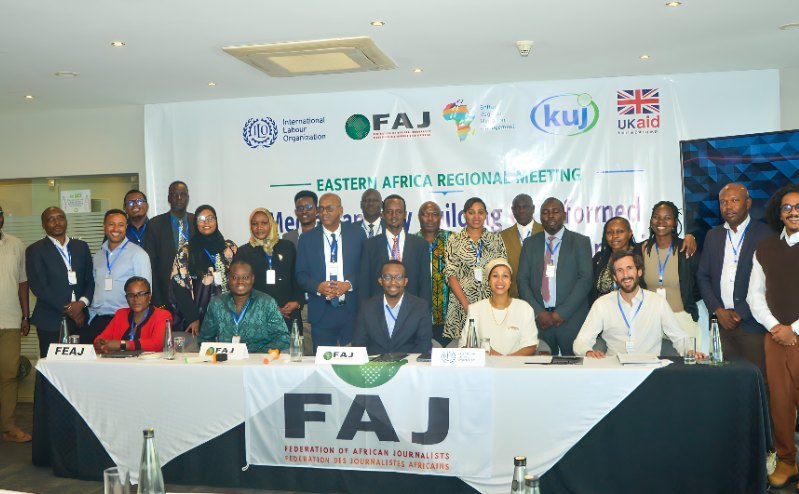
The commitment was made during a three-day regional forum
held in Mombasa from June 18 to 20, which brought together journalists, editors
and leaders of media unions from 10 countries, including Comoros, Djibouti,
Ethiopia, Kenya, Rwanda, Somalia, South Sudan, Sudan, Tanzania and Uganda.
The forum was organised by the Federation of African
Journalists in partnership with the Federation of Eastern Africa Journalists,
with support from the International Labour Organization through the Better
Regional Migration Management Programme funded by the United Kingdom's Foreign,
Commonwealth and Development Office.
The meeting comes amid increasing migration flows across
Eastern Africa, one of Africa's most active migration corridors that serves as
a source, transit and destination region for millions of people seeking
employment, education and improved livelihoods.
Participants explored emerging migration trends, labour
mobility patterns and the economic and social factors driving movement within
and beyond the region.
They also examined the role of the media in promoting
informed public discourse and enabling communities to make evidence-based
migration decisions.
ILO Better Regional Migration Management Programme Chief
Technical Advisor Aida Awel said empowering journalists with credible
information and professional tools was essential in advancing responsible
migration reporting.
“By equipping journalists with the knowledge and tools to
report accurately and responsibly, we are contributing to greater public
awareness, accountability and regional cooperation on issues that affect
millions,” Awel said.
A major concern raised throughout the forum was the growing
prevalence of misleading migration narratives, particularly on social media
platforms where unverified information about opportunities abroad spreads
rapidly.
Delegates warned that such misinformation can encourage
irregular migration, expose vulnerable individuals to exploitation and create
unrealistic expectations, especially among young job seekers.
FAJ President Omar Faruk Osman urged journalists to uphold
professional standards when reporting on migration matters.
“Migration is one of the most significant public interest
issues facing Africa today. Journalists have a responsibility to report it
accurately and responsibly by exposing the risks of irregular migration and
exploitation while highlighting opportunities available within our countries
and across the region,” he said.
One of the key outcomes of the meeting was the regional
launch of the ILO Toolkit on Migration Reporting, a practical guide aimed at
helping journalists produce ethical, accurate and context-sensitive stories on
migration and labour mobility.
The conference also highlighted the dangers of human
trafficking, forced labour and unsafe migration routes, while encouraging
increased media coverage of legal labour mobility pathways, entrepreneurship,
skills development and employment opportunities within Africa.
The forum concluded with the adoption of the Mombasa
Statement on Responsible Migration Reporting, reaffirming journalists'
commitment to ethical, balanced and evidence-based reporting, while calling for
stronger regional collaboration, protection of editorial independence and
enhanced efforts to safeguard information integrity across Eastern Africa's
media landscape.