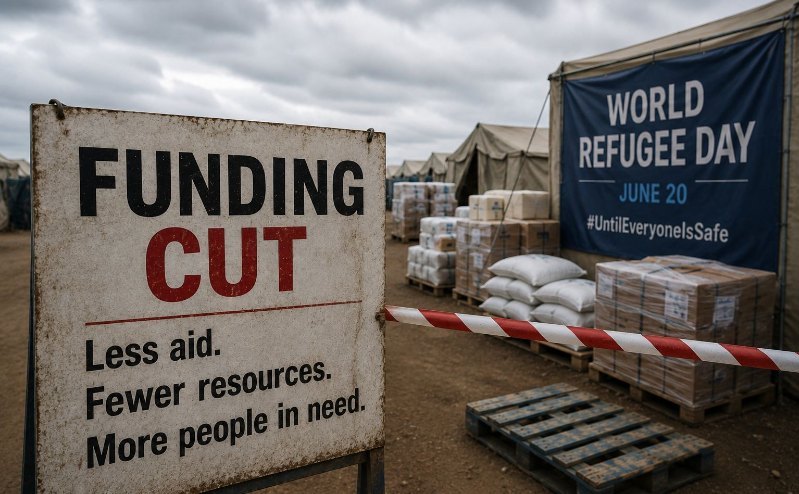
AI generated image
Humanitarian agencies have warned that shrinking funding for refugee programmes is leaving children across East and Southern Africa increasingly vulnerable to hunger, disrupted learning and reduced access to essential services.
The warning comes ahead of World Refugee Day on June 20.
In a joint statement released on Wednesday, the Inter-Agency Working Group for East and Central Africa, the Eastern and Southern Africa Education in Emergencies Working Group, Joining Forces East and Southern Africa, and the United Nations High Commissioner for Refugees (UNHCR) said declining resources are straining support systems for millions of displaced people across the region.
The warning comes as East and Southern Africa hosts 25.1 million forcibly displaced people, including 6.3 million refugees and asylum seekers and 17.1 million internally displaced people, according to the agencies.
As humanitarian resources come under increasing pressure, educators working with refugee communities say schools remain a critical source of stability and support for displaced children.
“We must be empathetic enough to find a balance between abiding by the rules and choosing what is best for the learners,” said Holli Ghaisen, Learning Lead and Educator at Amala Education in Kakuma Refugee Camp.
The agencies described education in emergencies as both lifesaving and life-sustaining intervention. They said schools often serve as entry points for nutrition support, hygiene services and referrals to specialised care. For refugee children, especially girls and children with disabilities, schools can provide safety, stability and a sense of normalcy amid displacement.
However, humanitarian groups warned that shrinking resources are increasingly affecting refugees’ access to essential services.
Warning of the growing impact of funding gaps, Cathy Rutivi, Regional Coordinator for Africa at Terres des Hommes Germany and Joining Forces Eastern and Southern Africa, said vulnerable families are already bearing the consequences.
“A refugee child wakes up today with less food than yesterday, not because of drought or conflict alone but because the world is looking away,” said Rutivi.
She also said a promise made 75 years ago through the 1951 Refugee Convention, that people forced to flee have the right to seek safety, is being undermined by funding gaps, ration cuts and shrinking humanitarian space across East and Southern Africa.
The agencies said refugees, particularly children and young people, continue to face reduced food support, disrupted learning and increasing protection risks as humanitarian resources decline.
The statement also highlighted the role of refugee-led organisations, saying they continue to demonstrate leadership, resilience and innovation despite increasingly constrained conditions.
“Never before have needs been so vast while resources diminished so sharply,” said Lilian Dodzo, regional leader at World Vision International.
“These realities demand not business as usual, but a decisive shift in how we operate, prioritise and partner.”
Ahead of World Refugee Day, whose theme this year is “Until Everyone is Safe,” the agencies called on governments, donors, UN agencies and non-governmental organisations to increase predictable long-term funding, protect access to education and essential services, and invest in measures that strengthen the resilience and self-reliance of refugees and host communities.
They also urged decision-makers to ensure refugee children, youth and women are meaningfully included in policies and programmes that affect their lives.


![[PHOTOS] Uhuru graces commissioning mass of Catholic Women](https://cdn.radioafrica.digital/image/2026/06/0bbd7e96-f180-4e02-966f-97c3fb201478.jpg)