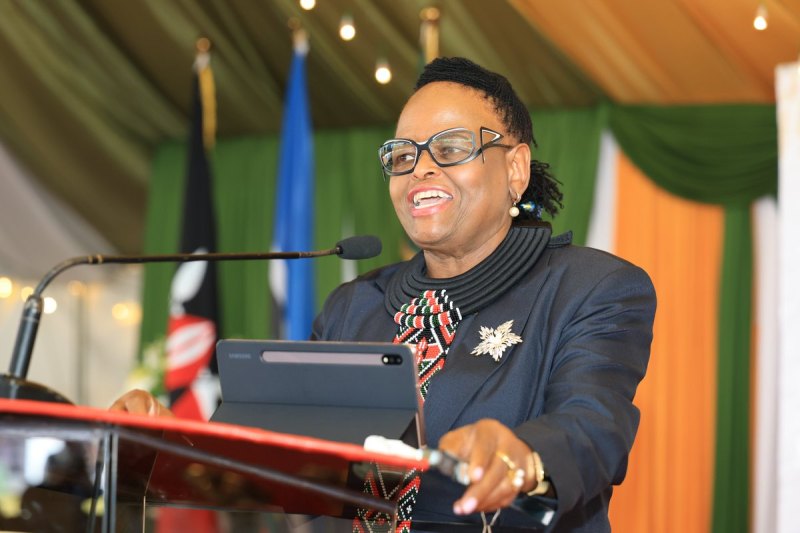
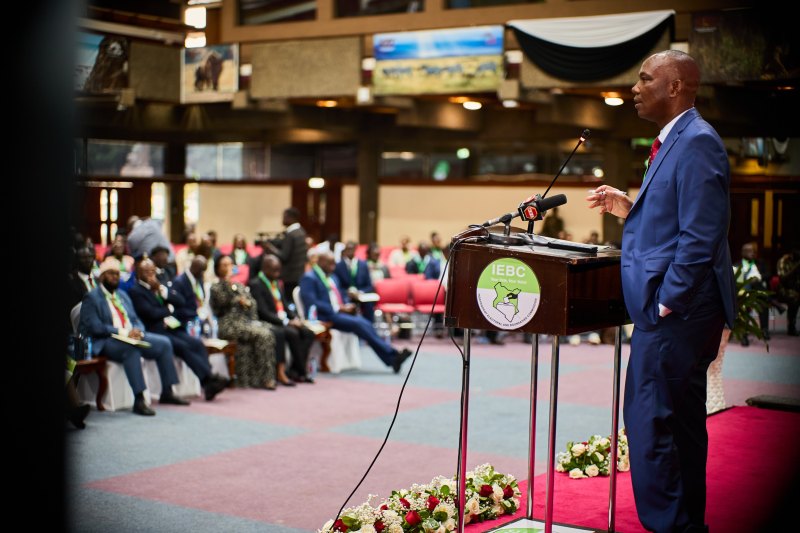
 Chief Justice Martha Koome speaking during the 3rd Africa Chief Justices’ ADR Forum at Safari Park Hotel in Nairobi, June 18 /JUDICIARY
Chief Justice Martha Koome has made a strong case for the expansion of Alternative Dispute Resolution (ADR), describing it as a central pillar in building people-centred justice systems across Africa.
The CJ said ADR represents one of the most practical responses to Africa’s longstanding access-to-justice challenges, arguing that courts alone cannot meet the scale and diversity of disputes faced by citizens.
Speaking during the 3rd Africa Chief Justices’ ADR Forum at Safari Park Hotel in Nairobi, Koome said the continent must rethink justice delivery to reflect how people actually seek resolution in their daily lives.
She cited recent continental data to underline the urgency of reform, referencing the Afrobarometer Round 10 Survey on Access to Justice, which shows that only about half of Africans trust that ordinary people can obtain justice through formal courts.
The CJ noted that before heading to the courts, many citizens continue to rely first on informal systems to resolve conflicts.
“Across the continent, many citizens turn first to traditional leaders, customary courts, community elders, religious leaders, and other community-based mechanisms when confronted with disputes,” Koome said, pointing to the findings as evidence that justice-seeking behaviour is deeply rooted in community structures.
According to the chief justice, this reality should not be interpreted as rejection of the judiciary, but rather as a signal that justice systems must evolve to become more accessible, responsive and aligned with lived experiences.
She said ADR offers a bridge between formal and informal systems, helping to resolve disputes faster, more affordably, and in ways that preserve relationships within communities.
"The findings challenge us as judicial leaders to broaden our understanding of justice and to create pathways through which disputes can be resolved quickly, fairly, affordably, and in ways that strengthen rather than fracture communities," she said.
Koome emphasised that courts remain essential guardians of constitutionalism, human rights and the rule of law, but insisted they are not designed to be the only entry point to justice.
She said strengthening ADR mechanisms would reduce case backlogs and improve trust in the justice system.
Beyond social justice, Koome also framed ADR as an economic necessity. She argued that efficient dispute resolution is increasingly tied to Africa’s economic competitiveness, particularly under frameworks such as the African Continental Free Trade Area and Agenda 2063.
Faster resolution of commercial disputes, she said, lowers transaction costs and strengthens investor confidence.
"In this sense, commercial justice must be viewed as a form of economic infrastructure," Koome noted.
She encouraged judicial leaders and stakeholders attending the forum to share experiences and develop practical reforms that embed ADR more firmly within national justice systems.
Koome expressed optimism that the forum would yield actionable recommendations and a Nairobi Communiqué to guide continental reform efforts.
The Chief Justice concluded by urging a shared vision of justice systems that “serve, listen and resolve,” stressing that Africa’s future justice architecture must prioritise inclusion, accessibility and reconciliation.
![[PHOTOS] Raila Odinga Stadium construction enters home stretch](https://cdn.radioafrica.digital/image/2026/06/45f6990c-4882-4cd2-b83c-8fc730dcdce5.jpg)