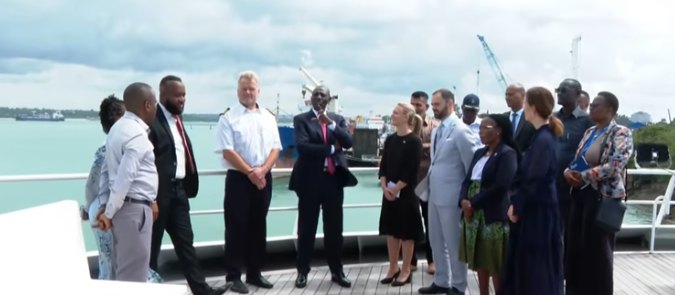
President William Ruto arrived in Mombasa on Thursday following a three-day visit to France, where he attended the G7 Summit in Évian.
Upon landing in Mombasa, the President proceeded to tour the Dr Fridtjof Nansen Research Vessel, where he was expected to engage stakeholders in ocean governance and maritime research initiatives.
The visit comes during the ongoing African Ocean Governance Ministerial event in Mombasa, which brings together regional leaders and partners to strengthen cooperation in the sustainable use of ocean resources.
This is the first Our Ocean Conference held on African soil that places the global spotlight on ocean action and leadership across Africa and highlights the unique coastal communities, biodiversity, and ecosystems of Kenya and East Africa.
Guided by the theme “Our Ocean, Our Heritage, Our Future”, the conference focused on the essential role that the ocean plays in shaping culture, communities, and livelihoods.
Under Kenya’s leadership, the eleventh Our Ocean Conference will unite governments, communities, innovators, and businesses to move the global ocean agenda from dialogue to delivery, placing jobs, equity, and healthy oceans at the center of international cooperation.
Ruto returned to the country from Paris on Thursday morning, where he attended the G7 summit and proceeded to Mombasa, where he toured the renowned research vessel Dr Fridtjof Nansen, currently docked at the Port of Mbaraki.
The vessel, which arrived in Kenya on May 6, is at the heart of the EAF-Nansen Programme, the longest-running fisheries development partnership between the Food and Agriculture Organization of the United Nations (FAO) and the Government of Norway.
Named after the late Norwegian scientist, explorer and humanitarian Dr Fridtjof Nansen, the vessel flies the United Nations flag and serves as a platform for international scientific cooperation among partner countries, researchers and development organisations.
The Port of Mbaraki welcomed the vessel as part of celebrations marking the 50th anniversary of the EAF-Nansen Programme, a milestone for a partnership that has supported sustainable fisheries management and marine research across the developing world for five decades.
Equipped with state-of-the-art technology, the vessel's mission is to generate scientific knowledge on marine resources and ecosystems, helping governments and stakeholders make evidence-based decisions for the sustainable management of oceans and fisheries.
The current Dr Fridtjof Nansen is the third vessel to carry the name. Owned by the Norwegian Agency for Development Cooperation (Norad) and operated by Norway's Institute of Marine Research (IMR), it entered service in 2017.
Its predecessors served from 1974 to 1993 and from 1993 to 2016, collectively conducting extensive research missions around the world.
Since its maiden voyage in 1975, the vessel has undertaken scientific surveys in the waters of nearly 60 countries across East and West Africa, Southeast Asia, the Eastern Central Pacific and the Caribbean, covering hundreds of thousands of nautical miles.
Beyond research, the vessel plays a critical role in strengthening the capacity of fisheries institutions and supporting scientists in developing the knowledge needed to protect marine ecosystems and promote sustainable use of ocean resources.
Ruto was also expected to join Zanzibar's President Hussein Ali Mwinyi at the closure of the 11th Our Oceans conference happening in the Coastal city.
At the G7 Summit, Kenya used the forum to reaffirm its commitment to responsible industrialisation of fisheries, expansion of coastal cold-chain systems, value addition infrastructure, and scaling up of blue carbon projects and community-led mangrove conservation efforts.
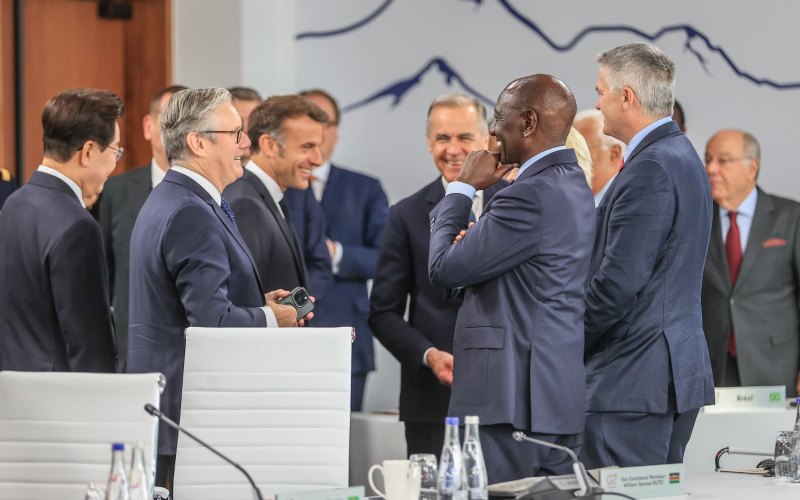
During the G7 Summit, Ruto joined leaders of major global economies and held bilateral talks with several world figures, including Indian Prime Minister Narendra Modi, German Chancellor Friedrich Merz, Ukrainian President Volodymyr Zelensky, European Commission President Ursula von der Leyen, and World Bank Group President Ajay Banga.
The invitation and engagements underscored Kenya’s growing role in global discussions on trade, development financing, climate action, digital transformation, food security, and reforms to the international governance system.
Ruto also played a prominent role during the G7+ working session on “Fostering New Partnerships and Rebuilding International Solidarity,” where he delivered the lead intervention on behalf of Africa.
In his address, he called for a shift in global relations, urging a framework grounded in sovereign equality and mutual benefit rather than dependency.
“Africa seeks neither dependency nor patronage. We seek partnership. Not as beneficiaries, but as equals. Not as spectators, but as co-authors of a shared future,” Ruto said.
He also renewed his criticism of the international financial system, arguing that African countries continue to borrow at significantly higher interest rates compared to their global counterparts, a situation he said undermines development efforts across the continent.