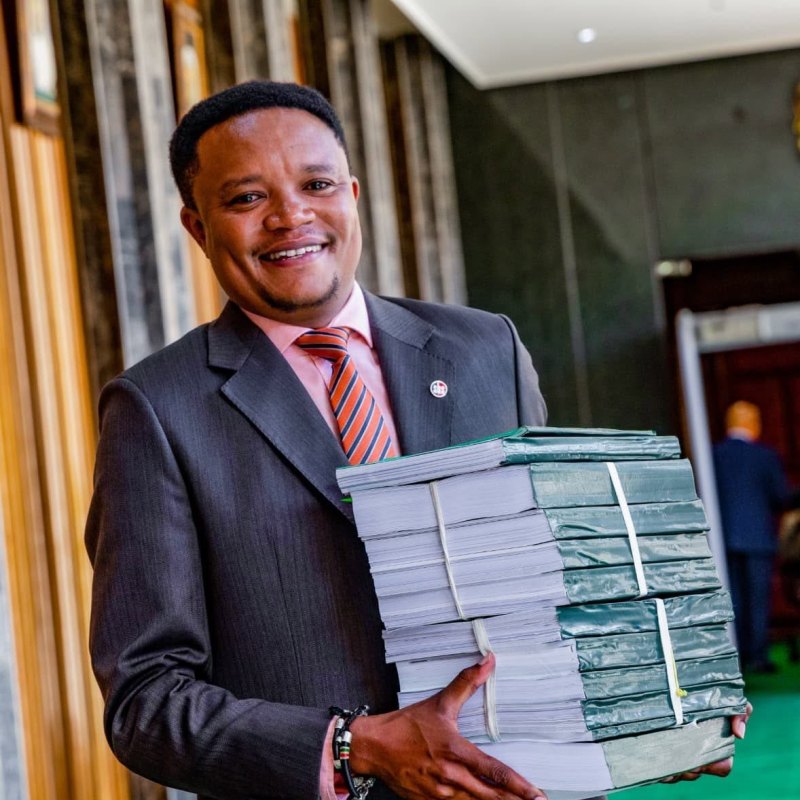
 Finance and National Planning chairperson Kimani Kuria, with the report and public views on the Finance Bill, 2026, ahead of tabling before the National Assembly on June 16, 2026. /PARLIAMENT
The National Assembly's Finance and Planning Committee on Tuesday tabled its report on the Finance Bill 2026, setting the stage for a crucial parliamentary debate as lawmakers move closer to determining the country's tax and revenue measures for the 2026/27 financial year.
The report, presented by committee chairperson Kimani Kuria, marks one of the final legislative steps before the Bill can be passed into law.
MPs were expected to take the Bill through the Second Reading on Wednesday, with a high likelihood that it will proceed to the Committee of the Whole House for clause-by-clause consideration.
Also tabled before the House were nine volumes containing more than 100,000 submissions from members of the public and stakeholders collected during the public participation exercise.
During the Tuesday session, debate on the committee report was marked by heated exchanges as MPs clashed over several of the proposed tax measures and the committee's recommendations.
The Finance Bill 2026 seeks to raise an additional Sh98.9 billion in revenue, more than three times the approximately Sh30 billion generated through the Finance Act 2025 and the Tax Laws (Amendment) measures introduced after the withdrawal of the Finance Bill 2024.
The abandoned Finance Bill 2024 had been projected to raise Sh344 billion before it was rejected following widespread public opposition.
The subsequent adjustments to tax policy were intended to cushion households and businesses while preserving government revenues.
Presenting the report, Kuria assured lawmakers that contentious proposals would be referred back to the National Treasury for further consideration where necessary.
Among the issues attracting the greatest attention was the absence of tax relief for workers earning Sh30,000 and below.
Kuria told the House that the committee had urged the National Treasury to revisit the proposal and review the broader structure of PAYE taxation.
"This committee recommends that the National Treasury relooks into overhauling all the tax bands," he said.
The committee noted concerns raised by stakeholders that high-income earners continue to face tax rates of up to 35 per cent, arguing that a comprehensive review of the PAYE structure would create a fairer and more balanced taxation system.
On the proposed taxation of imported mobile phones, the committee endorsed the Treasury's proposal to consolidate existing levies into a one-off tax of 25 per cent.
However, it rejected plans to impose the tax upon activation of mobile devices.
"We strongly feel that it is important to establish a framework to make sure that we have the correct software installed by sharing data with Tangos and by making sure that the Communications Authority is ready to charge taxation on activation," Kuria said.
He argued that the country lacks the necessary systems to effectively implement activation-based taxation without inconveniencing consumers.
"What will happen if I go and buy a phone from a dealer, and I'm not aware whether taxes have been paid, and I send that phone to my brother in the village, only for my mother to be told that you cannot use the phone because the phone has not paid the requisite taxes?"
According to the committee, a proper implementation framework would help safeguard revenue while preventing ordinary Kenyans from bearing the consequences of compliance failures by importers and dealers.
The committee also proposed significant amendments to plans to introduce minimum tax on deemed dividends.
While agreeing with the Treasury that the measure is necessary to curb tax avoidance through prolonged retention of profits, MPs opposed the proposed threshold of 60 per cent.
Stakeholders had challenged a proposal to amend Section 24 of the Income Tax Act to treat undistributed corporate profits held for more than 12 months as deemed dividends subject to taxation.
"The committee, therefore, is proposing to moderate the threshold to a maximum of 40 per cent to achieve a balance between revenue collection and allow businesses sufficient flexibility to retain earnings for growth and investment," Kuria said.
The committee further supported the proposal to stagger tax return filing deadlines to reduce pressure on the Kenya Revenue Authority's systems.
Under the Treasury proposal, nil returns would be filed by January 31, individual returns by April 30 and corporate returns by June 30.
However, the committee recommended retaining only two filing deadlines.
"The committee noted that nil returns require minimal information while corporate returns require more detailed financial records and compliance procedures. We therefore recommend that we only have two timelines: four months for individual taxpayers and six months for corporate taxpayers," Kuria said.
He said the changes would reduce the annual rush that often overwhelms KRA systems as taxpayers scramble to beat the June 30 deadline.
The committee also indicated it would seek further amendments to the Income Tax Act to ensure fees generated from card-based transactions remain subject to taxation while preventing additional costs from being passed on to consumers.
The committee further backed the Treasury's proposal for a one-year tax amnesty targeting defaulters, saying the measure could encourage settlement of outstanding principal tax liabilities.
However, the committee warned that repeated amnesties risk creating a culture of non-compliance.
"The committee noted that although this provides a relief to taxpayers, it's very dangerous for the country, and it could be termed as being unfair," Kuria said.
He noted that compliant taxpayers could view the measure as rewarding individuals and businesses that deliberately failed to meet their tax obligations.
"Some of the taxpayers were saying that if you are going to forgive the interests and penalties for those who did not pay, then you should also refund those who paid their interests and penalties."
With the Bill now entering its decisive stages, lawmakers are expected to engage in intense debate over the proposed measures as Parliament weighs the need for additional revenue against growing concerns over the tax burden facing households and businesses.