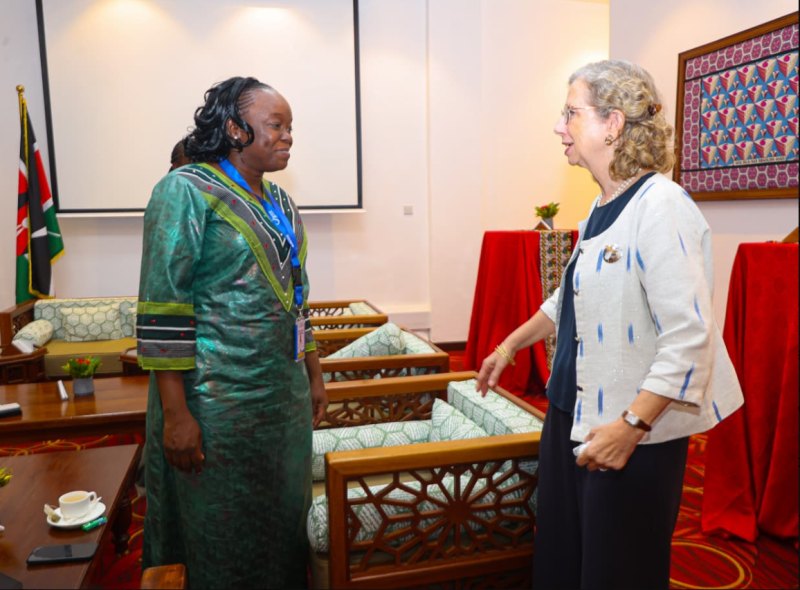
 Cabinet Secretary for Environment, Climate Change & Forestry Dr Deborah Mlongo Barasa with the Executive Director of the United Nations Environment Programme (UNEP) Inger Andersen, at the 11th Ocean Conference in Mombasa /HANDOUT
Kenya’s coastline is once again under pressure after a powerful storm exposed the country’s deepening climate vulnerability, raising fresh alarm over the resilience of coastal ecosystems.
The storm, which recently swept across parts of the coast, disrupted fragile shoreline systems and reignited concern over the increasing frequency and intensity of extreme weather events affecting coastal communities.
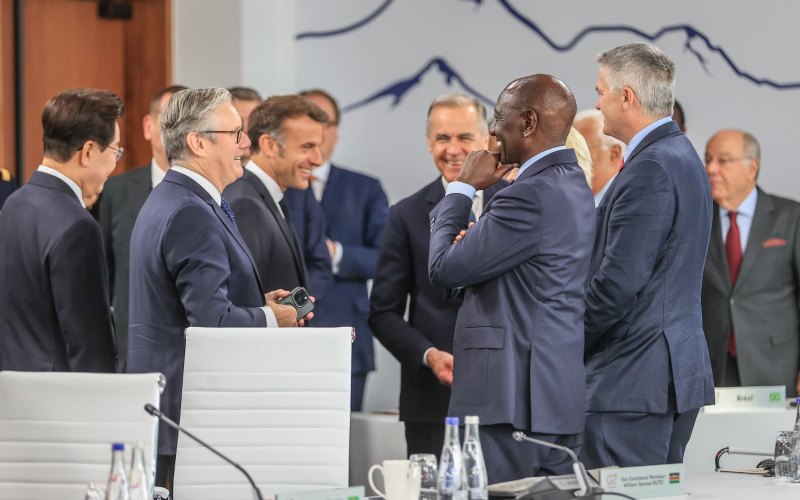
Speaking at the 11th Our Ocean Conference in Mombasa, Cabinet Secretary for Environment, Climate Change & Forestry Dr Deborah Mlongo Barasa said the event is a clear reminder that climate impacts are no longer distant threats but immediate realities shaping lives and ecosystems.
“What we are witnessing along the coast is not an isolated disruption. It is part of a wider climate pattern that demands urgent investment in resilience, especially for communities whose livelihoods depend directly on the ocean,” she said.
Her remarks came as Kenya joined international partners in reaffirming commitments to strengthen ocean protection and climate adaptation measures, particularly in vulnerable coastal zones.
The conference brought together countries including Türkiye, Brazil, Indonesia, Panama, Vanuatu, and Zanzibar, alongside global conservation organisations, to advance a coordinated response to declining marine ecosystems.
Central to the discussions were coral reefs, which play a critical role in protecting shorelines from storm surges while supporting marine biodiversity and sustaining hundreds of thousands of livelihoods along Kenya’s coast.
Their degradation, officials warned, could significantly increase exposure to future storms similar to the one recently experienced.
In response, Kenya announced its participation in a High-Level Political Commitment for Climate-Resilient Coral Reefs aimed at strengthening protection, financing, and restoration efforts across marine ecosystems.
The initiative seeks to improve management of marine protected areas while closing long-standing funding gaps that have slowed coastal resilience efforts.
Authorities emphasised that shifting from reactive disaster response to proactive ecosystem protection is now essential.
Barasa further stressed the need to reframe how coastal protection is approached, noting that natural systems must be treated as critical infrastructure.
"Coral reefs and coastal ecosystems are not optional environmental assets. They are essential defence systems for our economy, our people, and our future resilience,” she said.
Kenya is also advancing innovative financing mechanisms, including reef-positive insurance models, blue carbon markets, and fisheries-based investment approaches to support long-term ecosystem protection.
The government has further proposed the establishment of a Regional Reef Resilience Finance Hub in Mombasa to coordinate funding and technical support for coastal protection across the region.
As climate risks continue to intensify, the recent storm has underscored the urgency of building stronger natural and financial systems to protect vulnerable coastal communities from future shocks.