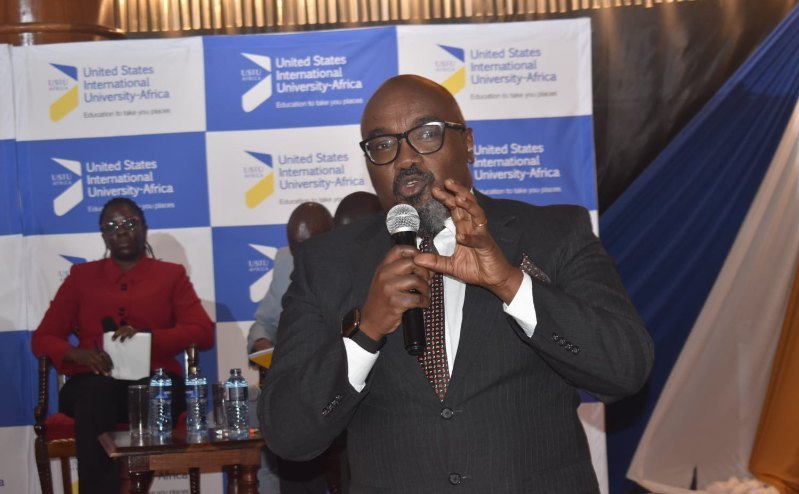
 USIU-Africa Vice Chancellor Professor Mwendwa Ntarangwi speaking during the USIU-Africa Employer Breakfast forum/ VALLERY NAGARA
When university students enter the labour market today, they are stepping into a world fundamentally different from the one their parents knew.
For decades, the formula appeared straightforward: study hard, earn a degree and secure employment. However, across Kenya and much of the world, that formula is increasingly being reshaped by technological disruption, changing workplace expectations, artificial intelligence and evolving employer needs.
Degrees still matter. Yet employers are increasingly asking a different question: what can you do?
This shift formed the centre of discussions at the USIU-Africa Employer Breakfast, where employers, university leaders, human resource practitioners and students gathered to examine the future of work and what it means for graduates entering an increasingly competitive labour market.
The discussions painted a picture of a world where adaptability, continuous learning, problem-solving and human skills are becoming just as important as academic qualifications.
According to the Kenya National Bureau of Statistics, youth continue to make up the largest share of the country’s unemployed population, even as universities produce thousands of graduates annually. KNBS stated that youths aged 20–29 comprise the highest share of unemployed Kenyans, with over 1.6 million individuals in this bracket actively without work. It added that young people under 35 years make up roughly 75 per cent of Kenya’s total population and represent over 70–80 per cent of the country’s unemployed workforce.
At the same time, rapid advances in artificial intelligence and digital technologies are changing how work is performed and who gets hired. For universities and employers alike, the challenge is no longer only preparing students for existing jobs, but also preparing them for jobs that may not yet exist.
A labour market in transition
Speaking at the forum, USIU-Africa Vice Chancellor Professor Mwendwa Ntarangwi said students and employers are navigating the same disruptions, even if they experience them differently. Students worry about how to enter and succeed in the world of work, while employers are concerned about finding talent capable of helping organisations thrive. Yet both groups face a rapidly changing environment.
"The shelf life of skills these days seems to be getting shorter. So re-skilling and re-tooling are necessary," Ntarangwi said.
He identified three major disruptions shaping today’s workplace: shrinking skill relevance, an increasingly unpredictable labour market and a growing emphasis on fit beyond credentials. He noted that graduates are no longer competing only with their classmates.
"For students, you're not just competing with your classmates. You're competing with others in East Africa and, of course, remote candidates globally."
Remote work, global hiring platforms and artificial intelligence have widened the labour market beyond geographical boundaries, exposing Kenyan graduates to competition from talent across the world. Employers, he added, are increasingly searching for workers who can adapt to uncertainty.
"Employers, you're not hiring fancy CVs. You're hiring for adaptability and agility," he said.
The degree gets you in the room, but not the job
One of the strongest themes to emerge was the changing value of academic qualifications. Degrees remain important, but they are increasingly viewed as a starting point rather than a guarantee of employment.
"The degree will get you in the room. But you have to demonstrate you need to get a chair and stay in the room," Ntarangwi said.
He said this demonstration comes through internships, projects, leadership experience and evidence of practical achievement.
Employers echoed the same sentiment. Peter Gacoka of Safaricom said organisations are increasingly looking beyond certificates.
"Yes, it's good to have the papers, but when you come for that interview, we won't be looking at your certificates. We'll actually be looking at what can you offer and what other skills do you have," he said.
He added that employers seek candidates capable of filling specific organisational gaps.
"The employers have a gap they want to fill. So what gap are you coming to fill?"
This reflects a broader global shift towards skills-based hiring, where competencies are prioritised alongside academic credentials. Increasingly, technical knowledge must be accompanied by communication, creativity, teamwork and problem-solving skills.
From career ladders to career lattices
The traditional career ladder is also being challenged, with careers becoming more dynamic and requiring movement across disciplines and continuous reinvention.
Ntarangwi urged students to strengthen collaboration skills.
"The age of lone buffaloes working alone is long gone. You'll be tasked to work with someone you may not know or may not even like. But you have to deliver."
USIU-Africa’s Deputy Vice Chancellor for Transformative Teaching, Learning and Research, Professor Amos Njuguna, said the university deliberately exposes students to interdisciplinary learning. A psychology student may take business courses, a pharmacy student may study psychology, while others explore information technology, artificial intelligence and robotics.
"We start by asking how can you be useful and how can you be a problem solver," Njuguna said.
Through exposure to research, innovation, entrepreneurship and industry engagement, universities aim to produce graduates capable of navigating a complex world.
For many graduates, job search strategies remain focused on applications and waiting for responses. However, employers say networking increasingly determines access to opportunities.
"Most jobs are not found on ads. They're found in spaces like this," Ntarangwi said.
"Ten minutes with someone beats 50 letters that you've sent for applications."
He described such engagements as conversations rather than transactions.
"It is a dance, not a sit-down concert."
The AI revolution and the human advantage
Artificial intelligence has become a defining force in the future of work, transforming industries including content creation, data analysis, customer service and software development. However, employers insist that technology alone is not enough.
Peter Gacoka said while employees in his organisation have undergone AI training, human capability remains essential.
"We believe AI without humanness is not going to take us anywhere."
He added that AI must be combined with creativity and critical thinking.
"As much as AI becomes one of your core competencies, please bring in the human into it, because we are all human in the first place."
Learning that never ends
Another emerging reality is that learning does not end at graduation. Employers increasingly expect continuous upskilling.
Gacoka described this as "atomic learning."
"We don't believe in long-term programmes. We believe in learning for the skill that you're going to use today."
He warned of rapid skills obsolescence.
"If you learn for three months, chances are by the time you complete that learning, you are likely to be obsolete."
The arrival of Generation Z is also reshaping workplace culture. Ntarangwi said young employees prioritise growth and purpose.
"They care about growth. Show them what growth looks like. Show them what accomplishment looks like," he said.
Gacoka noted that organisations must also prioritise employee welfare.
"Organisations who don't have good medical schemes and don't care about the financial well-being of their employees will not succeed in attracting the best students."
He added that recruitment is shifting towards digital spaces.
"Meet them where they are. Today, they are more connected on social media than on newspapers," Ntarangwi said.
Resilience is also becoming central to organisational survival. Lillian Galla of DTV described it as the ability to adapt, recover and thrive.
"So resilience is an art. A is the ability to adapt, R is to recover and T is to thrive."
She said organisations must create environments that encourage innovation, citing an example where a 23-year-old employee developed a platform for women in STEM after being given an opportunity to present her ideas.
"These people don't need appointments. Most of the time, they have the solutions in them."
She emphasised the importance of empowerment.
"They require an empowered mindset. They need to be told, yes, you can do it."
Inclusion beyond numbers
On inclusion, Michelle from Light for the World highlighted barriers faced by persons with disabilities, including stigma, inaccessible workplaces and negative attitudes.
"As long as we don't change our mindsets, that's where it begins."
She noted that bias can occur even at the recruitment stage.
"By the time that advert goes out, we are already biased."
She added that accessibility must include digital systems and workplace technologies.
"If I am not able to access your system, then your system is not accessible."
She also pointed to intersectional challenges affecting persons with disabilities.
At its core, the discussion underscored a shift in the labour market towards problem-solving as a central competency. USIU-Africa’s approach emphasises inquiry, innovation, entrepreneurship and community engagement, encouraging students to apply knowledge in practical ways.
The changing world of work is challenging long-held assumptions about education and employment. Degrees remain valuable, but increasingly serve as entry points rather than final destinations.
Adaptability, lifelong learning, creativity, collaboration and resilience are emerging as defining qualities of the modern workforce. For graduates, success may depend less on what they studied and more on how quickly they can learn, adapt and solve problems in a rapidly changing environment.
As universities, employers and policymakers rethink the future of work, one reality stands out: the future may belong not to those with the most credentials, but to those who remain curious enough to keep learning.
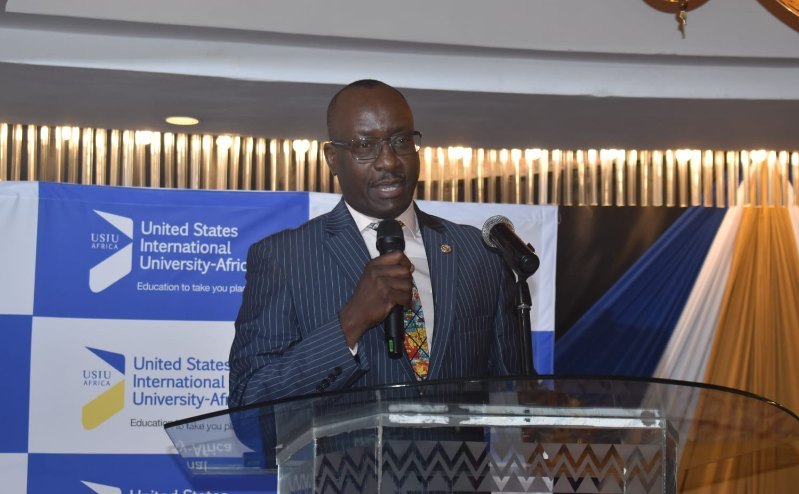 Founder and CEO C Suite Impact Consulting LTD speaking during the USIU-Africa Employer Breakfast forum /VALLERY NAGARA
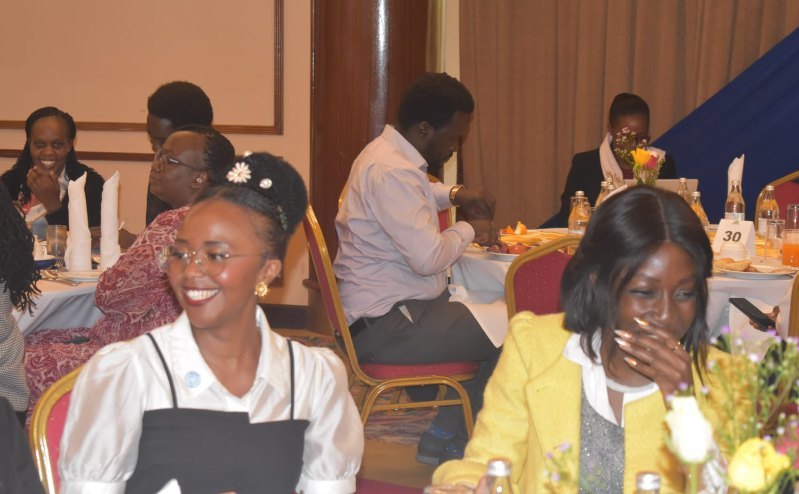 Some of the attendees present during the USIU-Africa Employer Breakfast forum /VALLERY NAGARA