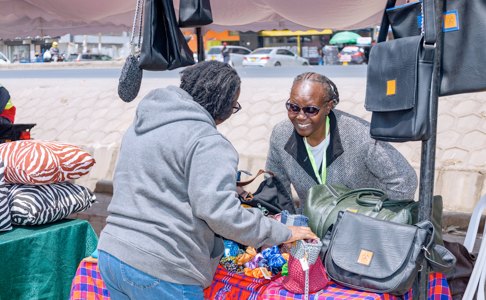
 Entrepreneurs from refugee and host communities showcase and market their products during a community trade fair in Kibera /IRC
Refugee women running small businesses in Nairobi's informal settlements are earning significantly less than their male counterparts and other groups in the same communities, a new research has shown.
The study has raised urgent questions about whether standard livelihoods interventions are reaching the people who need them most.
The findings, published by Boosting Urban Innovations for Livelihoods Development (Re:BUiLD), an initiative run by the International Rescue Committee, show that women-owned businesses recorded average monthly profits of just $52 (Sh6,800), compared with $88 (Sh11,500) for businesses owned by men.
Women-run enterprises were also concentrated predominantly in food and clothing, sectors widely regarded as among the most competitive and lowest-margin in the urban informal economy.
Perhaps most strikingly, the study found that increased cash grants combined with mentorship did little to move the needle for refugee women.
While the additional support improved productive asset ownership among that group, it had minimal effect on the time women spent on their businesses or on their monthly profits, outcomes that matter most for long-term economic self-reliance.
The broader study was more encouraging at the aggregate level. Cash transfers, whether accompanied by mentorship or not, improved business outcomes across participants in both the short and medium term.
Traders who received support were more likely to own businesses, spend more time operating them, invest in productive assets, and record higher monthly profits.
The findings reinforce what many urban economists already suspect; access to capital is the single most binding constraint facing micro-entrepreneurs in Nairobi's informal economy.
In a market where a trader who cannot restock loses customers rapidly and a service provider without tools cannot convert skills into income, the ability to buy inventory, replace equipment or absorb a difficult trading week is often the difference between staying open and shutting down.
For refugees and Kenyan small traders, that margin can be razor-thin.
The study said Nairobi was hosting 118,144 registered refugees and asylum-seekers by the end of April 2026, according to combined government and UNHCR data, making the capital the focal point of a policy conversation that is rapidly shifting from camps to cities.
Kenya's
total refugee and asylum-seeker population stood at 847,780 over the same
period, with Nairobi accounting for 13.9 per cent of the national figure, even
as Garissa and Turkana, home to the Dadaab and Kakuma camp complexes, continue
to host the largest overall numbers.
Urban refugees, the research notes, operate within the same systems as Kenyan small traders: business licensing, market access, inspections, mobile money, rent, transport, and informal credit.
Yet, where documentation is not recognised or market rules remain unclear, refugees can find themselves pushed into the most fragile corners of the informal economy, with less security and fewer pathways to growth than their Kenyan peers.
The
weaker outcomes for refugee women in particular point to constraints that go
well beyond finance.
Researchers and development practitioners working in the sector have long noted that refugee women in urban settings frequently face compounding disadvantages-limited mobility, caregiving responsibilities that restrict business hours, restricted access to networks and market information, and, in some cases, discriminatory treatment by landlords, suppliers, and licensing authorities.