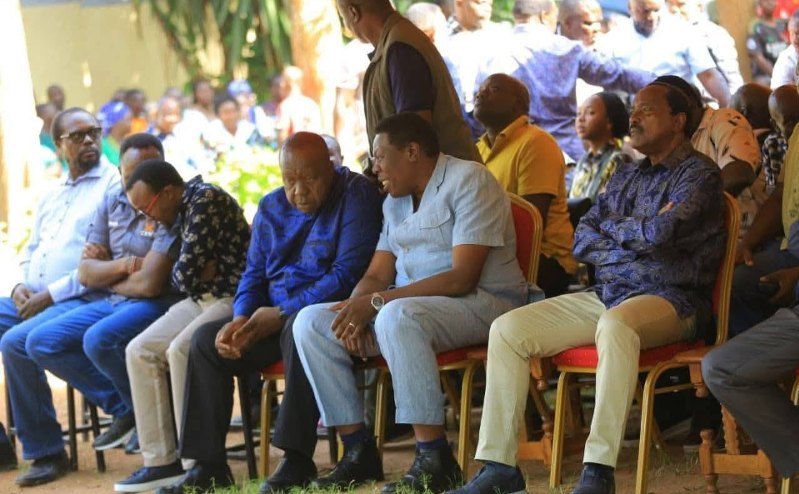
 Opposition leaders during a church service at Kibabii Catholic Church in Bungoma county/HANDOUT
This comes amid mounting questions over his relationship
with key coalition partners and his commitment to the opposition's joint
political activities.
Matiang’i appeared on the final day of the three-day tour in
Bungoma county and publicly apologised for missing the earlier rallies.
The Jubilee deputy party leader said he had been forced to
attend a funeral following the loss of a close family friend.
“I have apologised privately, but I also need to do it
publicly. We were supposed to be here from Friday, but I had a funeral, and I
had to rush there,” he said.
“One of our close brothers lost a loved one and we
had to go there. I have only found a chance to come here today.”
The former Interior CS spoke during a Holy Mass at St Mary's
Kibabii Catholic Church in Kanduyi constituency, where
opposition leaders gathered on the final leg of the regional tour.
On Friday, Matiang’i attended the burial of Rukia Mandari,
the wife of former Solicitor General Kennedy Ogeto, in Nyamira county.
However, his whereabouts on Saturday remained unclear,
further fuelling speculation about his absence from the opposition events.
While his explanation may have addressed immediate questions
about his no-show, it did little to silence growing concerns about the state of
his relationship with other opposition principals.
His absence was particularly noticeable given the
significance of the Western Kenya tour, which was intended to demonstrate unity
among opposition leaders as they intensify preparations for the 2027 General
Election.
Present during the rallies were Democracy for Citizens Party
(DCP) leader Rigathi Gachagua, Wiper leader Kalonzo Musyoka, Democratic Party
leader Justin Muturi, DAP-Kenya leader Eugene Wamalwa and Trans Nzoia Governor
George Natembeya.
Notably, no senior official from the Jubilee Party attended
the first two days of the tour in Matiang’i’s absence.
At the launch of the opposition's Western Kenya campaign in
Luanda, Vihiga county, Wamalwa attempted to calm speculation by assuring
supporters that Matiang’i was on his way.
However, the former Interior CS never showed up.
Political analysts argue that the incident is the latest
sign of growing unease within the opposition coalition, where competing
ambitions and succession calculations are increasingly threatening the unity
leaders have worked hard to project.
“A divided opposition, one that is busy trading barbs and
questioning each other's loyalties, projects weakness and disorganisation to
the electorate,” said political analyst Prof Olang Sana of Maseno University.
According to observers, tensions between Matiang’i and
sections of the opposition have been simmering for months and have become
increasingly difficult to conceal.
Two weeks ago, Gachagua's DCP publicly distanced itself from
political rallies organised by PNU leader Peter Munya and attended by Matiang’i
in Meru and Isiolo counties.
DCP national organising secretary Mithika Linturi openly disowned the meetings and
urged party supporters to stay away.
Linturi insisted that the events had neither been sanctioned
by DCP nor discussed by opposition principals.
The remarks exposed what insiders describe as growing
discomfort within Gachagua's camp over Matiang’i's independent political
engagements and his expanding influence beyond his traditional Gusii political
base.
The unease appears to have intensified after the Party of
National Unity formally endorsed Matiang’i as its preferred presidential
candidate.
That endorsement significantly elevated Matiang’i's national
political profile and positioned him as a serious contender for the opposition
ticket, potentially placing him on a collision course with other coalition
leaders harbouring similar ambitions.
Although opposition principals have repeatedly insisted that
they remain united in their mission to challenge President William Ruto in
2027, recent events suggest that underlying tensions remain unresolved.
The battle has increasingly extended beyond the principals
themselves and into the ranks of their allies, strategists and supporters.
On social media, allies of both Matiang’i and Gachagua have
been engaging in sustained public exchanges that have exposed deep mistrust
between the two camps.
The rivalry became even more visible following the
opposition's disappointing performance in recent by-elections.
Gachagua's chief social media strategist Kenneth Njohi,
popularly known as Councillor Njohi, launched a sharp attack on Jubilee,
arguing that the party and DCP could not coexist politically within the Mt
Kenya region.
Njohi dismissed Jubilee as a party that no longer
represented the interests of the region, remarks that were interpreted by
Matiang’i's supporters as an attempt to limit his political influence outside
the Gusii region.
The comments triggered strong reactions from Jubilee
loyalists, who accused DCP allies of undermining opposition unity at a critical
political moment.
Former Jubilee deputy organising secretary Pauline Njoroge
has repeatedly cautioned opposition leaders against internal wrangles.
“Divisions and infighting cannot be part of our journey at
this critical stage,” she said.
The hostility has also fuelled claims within sections of the
opposition that Matiang’i is pursuing a parallel political strategy independent
of the coalition's collective agenda.
At one point, lawyer Ndegwa Njiru, a close ally of both
Kalonzo Musyoka and Gachagua, accused Matiang’i of being a “state project”
allegedly intended to weaken the opposition from within.
The explosive allegations represented one of the most direct
attacks against Matiang’i by senior opposition figures.
“Matiang’i is a state project. Matiang’i is an NIS project,”
Njiru claimed during a television interview.
He further alleged that the former Interior CS had
frustrated efforts by opposition leaders to organise political activities in
Kisii while independently conducting meetings in other parts of the country.
The accusations widened the gulf between Matiang’i's
supporters and sections of the opposition leadership.
His allies, however, have dismissed the claims, arguing that
they are part of a broader effort to frustrate his presidential ambitions and
curtail his growing national appeal.
Particularly controversial have been Matiang’i's recent
political activities in the Mt Kenya region.
His closed-door meetings with political leaders, opinion
shapers and grassroots mobilisers in Meru, hosted by Munya, reignited
speculation that he is quietly building an independent political network in a
region traditionally viewed as Gachagua's political backyard.
The meetings revived longstanding concerns among some
opposition figures that Matiang’i could emerge as an alternative centre of
power within the coalition.
Former Nyeri Town MP Ngunjiri Wambugu has criticised what he
describes as attempts to label political competitors as government projects
whenever they challenge Gachagua's influence.