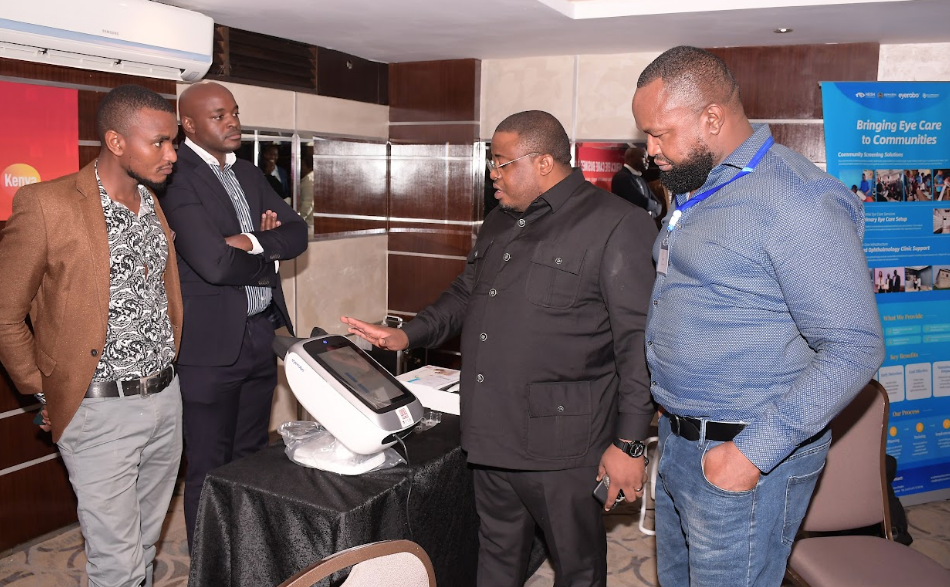
 Agbor Bernard, CEO Africa Opthamology Foundation demonstrates how a device works /HANDOUT
Experts are pushing for adoption of Artificial Intelligence-enabled devices to improve access to eye care services in villages and informal settlements.
The portable devices, which do not need trained eye professionals to operate, can be set up in the grassroots where eye care services are scarce.
Hellen Yan of He Eye Specialist Hospital Group in China says these devices can identify up to 90 per cent of common eye diseases, analyse blood vessels and predict early-stage cardiovascular diseases, neurovascular conditions and neurological issues in the brain.
"We just train the volunteers or the common staff, maybe just half an hour to an hour," Yan said. "And then they can use and apply the devices smoothly and screen the patients in their small clinics in the remote areas."
Engineered specifically for rural environments, the screening system operates completely independent of internet infrastructure.
“In areas lacking connectivity, diagnostic reports are generated locally at the screening site. In areas with internet access, patients can receive their diagnostic health reports directly on their mobile phones immediately,” Yan said.
While initial pilot programmes in Tanzania, Ethiopia, Cameroon, Uganda and Ghana countries may have received donated equipment, Yan said the ultimate goal is to co-create sustainable commercial models with local stakeholders.
This, the partners seek to achieve by setting up vision centres.
"Only donating the devices can't solve the problem," Yan stated. "We hope that we can discuss together to make a proposal and set up a business model to make the services valuable, get some revenues, and make this model work dynamically, " she said.
In Kenya He Eye Specialist Hospital Group is seeking to partner with Women Youth and Children Development Organisation to pilot the programme in Kenya.
Some of the equipment include the portable stick lamp which is a small device for primary eyecare. This equipment is 15 centimetres long and can be attached to a mobile phone. It is able to examine the front of the eye like a stick lamp and can record videos and can take pictures.
The other device is the Fundus camera which is a small device, non-mediatic, that is able to automatically in less than 20 seconds pick out both eyes and give you the image of the back of the eye.
“This is very good in detecting diabetic retinopathy and also some kind of suspicion of glaucoma and all of that. So that can also be exported,” Agbor Bernard, chief executive officer of Africa Opthamology Foundation, however clarified that the devices will not replace eye specialists jobs, but to enhance their work.
“AI is not here to replace eye care personnel, it is here to add value to their work and to easen their work. If a patient comes from one of the vision centres and presents himself with a diagnosis from the equipment, this will help the eye care personnel to efficiently find a solution to the problem,” he said.
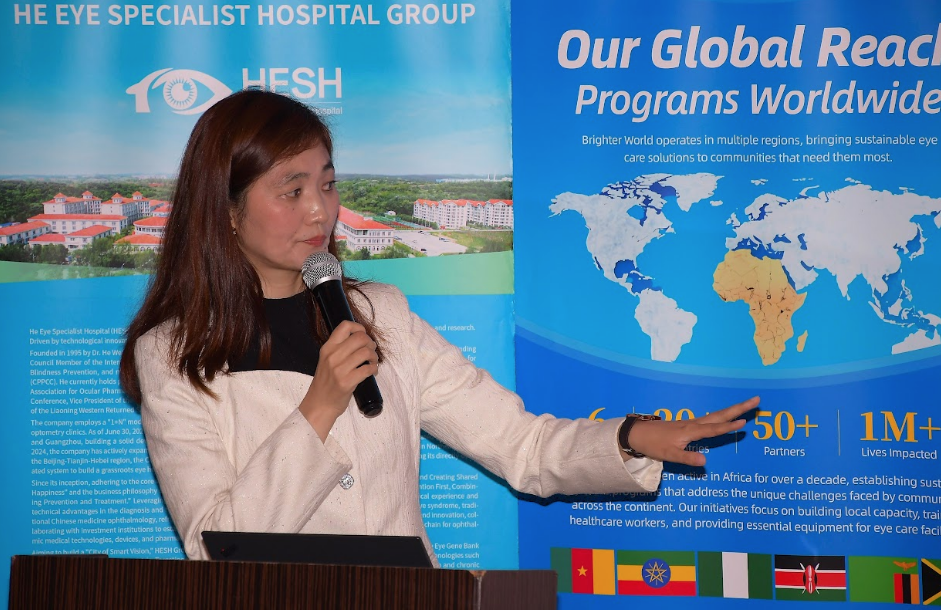 Helen Yan, assistant to president He Vision Group during a meeting in Nairobi /HANDOUT
The Optometrists Association of Kenya president Daniel Mochere says five years ago, Kenya only had 150 eye surgeons, less than 500 optometrists and less than 200 opthamologists.
In Nairobi, of the 128 public health facilities, only four namely, Mbagathi Hospital, Mutuini Hospital, Mama Lucy Kibaki Hospital and Mama Margaret Kenyatta Hospital, provide eyecare services.
Mochere welcomed the project, saying it will be a game-changer in terms of giving patient information.
The vision centres model, the project is seeking to use will ensure access to eye care for many people, he said.
He says the devices are going to help with wrong diagnoses and also lessen the workloads of eye specialists.
“We’ve seen situations whereby some people when maybe they have eye trauma, somebody has an eye injury, you rush to a nearby chemist, get medication for eye without understanding the extent of the injury,” Mochere said.
“We are happy today because we need to embrace technology and get all eye care personnel and stakeholders to come on board and see how we can move this agenda forward.”
He said the association in partnership with He Eye Hospital Group and the Women Youth and Children Organisation is going to hold sensitisation forums.
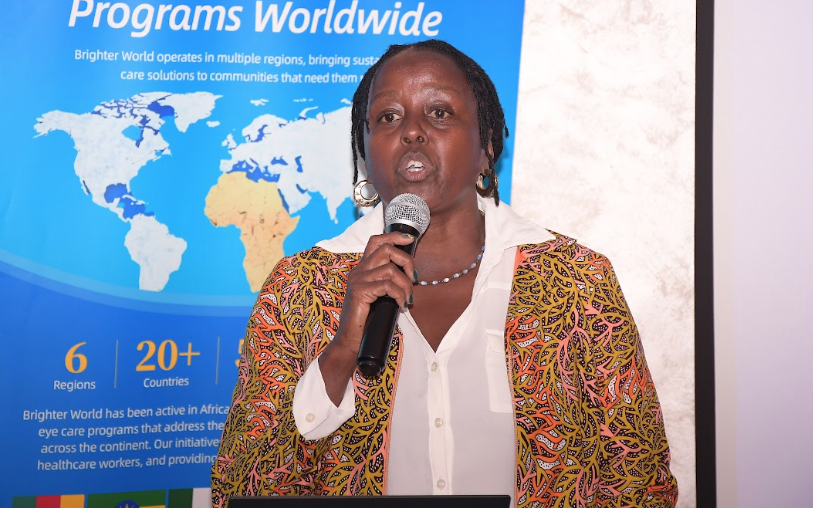 Terry Kiragu, the co-founder of Women Youth and Children Development Orgnanisation during a meeting in Nairobi /HANDOUT
Terry Kiragu, the co-founder of Women Youth and Children Development Organisation said many low-income earners are becoming blind due to lack of knowledge and access to eyer care.
She says the most common eye problems and cataract issues and those issues caused by underlying conditions such as diabetes and hypertension.
“This project is about preventing blindness and because eyes rarely swell and bleed, they are the last organs people treat,” Kiragu says.
She says having worked with more than 300 elderly women in the slums, she has seen many whose eyesights are dimming and do not have anywhere to go.
“Most of these conditions have no permanent solutions at primary level or at the community level, and that's why we are here, very passionately pursuing this model that we are calling vision centres, which means that facilities or clinics are brought to the ground, and people become more aware on how to take care of their eyes,” Kiragu says.