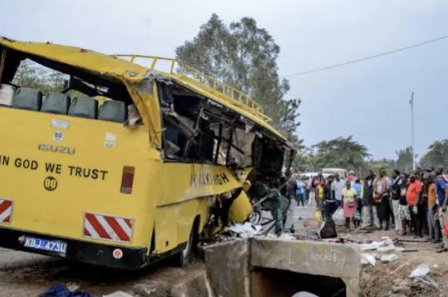
The August 2025 road accident that claimed 26 lives in Kisumu could have been caused by a combination of brake failure, speeding and road design flaws, new details show.
This comes even as the government says investigations into the bus accident are yet to be concluded.
In a statement to the Senate, Roads and Transport Cabinet
Secretary Davis Chirchir said the National Police Service is still conducting
formal investigations into the August 2025 crash at the Coptic roundabout along
the Kisumu–Kakamega highway.
“The National Police Service has not finalised its report
yet,” Chirchir said.
He added that a technical crash analysis by the National
Transport and Safety Authority (NTSA) had already established probable causes
and contributing factors.
According to the report, the bus lost control while descending a steep slope towards the roundabout.
Investigations indicate that the vehicle’s braking system
was ineffective, likely due to insufficient compressed air pressure, causing
the driver to hit a speed hump at high speed before veering off course.
The bus, which was travelling at 61 km/h—well above the
recommended limit—rolled over after the driver attempted to avoid a collision,
eventually landing in a roadside drain.
The crash killed the driver and 24 passengers on the spot,
while dozens of others sustained serious injuries.
The NTSA report also cited a lack of anti-roll bars, weak
vehicle structure and failure by passengers to wear seat belts as factors that
worsened the fatalities.
Beyond mechanical issues, the crash exposed glaring
infrastructural weaknesses.
The roundabout’s outward-sloping design increased the risk
of rollover, while the steep gradient leading to the junction amplified vehicle
momentum.
Investigators also flagged inadequate safety features,
including lack of guardrails and clear speed limit signage.
Following the accident, the Kenya National Highways
Authority (KeNHA) conducted a site inspection and proposed a redesign of the black
spot.
Planned works include reconstructing the section into a
safer through-traffic road, improving drainage and installing enhanced safety
features.
However, the Ministry has admitted that the project has
stalled due to budgetary constraints.
“Works are yet to commence due to budgetary constraints. The
Ministry shall prioritise the same in the next budgetary cycle,” Chirchir told
the Senate.
In the meantime, temporary measures have been put in place,
including installation of crash barriers, road markings and reflective studs to
improve visibility. Right turns at the junction have also been prohibited to
reduce risk.
The tragedy has sparked wider concern over road safety in
the western region, with lawmakers pressing the ministry to act on rising cases
of fatal accidents involving long-distance passenger buses.
Chirchir said the government has since intensified safety
audits and blackspot mapping across major roads leading into Kisumu, including
the Kisumu–Busia, Kisumu–Kericho and Kisumu–Kakamega highways.
Multiple audits conducted between 2019 and 2024 identified
hazardous sections and recommended corrective measures.
To curb accidents, the ministry has rolled out a
multi-agency approach involving enforcement, engineering and public awareness.
This includes weekly joint crackdowns on traffic offenders,
mandatory inspections for public service vehicles and driver sensitisation
campaigns through local media.
Authorities are also tightening enforcement of regulations
governing long-distance drivers. These include mandatory use of two drivers for
long trips, strict journey planning and limits on continuous driving hours.
Additionally, drivers will now be required to take a minimum
eight-hour rest before resuming night shifts, as part of efforts to combat
fatigue-related accidents.
The ministry is also pushing for stricter vehicle safety
standards, particularly for buses, including enhanced inspection of braking
systems and mandatory installation of stability features such as anti-roll
bars.
Despite these measures, the delay in implementing long-term
infrastructure fixes has raised concerns about continued risks for motorists
using the busy Kisumu–Kakamega highway.