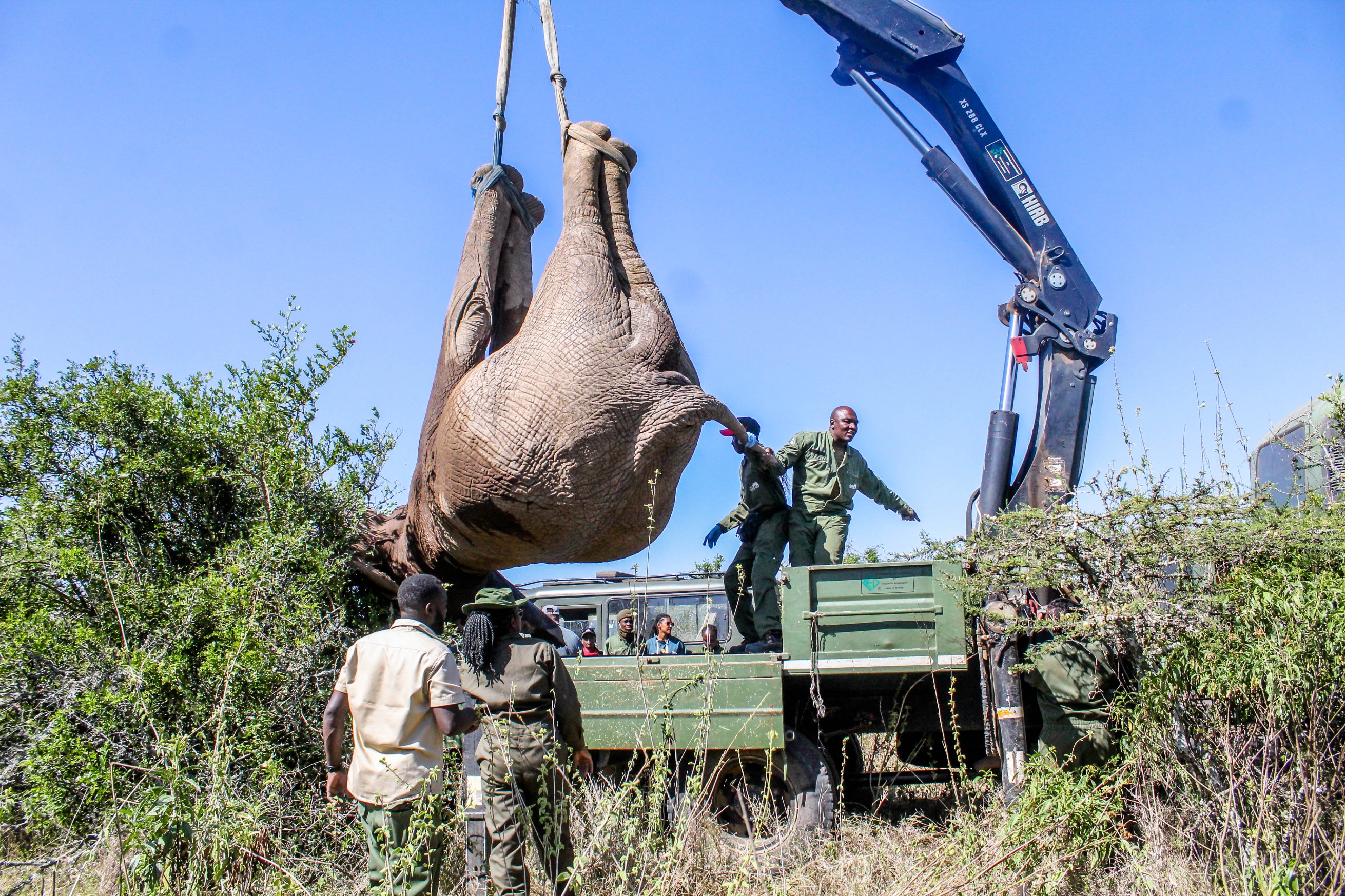
The Kenya Wildlife Service has begun relocating bull elephants from Solio Ranch Conservancy to Tsavo West National Park to protect rhino habitats and reduce rising human–wildlife conflict.
The translocation is being carried
out by KWS veterinary and capture teams in partnership with conservation
organisations.
It focuses on adult male elephants that had settled at Solio for extended periods.
Solio Ranch Conservancy is one of Kenya’s most important privately owned wildlife sanctuaries and a key stronghold for black rhinos, also hosting a large population of white rhinos.
Solio is recognised as the world’s oldest private eastern black rhino sanctuary, managing around 150 black rhinos and over 250 white rhinos.
It has also reintroduced more than 100 black rhinos and 60 white rhinos to other locations in Kenya and Uganda.
According to KWS, the prolonged presence of adult bull elephants at Solio had begun to disturb the delicate ecological balance.
While elephants are fully protected under Kenyan law, adult males can be unpredictable in confined spaces.
Their continued stay posed growing risks to sensitive rhino habitats, conservation infrastructure, and the safety of nearby communities.
“Solio plays a critical role in Kenya’s rhino conservation efforts, and maintaining ecological balance there is essential,” KWS said.
“This translocation is a science-based intervention aimed at safeguarding conservation gains while reducing human–wildlife conflict.”
The situation at Solio reflects a broader national challenge.
Traditional wildlife migratory corridors linking ecosystems such as Mount Kenya and the Aberdares have increasingly been blocked by human settlement, agriculture, fencing and infrastructure.
These corridors allow elephants and other wildlife to move naturally between habitats in search of food, water, and breeding grounds.
As these routes disappear, elephants are forced into smaller conservation areas or closer to farms and settlements, increasing competition for space and the likelihood of conflict.
Kenya’s elephant population has risen steadily, from around 36,280 in 2021 to over 42,000 in 2025, while the black and white rhino population together grew to about 400 animals at Solio alone. This illustrates both conservation success and increased pressure on habitats.
“Blocked corridors force elephants into smaller areas, increasing conflict,” KWS said.
Relocating the bulls to Tsavo West National Park, one of the country’s largest and least fragmented protected areas, provides the elephants with wider roaming space while easing pressure on a high-value conservation area.
The exercise aligns with the KWS Strategic Plan 2024–2028, which emphasises science-led decision-making, mitigation of human–wildlife conflict and landscape-level conservation planning.
Human–wildlife coexistence is a core objective, alongside strengthened community participation and wildlife health management.
“Our strategic approach recognises that coexistence is not optional,” KWS said. “We must protect communities, conserve endangered species, and manage wildlife populations responsibly. Translocation is one of several tools used when preventive measures are no longer sufficient.”
Beyond relocations, KWS has invested in electric fencing, rapid response units, problem-animal control teams and community engagement programmes to reduce conflict.
However, the agency maintains that long-term solutions depend on securing, protecting and restoring wildlife corridors.
“Without functional migratory corridors, these challenges will persist,” KWS said.
“Safeguarding wildlife movement routes is essential to reducing conflict and ensuring sustainable conservation outcomes.”
As Kenya continues to experience rapid population growth and land-use change, the relocation of elephants from Solio to Tsavo underscores a growing reality: conservation success now depends as much on planning and corridor protection as it does on protecting wildlife itself.