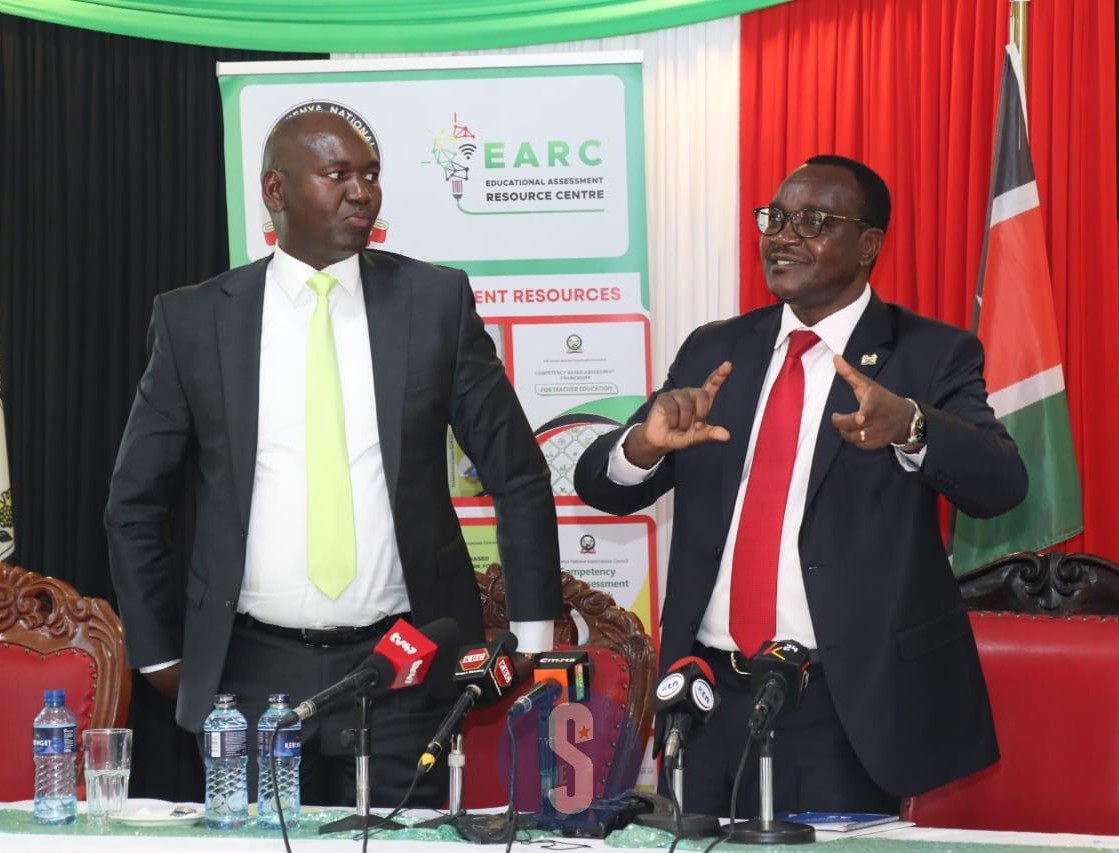
GIRLS outperformed boys in the inaugural Kenya Junior School Education Assessment, emerging stronger in most subjects assessed under the new Competency-Based Education grading system.
Nairobi accounted for the highest number of candidates who sat the 2025 KJSEA, Education Cabinet Secretary Julius Ogamba announced.
Speaking
while releasing the results at the Kenya National Examination Council
headquarters in Nairobi, Ogamba said the capital city registered 71,022
candidates, followed by Kakamega county with 59,384, while Nakuru ranked third
with 54,028.
A total of 1,130,459 learners sat the assessment, with
boys accounting for 578,630 (51.19
per cent) and girls 551,829 (48.81
per cent). Ogamba said 41 counties recorded a significantly higher entry of
male candidates than female candidates, while Mombasa was the only county that
achieved gender parity. Isiolo, Samburu, Nairobi, Marsabit and West Pokot had a
significantly higher number of female than male candidates, he added.
"Majority of the learners who sat for the 2025 KJSEA, that is 642,620 which is 56.84 per cent, were within the appropriate age range of 14 to 15 years," Ogamba said. He noted that 35,270 candidates (3.12 per cent) were underage at 13 years and below, while 415,059 (36.71 per cent) were aged 16 and 17.
Learners aged 18 years and above were 37,638 (3.33 per
cent), with Kilifi recording the highest proportion of overage learners (16 and
above) at 64.90 per cent, followed by Kwale at 64.78 per cent, Garissa at 63.38
per cent, Taita Taveta at 62.06 per cent and Mandera at 62.05 per cent. Baringo
had the highest percentage of underage learners at 10.10 per cent, followed by
Bomet (7.56 per cent), Marsabit (7.84 per cent), Narok (7.28 per cent) and
Kericho (7.25 per cent).
Releasing the results, Ogamba said female candidates outshone their male counterparts in Exceeding Expectation in 10 of the 12 subjects assessed.
The widest gender gap was recorded in Kiswahili, where 64.86 per cent
of girls exceeded expectations compared to 51.41 per cent of boys. Girls also
led in Christian Religious Education, with 59.77 per cent attaining the top
grade against 48.39 per cent of boys, while in English, 52.86 per cent of girls
exceeded expectations compared to 48.45 per cent of boys. In Social Studies,
girls posted 62.89 per cent in the top band, against 54.35 per cent of boys.
Ogamba announced that this year’s results were guided by a new and complex grading system that does not allocate percentage or numerical marks. Instead, learners were graded using four performance levels: Exceeding Expectation, Meeting Expectation, Approaching Expectation and Below Expectation.
The candidates were assessed on these four levels, with the
scoring metric based on an eight-point scale where point 8 represents the best
performance at Exceeding Expectation 1 and point 1 represents Below Expectation
1.
The final grade comprised 20 per cent from the Kenya Primary School Education Assessment (KPSEA), 20 per cent from school-based assessments in Grades 7 and 8, and 60 per cent from the summative Grade 9 KJSEA.
Ogamba
said reporting of scores was done on an eight-point scale to distinguish
exemplary performance from good performance.
Across the 12 subjects assessed, seven recorded a higher proportion of learners performing at Meeting Expectation and Exceeding Expectation.
These included Hindu Religious Education (84.62 per cent);
Integrated Science (61.77 per cent); Social Studies (58.56 per cent); Creative
Arts and Sports (58.04 per cent); Kiswahili (57.98 per cent); Christian
Religious Education (53.96 per cent); and Agriculture (52.26 per cent).
Ogamba said 75 per cent of learners performed at Approaching
Expectation and above across all subjects. Creative Arts and Sports posted the
strongest showing, with 96.84 per cent attaining Approaching Expectation and
above, followed by Agriculture at 96.2 per cent, Kiswahili at 93.11 per cent
and Social Studies at 92.92 per cent. He raised concern over Mathematics and
Kenya Sign Language, where only 32.44 per cent and 22.14 per cent of candidates
respectively attained Meeting and Exceeding Expectation.
The CS said 59.09 per cent of all candidates demonstrated the
potential to pursue the STEM pathway in Senior School, 46.52 per cent qualified
for the Social Sciences pathway and 48.73 per cent for the Arts and Sports
pathway.
Placement to Senior Schools will begin next week and conclude by December 20,
2025. The 9,540 institutions have been categorised into C1, C2, C3 and C4 based
on the pathways offered. Ogamba assured that the schools have adequate
capacity, noting that 929,262 learners will exit the current Senior School
population after this year’s KCSE, leaving three classes in session.
"These classrooms are expected to provide extra space
enabling us to avoid overcrowding. We therefore have more than enough capacity
to accommodate the learners," he said.
Grade 10 students will start reporting from January 12,
2026.