



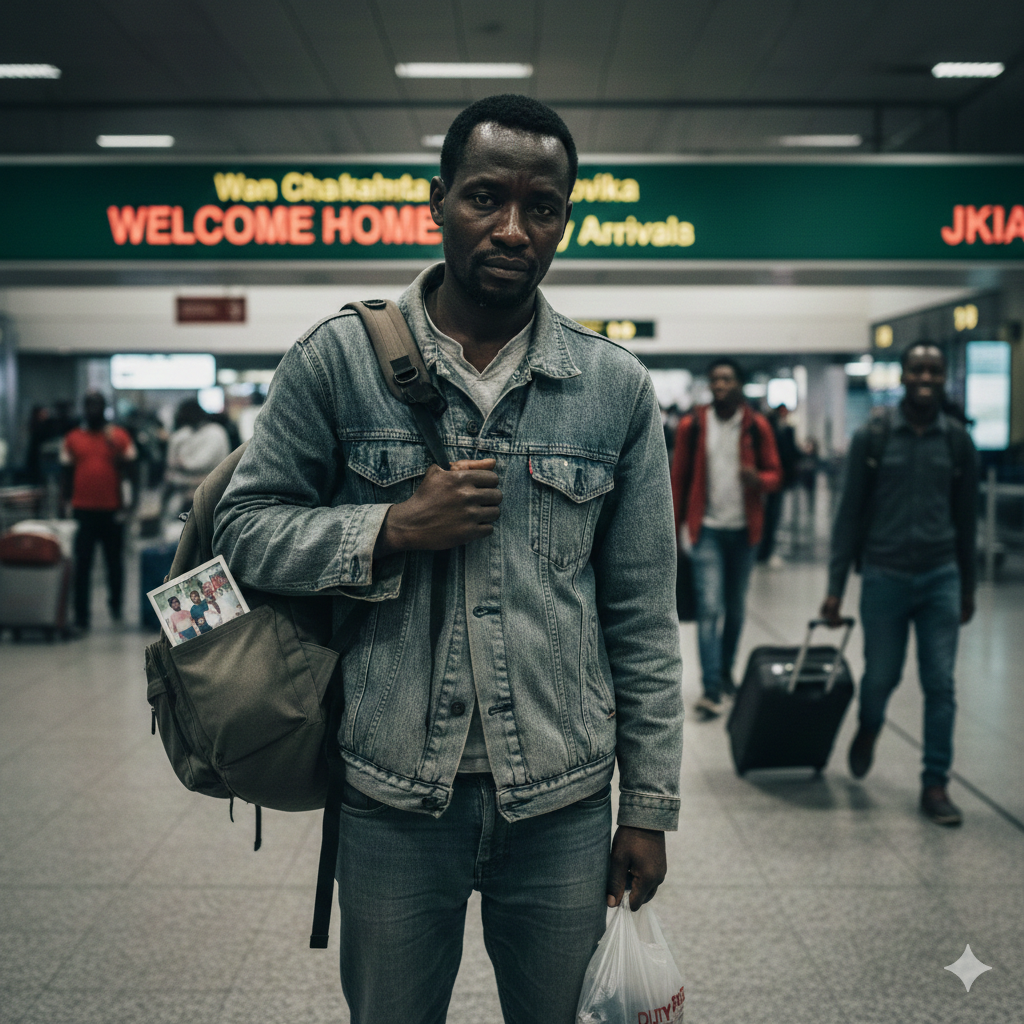
Expulsion from a foreign country is a sudden and brutal severing of a life
built on hope and sacrifice.
For thousands of Kenyans living and working abroad, the knock on the door,
the abrupt detention, and the forced repatriation are nightmares that shatter
not just individual lives but entire families and economic ecosystems back
home.
While global headlines often focus on the
geopolitical aspects of migration, the reality for a deported Kenyan is a
descent into a complex web of social stigma, economic paralysis, and emotional
trauma.
This feature examines the harsh journey of a Kenyan citizen stripped of
their diaspora life and thrust back into a home country that often feels
profoundly foreign.
The latest example comes from the United
States, where President Donald Trump’s administration is deporting 15 Kenyan
nationals labelled by his government as the “worst of the worst.”
The individuals were arrested by the U.S. Immigration and Customs
Enforcement (ICE), a federal agency under the Department of Homeland Security
(DHS).
According to DHS, the Kenyans—now branded as “criminal aliens”—have been
convicted of a variety of offences ranging from drink-driving to kidnapping.
“Under Secretary (Kristi) Noem's leadership,
the hardworking men and women of DHS and ICE are fulfilling President Trump’s
promise and carrying out mass deportations — starting with the worst of the
worst — including the illegal aliens you see here,” the department said in a
statement.
The list, released on December 10, shows
arrests conducted across several U.S. states. The Kenyans in detention were
picked up in coordinated raids in Colorado, Texas, California, Arizona,
Tennessee, Utah, Massachusetts, Washington, Georgia, Pennsylvania, and Minnesota.
Their alleged crimes include violent offences, domestic violence, fraud,
drug-related activity, aggravated assault, weapons charges, racketeering,
kidnapping, and other serious criminal conduct.
Deportation, a punitive and administrative act
by a host government, rarely follows a gentle timeline. Often, it is the
culmination of irregular immigration status—an expired visa, a failed asylum
claim, or, in many Gulf countries, an unresolved dispute with an employer.
In high-profile cases, deportations may be politically motivated or linked
to severe legal violations.
Kenyan diplomatic missions abroad offer consular support, but their capacity is often strained, especially in regions with high numbers of distressed migrant workers, such as the Middle East.
The Kenyan
Embassy in Doha, for instance, outlines its role as ensuring “a fair and speedy
trial” and humane treatment for detainees, but explicitly states, “the Embassy
does not provide any financial assistance or bond facilities for detained
Kenyans.” This lack of a safety net leaves many migrants painfully vulnerable.
The deportation process itself is often swift
and opaque. Kenyan immigration and security officials follow a structured
protocol when a Kenyan national is deported, according to government sources.
The procedure involves coordination between foreign authorities, the
Directorate of Immigration Services, and local security agencies to ensure
proper identification, security screening, and legal processing of returnees.
Deportation typically begins with formal
communication from the foreign government. Kenyan embassies abroad are notified
before the individual boards the return flight. Where the deportee lacks valid
travel documents, the Kenyan mission issues temporary permits to facilitate
travel.
Upon arrival—usually at Jomo Kenyatta
International Airport (JKIA)—the deportee is received by immigration officers
and, depending on the case, detectives from the Directorate of Criminal
Investigations (DCI) or the Anti-Terror Police Unit (ATPU).
Foreign escorting officers hand over documentation detailing the reasons for
deportation, including immigration violations or criminal allegations.
Authorities then conduct identity
verification, followed by an initial interview and security screening to assess
the circumstances leading to the removal. The next steps depend on the gravity
of the allegations.
Individuals deported for minor infractions such as overstaying visas are
typically released after routine processing. Those linked to criminal activity,
fraud, or security-related concerns undergo further interrogation and may be
detained if they are wanted in Kenya or if local investigations are pending.
Where no Kenyan charges exist, the individual
is cleared after screening, although authorities may monitor those flagged for
potential risks. Immigration records are updated to reflect the deportation,
and travel documents are examined for authenticity.
Once released, deportees are treated as
ordinary citizens unless local charges arise. Reintegration is handled privately
by families, with limited state involvement beyond security and immigration
compliance. Officials emphasise that deportation is an administrative process
rather than a punitive one—unless Kenyan law has been violated.
Despite existing diaspora services—such as the
Diaspora Investment Support Office (DISO)—direct, comprehensive reintegration
programmes for deported citizens remain critically insufficient.
The International Organization for Migration (IOM) advocates for “humane and
orderly migration,” but for involuntary returnees, the process is far from
orderly. Kenya lacks a structured national strategy to address the unique needs
of deportees, who require psychosocial support, job placement guidance, and
financial literacy training.
In the absence of robust reintegration
mechanisms, many fall through the cracks, relying on fragmented community and
family support systems that are often quickly exhausted.
The journey of a deported Kenyan is a
cautionary tale—a dark facet of global migration. It is a story of dashed
aspirations, legal vulnerability, and a crushing return to a country unprepared
for their landing. It underscores the urgent need for stronger foreign policy
to protect citizens abroad and domestic policy to support those whose dreams
have been violently revoked.
“My goal is to go back to Kenya and figure it out,” Samwel Kangethe, a
Kenyan man who chose to self-deport from the U.S. after years of legal limbo
following a disputed residency renewal, told a U.S.-based outlet.
“The family has lost that income. They only have one income now. Sam is
going back to Kenya, and it's going to be really complicated for the family to
live in Michigan.”
Beyond
financial hardship, deported individuals face psychological distress, social
stigma, and the trauma of a forced return. Many come home with nothing but the
clothes on their backs—and the heavy burden of dreams abruptly undone.