AS politicians begin earnest preparations for the 2027
general election, President William Ruto is quietly executing a calculated
strategy aimed at fracturing the United Opposition. It began with the bringing
to the fold of Kanu leader Gideon Moi last month.
Sources close to the President said that his focus has now
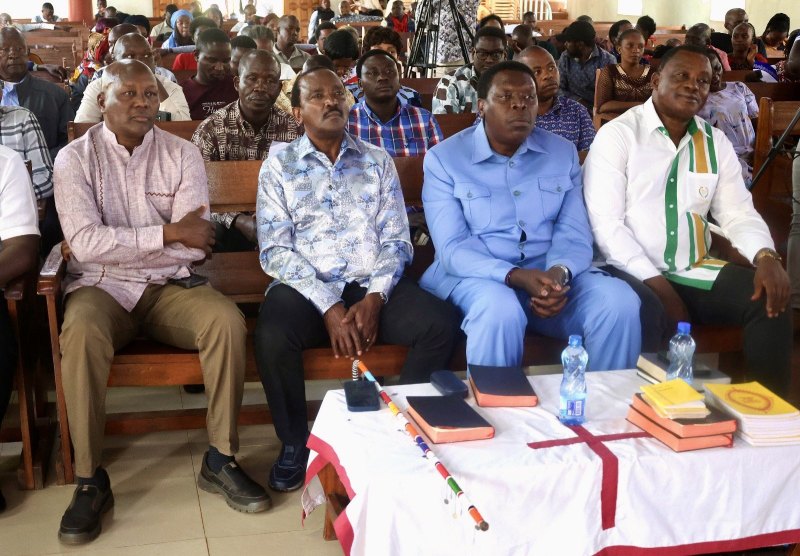
shifted towards former Defence Cabinet Secretary Eugene Wamalwa as he seeks to
isolate former Deputy President Rigathi Gachagua and capitalise on divisions
within the opposition.
Following the highly contested 2022 election, Kenya's
political land- scape remains highly fragmented.
The opposition, led by Wiper lead- er Kalonzo Musyoka and
Gachagua, Jubilee's Fred Matiangi, Eugene, Trans Nzoia Governor George
Natembeya, has been trying to consolidate power in anticipation of a robust
challenge against the Kenya Kwanza administration.
However, Ruto's strategic manoeuvres are designed to weaken
this unity, particularly by targeting Kalonzo and Eugene.
Despite several overtures from the President's emissaries,
Kalonzo has consistently rebuffed attempts to align with the government.
This rejection has prompted Ruto's strategists to pivot
their efforts towards Eugene, who is seen as a potential key player in galvanising
support from the Luhya community and Western.
The head of state already has two senior Luhya leaders in
Prime Cabinet Secretary Musalia Mudavadi and National Assembly Speaker Moses
Wetang'ula.
He has also been working with ODM leaders in the broad-based
government led by Cooperatives CS Wycliffe Oparanya
Ruto's team is reportedly planning to expand its coalition
by negotiating formal alliances with various parties, including ODM and
Eugene's Democratic Action Party (Kenya).
The rationale is clear: by bringing the former Defence CS
into the fold, Ruto can undermine Gachagua's in- fluence while simultaneously
consolidating power in Western.
Eugene's position has become increasingly precarious as he
grapples with the emergence of Natembeya, who has aligned himself with the
former DP.
According to sources, Gachagua has agreed not to run for
president, instead supporting a coalition led by Kalonzo with the Trans Nzoia
governor as his running mate and Matiang'i as Prime Minister.
This arrangement has left Eugene feeling sidelined,
particularly as he believes he should secure a prominent role, possibly even
the deputy presidency, in any opposition coalition.
His discomfort with the evolving dynamics has provided
impetus for Ruto's strategists to intensify their outreach.
They aim to present Eugene with the opportunity to play a
pivotal role in the Kenya Kwanza coalition, which they argue could be more
beneficial than remaining in a fragmented op- position.
Ruto has publicly declared his in- tent to win the next
election decisively, claiming that the only formidable opponent was Raila
Odinga, high- lighting his confidence in the current political landscape.
The President's strategy also includes fostering local
candidates- popular governors, parliamentary aspirants and MCAS to run under
parties associated with him.
This approach is particularly targeted at Central and
Eastern, where Ruto's team aims to secure at least. 30 per cent of the vote.
Sources indicate that candidates who agree to support Ruto's
coalition will have their campaign costs covered, further incentivising
defections from the opposition.
INSTANT ANALYSIS
As the political landscape continues to evolve, both Ruto
and the opposition will need to adapt their strategies to address the
challenges ahead. The question remains: will Ruto's tactics succeed in
fracturing the opposition, or will a united front emerge to challenge his
administration? Only time will tell as Kenya approaches another critical moment
in its political history.