Plans to hire 10,000 new police officers next month have
been thrown into jeopardy following a deepening rift between the National
Police Service and its oversight agency, the National Police Service
Commission.
The latest impasse revolves around a decision by NPSC to
gazette the controversial regulations, which have sparked outrage among police
leadership and key parliamentary agencies, casting doubt on whether the
recruitment will proceed as scheduled.
The controversy stems from the NPSC’s unilateral move to
send for gazettement the Recruitment and Appointments Regulations 2025. The
regulations hand full control of the recruitment process to the commission,
enabling it to run the entire exercise via an online platform—contradicting
earlier agreements reached with the police leadership, who had opposed an
online-only approach.
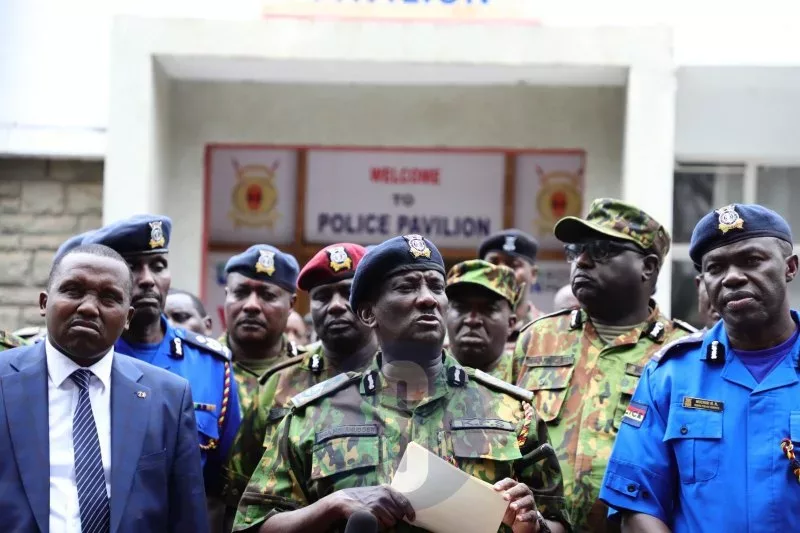
Inspector General of Police Douglas Kanja, who leads the
NPS, has strongly opposed the move, citing legal and logistical concerns.
He said the decision disregards previous understandings and
fails to consider the limitations of internet access in remote and marginalised
regions.
“This action is premature and illegal,” Kanja said during an
event in Garissa county.
“You cannot bypass Parliament and public participation when
implementing such crucial regulations. Something is clearly wrong at the NPSC.”
The regulations were forwarded to the Government Printer
early Wednesday morning and published in Gazette Notice No 159, expected to be
made public today.
This came despite recent rejection of the same draft
regulations by the National Assembly’s Committee on Delegated Legislation,
chaired by Ainabkoi MP Samuel Chepkonga.
The committee had flagged several problematic clauses,
including a provision that used poverty levels and marginalisation indices as
factors in determining recruitment eligibility. Lawmakers feared that this
could introduce bias and reduce transparency in the selection process.
In addition to demanding revisions to these criteria, MPs
also called for clear and equitable distribution of recruitment quotas across
all constituencies and safeguards to ensure accountability throughout the
process.
Had the regulations been accepted, the commission would also
have gained financial control of the recruitment exercise, including access to
Sh2.9 billion currently held by the NPS. That handover is now in limbo.
NPSC chief executive officer Peter Leley offered only a
brief statement, insisting that all necessary consultations had taken place
during the formulation of the new rules. However, this account has been
disputed by multiple parties.
In fact, several parliamentary committees—including the
Committee on Administration and National Security, led by Gabriel Tongoyo, and
the Committee on Implementation and Oversight of the Constitution, chaired by
Njoroge Baiya—have since intervened, urging the NPSC to halt the rollout of the
online system and revert to a more balanced approach.
Lawmakers have also expressed concern over the commission's
attempt to centralise powers previously shared with the police hierarchy and
independent oversight agencies.
Under the new framework, the NPSC would be both executor and
arbitrator of recruitment disputes—raising red flags about checks and balances.
The latest escalation has triggered accusations from the
Inspector General’s office, with senior police officials alleging that NPSC
chairperson Yuda Komora deliberately undermined earlier mediation efforts by
forcing the regulations through without consensus.
Sources privy to behind-the-scenes negotiations say that
during a Wednesday night session of a 15-member technical working
group—comprising representatives from the NPSC and NPS—police delegates were
shocked to learn that the regulations had already been submitted to the
printer. In protest, the NPS team walked out, accusing the commission of bad
faith and backtracking on previous agreements.
This development came barely a week after a high-level
reconciliation meeting chaired by Chief of Staff Felix Koskei. The meeting,
also attended by Interior CS Kipchumba Murkomen and top officials from both
sides, had temporarily diffused tensions, with both parties agreeing to suspend
the contentious online model and work towards a mutually agreeable solution.
An earlier mediation session spearheaded by MP Chepkonga had
led to the creation of the technical working group, co-chaired by CEO Leley, to
revise the draft regulations.
During those sessions, it had been agreed that the
online-only system would be dropped in favour of a hybrid approach, and that
the NPS would retain control of the recruitment funds.
Following that understanding, the NPSC even advertised the
upcoming recruitment drive, instructing candidates to download application
forms online and report physically to designated venues. This marked a
departure from the original plan, which had proposed a fully digital
system—from application to screening.
Yet, despite these developments, the commission now appears
to have reverted to its original position—gazetting the same unamended
regulations that sparked the standoff in the first place. This move has not
only reignited tensions but also cast serious doubt on the commission’s
commitment to negotiated resolutions.
The conflict exposes a deeper institutional rivalry between
the operational command of the police service and its civilian overseers. At
its core, the struggle centres on control over personnel decisions—a critical
element of broader police reform initiatives.
Observers warn that unless a compromise is reached soon, the
standoff could paralyse the recruitment process entirely and undermine ongoing
efforts to build public confidence in law enforcement institutions.
“This goes beyond recruitment,” political analyst Judith
Amimo said.
“It speaks to a growing crisis in how public institutions
share power and resolve conflict. The public ultimately pays the price.”
With just days to go before the recruitment was scheduled to
begin, uncertainty looms large. Whether or not 10,000 new officers will join
the force this year now depends on whether the two warring institutions can
find a way back to the negotiation table—and stay there.