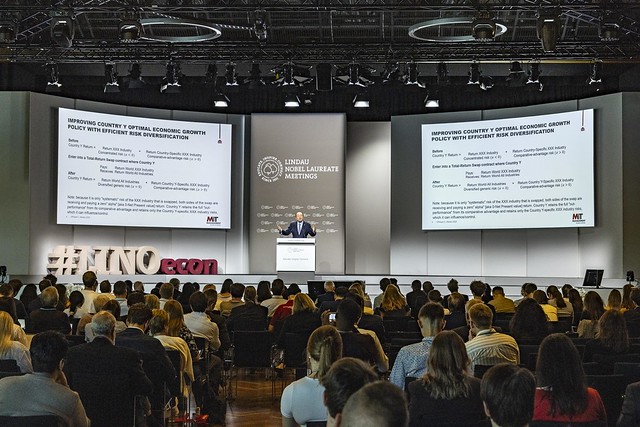
 Young scientists follow proceedings during Nobel Prize-winning economist Simon H. Johnson’s presentation at the 8th Lindau Nobel Meeting on Economic Sciences in Lindau, Germany, on August 28, 2025
As artificial intelligence (AI) continues to move rapidly into workplaces and economies across the world, a pressing question remains: will the technology bring inclusive growth, or will it deepen inequality by pushing workers out of jobs?
Economists warn that AI is set to
disrupt labour markets on a scale not witnessed since the Industrial
Revolution, with consequences that will reverberate far beyond the economy.
At the 8th Lindau Nobel Meeting on Economic Sciences in Germany, Nobel
Prize-winning economist Simon H. Johnson issued a cautionary note.
He argued that AI is likely to accelerate skill-biased technological change,
pushing labour markets into deeper polarisation.
White-collar jobs, he noted, are already among the most vulnerable. Johnson,
who shared the 2024 Nobel Memorial Prize in Economic Sciences with Daron
Acemoglu and James Robinson, reminded his audience that technology has never
been neutral.
In his words, technology is always a choice, shaped by decisions on how it
is developed, who gets access to it, and what kinds of jobs emerge from it.
The stakes, according to new reports, are immense. The World Economic
Forum’s Future of Jobs Report 2025 shows that 40 percent of employers
expect to cut clerical and administrative roles as a direct result of
automation.
The International Labour Organisation’s Generative AI and Jobs Report
2025 echoes these concerns, pointing out that one in four jobs globally is
directly exposed to AI.
The risks are highest in advanced
economies and particularly for women, who make up the majority of clerical
workers.
Still, AI is not only about job losses. The World Economic Forum projects a
net gain of 78 million jobs by 2030 as new industries take root and new types
of work emerge.
Similarly, PwC’s Global AI Jobs Barometer 2025 highlights that workers with AI skills are already earning a 56 percent wage premium, and sectors that adopt AI show productivity growth three times higher than those in traditional industries.
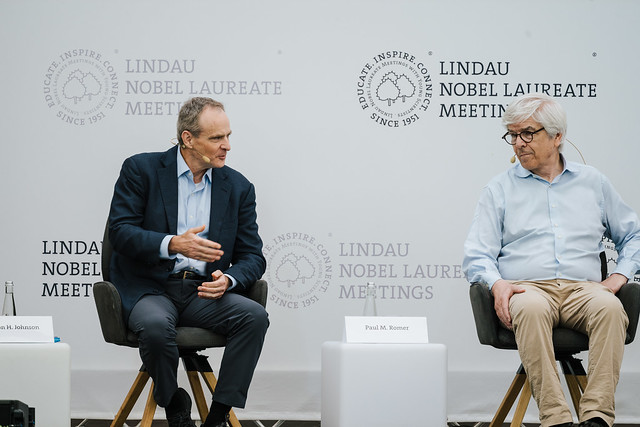
Johnson, however, warned that such benefits will not be evenly shared.
He pointed out that sixty per cent of the United States labour force does
not hold a college degree, leaving them especially vulnerable in this wave of
technological change.
The better-off, he observed, are positioned to thrive, while those with less
education will experience mounting pressure.
To him, the danger is not just economic but political. Rising inequality, he
argued, carries the risk of destabilising societies.
If AI deepens the patterns already visible from the last forty years of
digital transformation, then further polarisation and public anger will be
difficult to avoid.
The larger question, he said, is whether democracies will have the strength
to respond to these challenges or whether widening inequality will weaken them
further.
His warnings carried echoes of the last digital revolution, which rewarded
high-skilled workers but left many others behind.
Without checks, he cautioned, AI could easily become a new driver of social
unrest.
For Johnson, the central issue is not whether AI will advance productivity
and science, it certainly will, but whether those gains will reach the people
who need them most.
He called on governments and industries to act deliberately in shaping the
future of AI.
In his view, AI policies must be designed to generate work opportunities for
people without college degrees. Investment in large-scale reskilling programmes
is essential if vulnerable workers are to stand a chance in the new job market.
Social safety nets must be strengthened to support those displaced by
automation, and fairness must extend beyond advanced economies to ensure that
AI also creates opportunities in the Global South.
Without such steps, Johnson warned, the deployment of AI by the tech
industry will only reinforce polarising trends, deepening inequality both
within and across nations.
In the end, his message was clear. Artificial intelligence is not destiny.
It is a choice, and societies must decide whether it becomes an engine of
shared prosperity or an accelerant of exclusion.