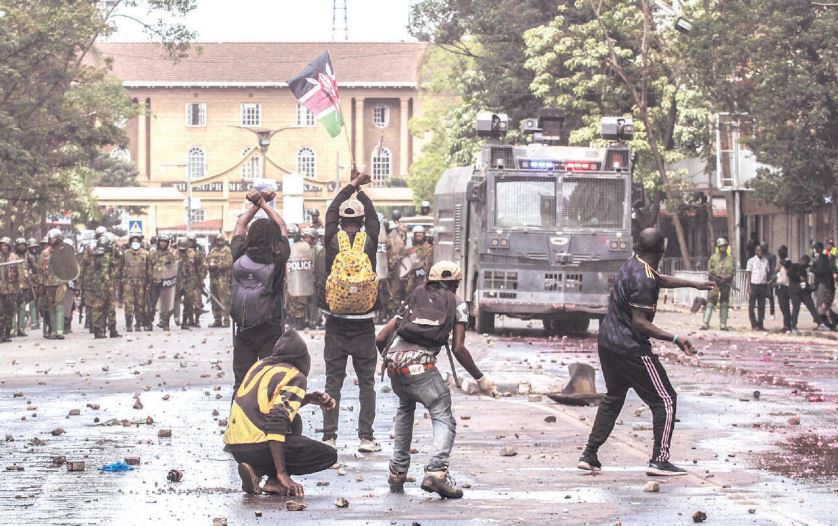
Kenya stands at a familiar and yet deeply unsettling crossroads. In the Kenya we live in today, the headlines are grimly familiar: graft scandals, arbitrary police killings, teachers on strike, jobless graduates, doctors pleading for basic tools, transport chaos, and a leadership class that often appears detached from the lives of ordinary citizens. The rot is deep.
Corruption no longer shocks us; it defines us. Misrule isn’t accidental — it’s a system. Injustice doesn’t slip through the cracks — it is designed into the very cracks.
However, now it is not just the rot, but also the slow and dangerous normalisation of it. We are no longer merely victims of the system — we risk becoming complicit through our silence.
And yet, even in the face of this despair, many Kenyans still dare to imagine. Imagine a Kenya where our hospitals have medicine and our doctors are paid on time.
Imagine a country where schoolchildren have desks and meals and their teachers have dignity. Imagine a Kenya where traffic is not a deathtrap, where public transport is safe, efficient and predictable.
Where tribalism no longer trumps merit, and where you don’t need connections to get ahead — just talent, hard work and integrity.
We imagine a Kenya where the police protect, not prey. Where our leaders serve, not loot. A Kenya where justice is blind — not just to wealth, tribe, or power, but truly blind in service to truth and fairness.
We imagine a Kenya where public service is sacred, borne of duty and not a stepping stone to self-aggrandisement.
We imagine a country where our youth are not statistics of joblessness, but vibrant agents of change. Where women and youth lead, not as tokens, but as equals.
Where, our constitution isn’t a document to be manipulated, but a living covenant with the people. This imagined Kenya is not utopia, it is the unfinished promise of our Constitution.
However, change will not come from boardrooms or political podiums. It must and will come from us — ordinary citizens who refuse to be ruled through fear, fatigue, or ignorance. The new Kenya must rise from the ground up. This is where the role of civic actors and transformative media becomes crucial.
As an organisation committed to reimagining media as a tool for development, civic awakening, and participatory democracy, Development Through Media (DTM) has spent the last two decades amplifying citizen voices — especially those often excluded from the national conversation: the youth, women, grassroots leaders, the informal sector. DTM believes in media not just as a mirror to reflect what is, but as a hammer to shape what ought to be.
Through storytelling, civic education, participatory radio and grassroots capacity building, DTM is working to dismantle the old narrative of helplessness and replace it with a new one — of agency, of action, of hope. DTM is not here to watch history unfold; it is here to shape it.
Imagine what happens when youth-led digital campaigns go beyond hashtags to actual votes cast, bills passed, or budgets scrutinised. Imagine when boda boda riders use radio to discuss local policies. When a rural woman organises her village to push back against illegal land grabs. That is the Kenya we are helping build.
So, what must we all do to live in the Kenya we imagine? First, we must reclaim our citizenship. Democracy is not just about voting every five years.
It’s about asking questions, demanding answers, organising around issues, and showing up — at town halls, in public forums, on social media, and in the streets when necessary.
Second, we must stop electing leaders based on tribe, tokens, or theatrics. The stakes are too high for that. We need to demand competence, integrity, and accountability — not promises.
Third, we must support institutions that serve the public interest and resist attempts to weaken them. When the Judiciary is under threat, when Parliament is compromised, when the Auditor General is ignored, we must speak up.
Fourth, we must invest in civic education and knowledge dissemination. An uninformed citizenry is easy to manipulate. That’s why the work of independent media, public interest journalism, and civic actors like DTM is so essential.
Finally, we must raise a generation that refuses to inherit our cynicism. Our children must be taught not just to dream of a better Kenya, but to build it — armed with values, empathy, and courage.
The Kenya we imagine will not be handed to us in a ballot box or tucked inside a donor-funded project. It will emerge from relentless action, principled resistance, and patient organising. History shows us that change is always slow — until it isn’t. The Kenya we imagine is not a fantasy. It is a duty.
Edwin Wanjawa teaches Globalisation and International Development at Pwani University and is a Programmes Associate at DTM, a Media CSO [email protected]