The electricity bill, Kenya Power says, is determined by the electricity usage and
other charges that include tax and levies, which the firm collects on behalf
of the Government Agencies.
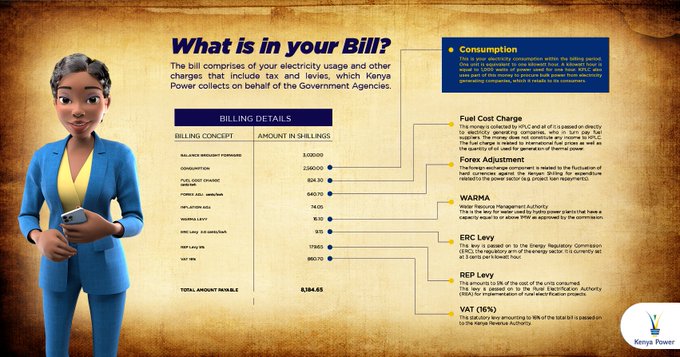
"The bill comprises Kenya power charges, which are the
electricity consumption within the billing period. One unit is equivalent to
one kilowatt hour. A kilowatt hour is
equal to 1,000 watts of power used for one hour," the firm said.
KPLC said it uses part
of this money to procure bulk power from electricity-generating companies,
which it retails to its consumers.
The bill, according to the utility firm, also contains taxes and third-party levies, which include
fuel cost charges.
Kenya Power says the money is collected by KPLC and passed on
directly to electricity-generating companies, who, in turn, pay fuel suppliers.
However, the company says the money does not constitute any income to KPLC.
The fuel charge is related to international fuel prices as
well as the quantity of oil used for the generation of thermal power.
In the taxes and third-party levies, there is also a forex
adjustment, which is the foreign exchange component related to the fluctuation
of hard currencies against the Kenyan Shilling for expenditure related to the
power sector (e.g., project loan repayments).
There is also a levy that goes to the Water
Resource Management Authority (WARMA), which caters for the water used by hydro
power plants that have a capacity equal to or above 1MW as approved by the
commission.
In addition, Kenya Power says there is the Energy Regulatory Commission (ERC)
levy that goes to the regulatory arm of the energy sector.
The levy is currently set at 3 cents per kilowatt hour.
The Rural Electrification Authority (REA) levy is also paid for the implementation of rural electrification projects.
The amount paid is 5% of the cost of the units consumed.
The last levy is a statutory levy, Value Added Tax (VAT), which amounts to 16% of the total bill, is passed on to the Kenya Revenue
Authority.
All those are the determinants of the amount that a user will
pay as the final electricity bill.



![[PHOTOS] Raila Odinga Stadium construction enters home stretch](https://cdn.radioafrica.digital/image/2026/06/45f6990c-4882-4cd2-b83c-8fc730dcdce5.jpg)