The Independent Electoral and Boundaries Commission is probably the most notoriously discredited institution in this country.
Well, to be fair, they most likely share that dubious distinction with the traffic police department. But the traffic cops have never brought the country to the precipice like the IEBC does every five years.
Besides, traffic police easily lose their stone-faced impunity promptly, whenever EACC detectives pop up in sting operations; something you can hardly say about IEBC commissioners and officials.
Because of this reputation, nearly every Kenyan holds his breath whenever new IEBC commissioners and chairman are to be appointed.
The collective anxiety is borne out of a perennial desire to finally have election officials who can deliver one credible election to redeem the country from its overriding image as one where corruption, gerrymandering and plain old theft have become a five-year cycle around the polls. You really can’t blame Kenyans for hoping, but things never go according to the script.
As soon as President William Ruto nominated one Erastus Ethekon as the next IEBC chairman on May 8, there was a near-collective quip across Kenya, with the question “who in providence’s name is that?”
In a country where surnames and tribes matter a lot, we rushed to Google to find out who this man was, which community he came from and whether or not that community was considered adversarial to ours.
Believe it or not, these things matter that much to us in Kenya. Let’s admit from the onset; we are very poor at finding things that promote our nationhood. Again, it is difficult to blame a populace that has had to watch over six decades of independence go to waste because of poor leadership and unmet expectations.
Quite predictably therefore, the unveiling of the next IEBC, rather than being a moment of relief after months of paralysis at the electoral agency, provided the avenue for a sharp background check on each nominee.
Often, this begins from the very simple; where do they come from? Then progresses to the mundane; who do they associate with under cover of darkness in places not many go to? Then of course, it all ends with the intriguing; who is their godfather in Kenyan politics?
No one does intelligence gathering and CSI checks (criminal record checks) like Kenyans trying to establish the backgrounds of newly appointed public servants. By the time they are done, I am certain many nominees wish they had stuck to their private lives or smaller jobs.
The IEBC chairmanship is a difficult job. The holder basically signs up to be a national hate figure. So much so that when former holders of the office, Samuel Kivuitu and Wafula Chebukati, passed on, many Kenyans made horrific comments and caricatures of the two. It is therefore shocking that there are people who still seek to be holders of the office, because some of the graphic images and comments made of the holders would drive one into depression.
To compound this already difficult position, appointment to chair has always been a complicated venture, where the unwritten rule is that a member of one of the big feuding political tribes (the Kikuyu, Luo and Kalenjin) cannot hold the office, without causing discomfort in high political places.
As a result, the IEBC chairman’s post has become the most powerful DEI hire appointment – diversity, equity and inclusion – given to someone from a tribe that is not problematic, but with every politician, including washed-out, recycled ones, hoping that this man (there has never been a woman) will announce them winner.
Because of all this horse-trading and push-and-pull among competing interests, the IEBC often ends up with a weak leader.
There was a time, of course, especially following the 2002 elections – when it was still the Electoral Commission of Kenya (ECK) – when one could have said that it delivered a credible election and had a principled leader in the form of Kivuitu.
But two things may negate this belief; one being that insiders have always opined that the man who played a key role in making 2002 such a resounding success was in fact Commissioner Gabriel Mukele and not Kivuitu as such.
And two, the resounding victory borne out of a united, multi-tribal vote for Mwai Kibaki, made election theft difficult. This is important in analysing the latter part of this conversation. Because every election since 2002 has been considered a close one, which essentially has always opened the door to alleged malpractices at the ballot.
But the nature of the anti-Kanu anger in 2002, which united the nation so mightily, created the platform on which regardless of who would have been chairman or commissioner at ECK, victory was ultimately pushed by the masses.
We are back to that season again. With a new IEBC about to be unveiled, the old question of who among the commissioners or chairman has ties with the regime; be they business or family ties.
My free advice to all who intend to run against Ruto in 2027 is that 2002 provides the ideal case study for them; one in which all opposition candidates caged their egos, rallied around one of them and delivered such a devastating blow that the incumbent’s preferred candidate had no option but to call a presser to concede defeat. In this scenario, the IEBC itself would have little wiggle room, even if it had amongst its officials people hellbent on overturning the will of the people.
If anything, the 2022 election fallout showed that the powers vested in the chairman are so much, that a majority of four commissioners differed with him, yet the chair still prevailed. Vice chair Juliana Cherera and commissioners Francis Wanderi, Irene Masit and Justus Nyang’aya, disagreed with Chebukati’s handling of the polls, but were unable to prevail.
Essentially therefore, even the desire to have specific people as commissioners, as a counter-balance to either the chairman or any attempts to interfere with the elections, doesn't work.
Between now and the 2027 elections, every action and word by the new IEBC officials will be deeply scrutinised for intention and motive. There are several byelections on the way, from which a gradual profile of each will be built, with an eye on the main one. But I submit that those who will seek to gauge these new commissioners and their chairman actually need to look elsewhere.
Either unite and diminish the possibility of a close election, thereby tying the hands of the IEBC as far as a free and fair election is concerned, or run too many competing presidential candidates, scattering yourselves to the four winds and giving the incumbent a great opportunity for a second term.
It is my contention that in a country where trust in institutions is lacking, only passionate people movements ever overcome huge adversity. As of now, tribal delegations are already lining up their sons (still no woman) as the preferred candidate for 2027.
Of course, no one will tell them that for Ruto, the more the merrier. Until that obligatory press conference to reject the results. But if there is even a remote chance that Ruto’s opponents will come together and rally behind one of them, the IEBC will be the least of their worries, regardless of the DEI hire system deployed in picking its top officials.

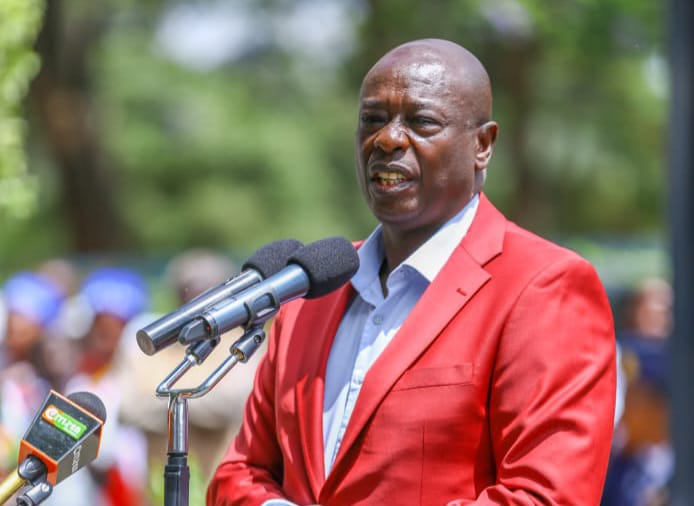
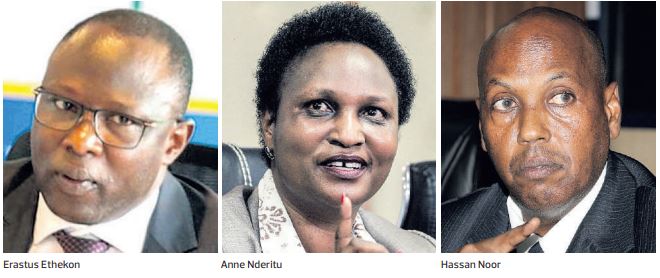 Some of the IEBC commission nominees








![[PHOTOS] Ruto pushes for stronger Kenya-EU economic ties in Brussels](https://cdn.radioafrica.digital/image/2026/06/3aebc395-285b-441c-8aa4-33cb538f8d44.jpg)