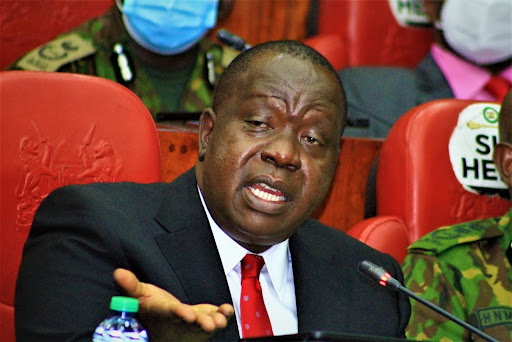
A seasoned academician, governance expert, and former Cabinet
Secretary, Matiang’i has served in some of the country's most critical
government positions.
Today, he is among the most preferred candidates for Kenya’s
2027 presidential election, a testament to his reputation as a no-nonsense
reformer and loyal public servant.
The former CS has teamed up with the big guns in the
opposition, including former Deputy President Rigathi Gachagua and Wiper leader
Kalonzo Musyoka, in plans to unseat President William Ruto in 2027.
On April 29, Matiang’i held a meeting with Gachagua, Kalonzo
and People’s Liberation Party boss Martha Karua as part of their initial
strategy meeting to lay the ground for the next general election.
This was Matiang'i's first-ever public meeting with
Gachagua's camp, ending speculations about his political allegiance ahead of
2027.
Since his return from the United States on April 18, Matiang’i
has held closed-door meetings with key regional and national leaders, with a
meet-the-people tour planned for Kisii on May 2.
But who is Fred Matiang’i?
Upon his completion of O-level education at Kiabonyoru Mixed
Secondary School in 1984, Matiang’i joined Kisii School for his A-levels.
As the last group of the 7-4-2-3 education system, Matiang’i
would qualify for Kenyatta University for a Bachelor of Education degree. He was
later employed as a secondary school teacher in Nyamira.
Upon his completion of a Master’s Degree in English from the
University of Nairobi, Matiang’i joined Egerton University as a lecturer. He also
taught at the University of Nairobi.
Matiang’i holds a PhD in communication and comparative literature
from the University of Nairobi.
Before his foray into government, he had built a solid
academic and professional career. With a Ph.D. in communication and comparative
literature from the University of Nairobi, he taught at Egerton University and
the University of Nairobi.
He also served as Eastern Africa regional representative for
the Centre for International Development, Rockefeller College of Public Affairs
and Policy, State University of New York, where he was also the Kenya
Parliamentary Support Programme director.
Matiang’i first made his entry into the Cabinet on April 23,
2013, when he was appointed Cabinet Secretary for Information, Communication
and Technology.
Then President Uhuru Kenyatta was keen on accelerating the
digital transformation kick-started by his predecessor, Mwai Kibaki.
Uhuru and Matiang’i are said to have first met and developed
some rapport when Uhuru was then the leader of the Opposition.
Matiang’i was by then in charge of the Kenya Parliamentary
Support Programme (KPSP), which was financing the parliamentary broadcasting
service and digitising the proceedings.
Their friendship blossomed when Uhuru Kenyatta was the
Deputy Prime Minister in the coalition Government.
Unlike most cabinet appointees, the former literature
lecturer at the University of Nairobi and Egerton University had not held prior
roles in elective politics or the public service when picked as CS in 2013.
This quickly worked to his advantage.
He had no prior baggage, constituents to please or political
ambitions to protect, allowing him to give his undivided attention to the task
at hand.
He was to oversee Kenya’s switch from analogue to digital
broadcasting and help newly elected President Uhuru to start fulfilling his
election pledges and the newly acquired political mandate.
In his now signature fashion, Matiang’i was able to
successfully deliver on key components of this critical process despite the
difficult circumstances.
This made him a key contributor to the digital dividends, with those now reaping the most having been the biggest
digital migration detractors.
While his government career is defined by quick, bold action
and policy shakeups, Matiang’i is a man admired and envied in equal measure,
depending on which side of the political spectrum one holds.
For some, Matiang’i is a trusted advisor and industrious
lieutenant who not only streamlined service delivery in government but also
spearheaded transformative reforms.
The radical gains were in key sectors such as ICT, Lands,
Education, Regional Administration, Immigration Services, Internal Security,
and lately, coordination of the government’s development agenda.
To others, Matiang’i is a feared operator who has dismantled
cartels and brought to bear the full might of the government on the fight
against inefficiency, ineffectiveness, service lethargy, crime and corruption.
For all the diverging views on Dr. Matiang’i, the common
link is that he is unanimously viewed as the single most defining figure in former
President Uhuru Kenyatta’s 10-year administration.
Matiang’i’s accomplishments at the ICT Ministry quickly
caught the eye of the President, who roped him in as acting CS for Lands in
2015 after the exit of Charity Ngilu.
This was one of the earliest signs that the overarching CS was quickly transitioning into the President’s “Dr. Fix it”
mode, a somewhat first among equals in the cabinet.
CS Matiang’i’s tenure at the Lands and Physical Planning
Ministry was as brief as it was equally eventful.
He immediately decimated
notorious cartels that had entrenched themselves at Ardhi House and set in
motion a slew of reforms.
He also ended the power tiffs often pitting the Lands
Ministry against the National Land Commission, ending in stabilising the Lands
ship that impacts so much of personal and corporate business activities.
In December 2015, Matiang’i was appointed Cabinet Secretary
for Education, Science and Technology, just as the education sector grappled
with rampant exam leakages.
Within months, he restructured the Kenya National
Examinations Council (KNEC), revamped security around exam materials, and
imposed stringent timelines that saw national exam results released within a
month—a radical improvement.
However, Matiang’i’s swift reforms did not come without
friction. His hardline approach led to strained relations with teachers’ unions
such as KNUT and KUPPET.
This was especially following the poor performance of
students in the 2016 Kenya Certificate of Secondary Education (KCSE) results—a
result many attributed to the strict anti-cheating policies he championed.
After the death of Interior Cabinet Secretary Joseph Ole
Nkaissery in July 2017, President Uhuru Kenyatta tapped Matiang’i to act as
Interior CS, while still retaining his education docket.
In January 2018, he was confirmed as the full Interior
Cabinet Secretary, reinforcing his image as the president’s go-to
problem-solver.
In January 2019, Kenyatta elevated him further, naming him
Chairperson of the National Development Implementation and Communication
Cabinet Committee through Executive Order No. 1.
The appointment made Matiang’i a de facto “Super Minister,”
coordinating all government departments and overseeing national development
programs.
His elevation did not sit well with President William Ruto (then
deputy president) amid claims that he had assumed most of his roles, including the commissioning
and launching of development projects.
A widely held view was that Kenyatta had elevated Matiang’i
to the position of a prime minister, and that the arrangement supplanted Ruto,
much of whose roles Matiang’i took over.
Because this is new territory for the country, it is
difficult to be definitive about this assessment, and only time will tell
whether it is correct.
A strong personality, Matiang’i cultivated a high profile
since he came to office as a cabinet secretary, receiving public acclaim and public
admiration.
His tenure at the Interior Ministry saw him navigate
sensitive and sometimes controversial matters.
Notably, in January 2018, following the symbolic
“swearing-in” of opposition leader Raila Odinga as the “People’s President,”
the Ministry oversaw the shutdown of major media houses, drawing sharp
criticism locally and abroad.
Matiang’i defended the action, citing national security and
the potential for mass unrest.
Matiang’i’s interactions with the opposition have often been
contentious.
During the 2017 election protests, his ministry clamped down
on opposition demonstrations, and later, in 2018, he gazetted the National
Resistance Movement—an arm of the opposition—as a criminal organisation.
The move led to high-profile arrests and public scrutiny.
Despite his detractors, Matiang’i is praised for his
efficiency, policy rigour, and unflinching stance on governance.
His ability to implement reforms across multiple
ministries—from ICT to Education, Lands, and Interior— earned him a
reputation as a “fixer” and an effective administrator.
Married with two children, Matiang’i maintains a relatively
low personal profile. He is fluent in Swahili and English, with working
knowledge of French.
He has previously worked with organisations such as USAID,
World Bank, and Transparency International, and has penned columns for the
Daily Nation.
Matiang’i aggressively campaigned for former Prime Minister
Raila Odinga ahead of the 2022 General Election.
Upon Raila’s defeat by President Ruto, Matiang’i moved to
the US, where he has been working for the World Bank.
He jetted back into the country on April 18 for a series of
engagements, but he is yet to publicly declare his 2027 presidential ambitions
amid growing speculations.
As 2027 approaches, political analysts see Matiang’i as a formidable contender given his track record.