At least six people were reported
dead in Nairobi last Monday after
heavy rains pounded the city, with informal settlements, or rather slums,
being the most affected.
In the city’s Mukuru Kwa Reuben
slums, one person died after being
swept away by floods, with more
than 500 residents being displaced
in the different slums across Nairobi.
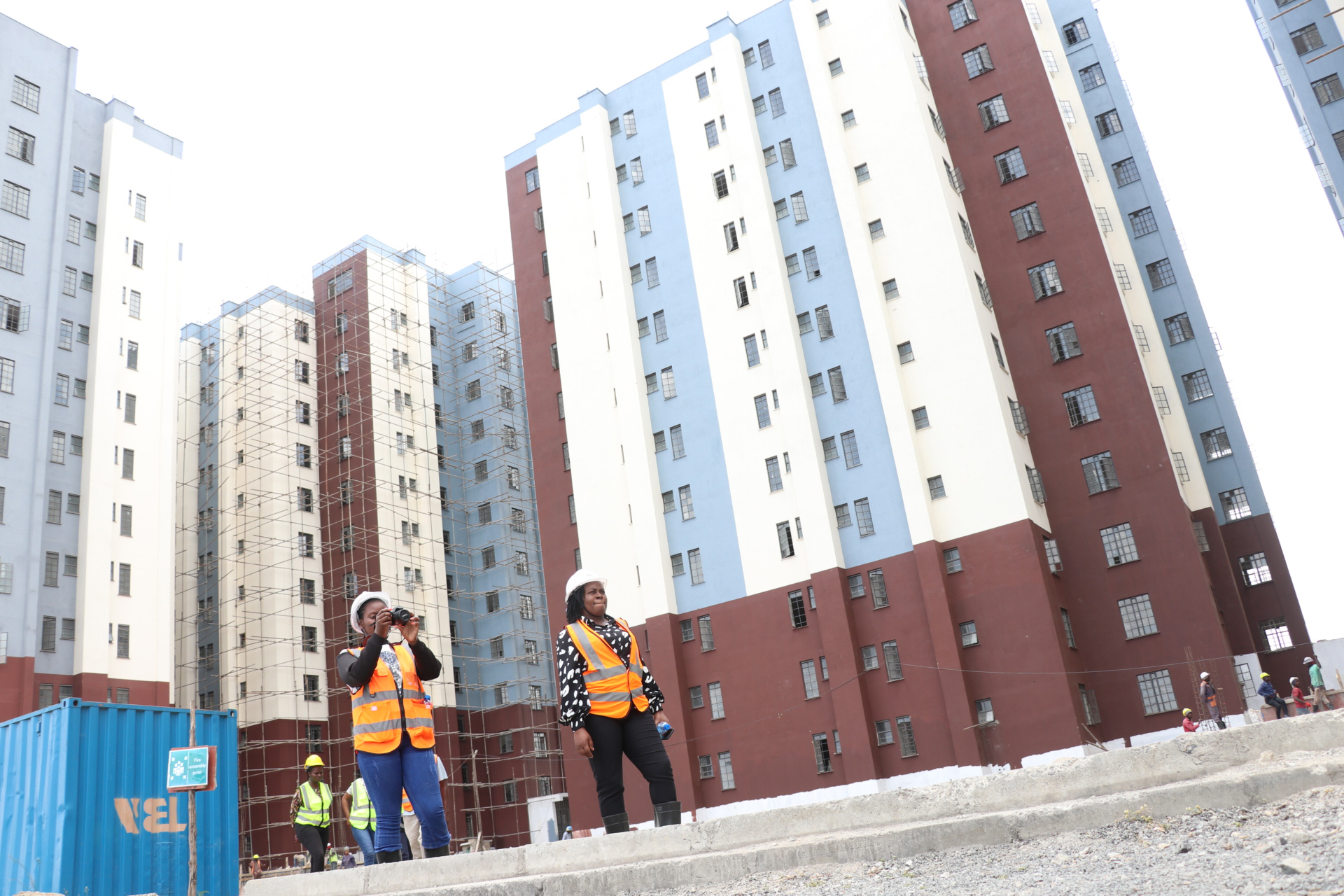
A short distance from the Mukuru
slums stands the Mukuru Affordable
Housing Project being developed
on a 56-acre parcel of land, initially
grabbed by private developers before
it was recovered by the Ethics and
Anti-Corruption Commission and
handed over to the government in
2020.
This is the biggest single housing
project being developed by the government, comprising 13,248 housing units made up of bedsitters (26
blocks of 5,616 units), 14 blocks of
one-bedroom units with 3,024 units
and 48 blocks of two-bedroom units
totaling 4,608.
“We are targeting mainly Mukuru
slum residents as we implement these
key projects that are aimed at replacing slums across the country with decent housing units for the population,” said Benjamin Njenga, secretary, Urban and Metropolitan Development at the State Department for
Housing and Urban Development.
It is part of the government’s affordable housing projects targeted
for the poor, low- and middle-income earners, with eradication of
slums across the country being at the
centre of the government’s housing
plan under social housing projects.
Other projects in Nairobi include
Shauri Moyo, Starehe and Soweto in
Kibra, with about 840,622 units in
the pipeline across different parts of
the country.
This initiative, however, faces a
constant threat where the targeted
population opts to rent out those
decent houses and build shanties for
themselves, defeating the whole purpose of the slum upgrading.
This is not, however, an issue that
started recently. History documents
such instances even as successive
governments commit to the affordable housing agenda.
Kenya’s affordable housing history includes initial attempts at a national housing policy in the 1960s,
followed by the National Housing
Corporation in 1965.
The hope for many of the city’s urban poor to own affordable houses
has, however, remained a pipe dream
over the years as these projects continue to be infiltrated by deep-pocketed individuals.
They end up snapping up units,
which they later rent out to the
middle class as the poor continue to
dwell in slums.
For instance, California estate in Nairobi’s Eastlands, or “Calif” as it is fondly known, was
built in the 1960s, targeted at the
poor in Majengo.
It was constructed after Tom
Mboya, the former independence
minister, lobbied the American government for decent housing for Africans who were living in mud and
brick houses in Pumwani, Majengo.
The project was opened in November 1967 by founding President
Jomo Kenyatta.
However, they ended up in the
hands of the rich after allottees sold
them.
The trend has continued to be replicated in similar projects over the
years, spanning the late President
Mwai Kibaki’s era, retired President
Uhuru Kenyatta, and now President
William Ruto.
The Sh3 billion Kibera People Settlement Development project (Kibaki flats)–a 900-housing project
targeted at upgrading families from
the slums, also ended up in the hands
of the rich.
“My uncle rented out his unit and
went back to the slum. Some people were bought out completely by
the rich. They have turned the units
into into rentals,” Mike Njenga,
alias “Rasta”, a resident of Kibera
Soweto, told the Star during a recent engagement at the Kibera Soweto
project, being developed by Ruto’s
administration.
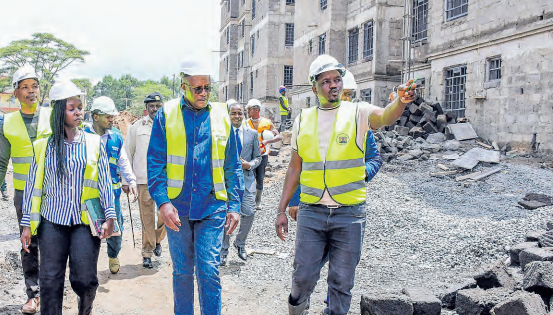
He is among the 286 local youths
employed at the project where the
government is putting up 4,005
units, comprising single rooms, double and three-roomed houses.
Njenga is among those who have
also been issued with a housing card
as the government seeks to ensure legitimate locals benefit from the programme.
He is saving for a one-room
self-contained house, which comes
with a deposit of Sh60,000 and a total price of Sh600,000.
If he secures
one, he goes into the rent-to-own
plan, which will run for 15 years.
However, he fears that he might
not get the house once completed
and could continue living in the corrugated tin-roofed house with a concrete fl oor in Kibera, where he pays
Sh700 as monthly rent.
“I am hoping there will be a lot of
transparency and the rich will not
come push us out with their money,”
Njenga said.
The National Housing Corporation boss, David Mathu said most
slum dwellers targeted in house upgrading programmes relocated back
to shanties, two years after being
handed decent houses.
“Those are social challenges that
do occur. In this particular project,
we have observed that most of them
rented the houses,’’ he told the Star.
Stingray Agutu, a manager at the
Park Road affordable housing project, shares the same thought.
“We have homeowners who, for
the love of money or something, have
chosen to rent out their house, irrespective of who rents it, because we
can tell there are houses within that
estate where 15 to 20 people are living in one house.”
President Ruto’s administration
has set an ambitious target of constructing at least 200,000 homes annually and one million units by 2027,
in its quest to address the housing
shortage in the country, where nearly 60 per cent of urban households
live in slums, according to the World
Bank.
There are approximately 2.5 million slum dwellers in about 200 settlements in the city, where the government owns all the land.
The government is developing the
projects backed by the housing fund
collected from a 1.5 per cent deduction from an employee’s gross salary
and a matching contribution from
their employer, making it three per
cent.
According to Lands and Housing
CS Alice Wahome, the deduction,
which is a tax, does not guarantee
one a home.
The government collects at least
Sh65 billion annually from taxpayers to drive the affordable housing
programme.
The kitty is being managed by the
Affordable Housing Board, which
receives applications, assesses them
and allocates houses through the
Boma Yangu platform.
CS Wahome has assured transparency in the allocation and that the
government will lock out speculative
buyers and buy-to-let investors preying on the housing units.
Once allocated, beneficiaries are
required to pay a deposit, depending on the size of the unit, then go
ahead to pay monthly instalments on
a rent-to-own basis.
For instance, a studio apartment
costing Sh640,000 requires a deposit
of Sh64,000, with a monthly payment rent (rent to own) of Sh3,900.
A one-bedroom unit under the social housing segment has a monthly
repayment of Sh5,350 after a 10 per
cent deposit on the Sh960,000 total
amount.
The affordable housing units have
been placed under three categories–
social housing, affordable housing
units and affordable middle-class
housing units, which fetch higher
prices, with buyers allowed for a
one-off payment if one has the whole
amount.
Wahome said her ministry will not
allow abuse of the process and that
the board has a final say, including
locking out those giving false information, even as she affirmed prudent
use of funds under the programme.
“Once applied, the board assesses the applicant before being allocated a
house, which they then pay a deposit
and go ahead to rent-to-own. There
is a criteria where the portal surveys
an individual, including their income
level. We evaluate individuals and
can decline allocations to individuals
considered wealthy or deep-pocketed who could be targeting the units
for renting out in the future,” the CS
said during a recent media briefing in
Nairobi.
According to the ministry, the
houses are being allocated on a ‘first
come, first served’ basis, with those
who have applied through the Boma
Yangu portal and selected the preferred houses being prioritised.