KANYADUDI: Implement the Nadco report in full to enhance political stability
Nadco was given mandate beyond the tax crisis of 2023
by OCHIENG' KANYADUDI
Audio By Vocalize
Kalonzo Musyoka and Kimani Ichung’wa hold the National Dialogue Committee report /FILE
Most studies conclude that
democratic breakdown
is more likely in
presidential than in
parliamentary regimes. One of the
most critical choices constitutional
drafters face is choosing
between presidentialism and
parliamentarism.
Research indicates
that this choice is an important
factor in democratic consolidation.
Presidentialism is said to have the
advantages of Executive stability,
greater democracy, and more limited
government, but the disadvantages
of executive-legislative deadlock,
temporal rigidity, and less inclusive,
‘winner-take-all’ government.
Parliamentarism, on the other hand,
has the opposite consequences.
An intermediate type, semipresidentialism, has both a prime
minister, dependent on the
confidence of the Parliament, and a
popularly elected president.
Semipresidentialism retains some of the
advantages of presidentialism while
showing the potential to diminish
some of presidentialism’s defects.
However, these basic types are not
based on incompatible principles
but rather on mixtures of elements,
such as separate survival of powers
or assembly sovereignty over
cabinets, that may be applied in
varying degrees to come up with
different regime constellations.
The Kenya Kwanza administration
got into political headwinds soon
after being sworn in. The economic
strain caused by the COVID-19
pandemic was weighing down
on government development
programmes.
The debt burden
was spiraling and becoming
unbearable as well as untenable. The
government turned to local resources
to generate the much-needed
funds for its ambitious projects.
This inadvertently led to new tax
proposals. The Finance Bill 2023
had intended to widen the tax base
and seal loopholes for tax evasion.
However, its implementation had
the counterproductive effect of
increasing the burden on citizens
and causing much more social
pain than the anticipated relief.
In
Parliament, the minority leadership
lost the argument, and the Bill sailed
through. The opposition leaders
thereafter responded by rallying the
public to civil disobedience.
They
mobilised the popular resistance
through the clarion call, “sufuria maandamano.". The protests turned
violent but became weekly and
relentless.
Through the intervention
of the diplomatic community and
the religious leaders, a truce was
arrived at and an uneasy calm
returned.
In the intervening period, the
opposition leader, Raila Odinga,
made several demands aimed
at reducing the tax burden. He
threatened resumption of protests
if these demands were not met.
The government, on the other hand
stuck to their ground.
President William Ruto insisted that the
process of revenue mobilisation is
parliamentary and only Parliament
had the mandate to settle the
dispute. He advised that the two
Houses of Parliament had capable
leadership to resolve the impasse.
He therefore proposed a bipartisan
approach to find a solution. The
opposition acceded to the proposal,
and a committee was established
comprising MPs and select
representatives of the main political
coalitions.
The National Dialogue Committee
(Nadco) was established via
Parliament and the membership
gazetted as required by law. The
committee was given mandate
beyond the tax crisis to include
issues of governance.
It took the
structure and strategy of the defunct
Building Bridges Initiative (BBI). It
turned out that the governance
agenda became the main plank
of the mandate of the committee.
The tax and economic burden
were identified as ancillary to the
governance structure system.
It is instructive to note that
ever since Kenya embraced the
presidential system in 1964, the
governance structure has been
somewhat unstable. On more than
one occasion, the country has
tottered on the brink of civil war.
The
worst was in 2007, when the postelection violence led to more than
1,000 deaths, as well as destruction
of property. Many more thousands
of citizens were displaced from
their homes and places of work on
account of ethnic profiling.
The international mediation,
led by Kofi Annan, led to the
establishment of the Grand
Coalition government of President
Mwai Kibaki and Prime Minister
Raila. However, it also brought into
force a new constitution in 2010
and a host of new governance and
oversight institutions.
The new constitution refined and entrenched
the presidential system modeled
on the US structure. It removed
the constitutional provisions in
the old laws that made room for
parliamentary practice.
Instead
of the opposition, it now had the
minority and majority instead of
the government side. In reality, the
constitutional provisions were not
consistent with the national political
psyche. The legislators continued
to conduct themselves as in the
Westminster parliamentary system.
The linear presidential system was
not responsive to the collegiality
of ethnic political coalitions. It
promoted exclusion more than
inclusivity.
The schism has been
palpable and a constant threat to
national stability. The system is
vertical and hierarchical. It does
not disperse power but concentrates
political authority in the presidency
instead.
It demands loyalty without
appreciating the tribal conclaves
that exist and commands absolute
obedience from their respective
kingpins.
Since the reintroduction
of multiparty democracy in 1991,
leading political figures have
mobilised voters and supporters
along ethnic lines.
Kenyan communities feel
recognised and included if a
member of their ethnic group is
strategically placed in the leadership
of a government agency or political
formation.
It is for this reason that
serious presidential candidates
seek to include in the ranks of their
respective political parties, key tribal
operatives. Every election since 2002
has been contested on the basis of
tribal alliances.
The main contenders would
woo and entice the leaders of
the second-tier tribes to their
camps with promises of strategic
positions and key development
projects. The resultant government is a de facto coalition yet de jure unitary presidential.
The internal
contradiction leads to tensions and
instability in government.
The BBI and Nadco processes
correctly identified this internal
contradiction and inconsistency
with the national political heritage
in their respective reports.
While the majority of the committee of experts,
led by senior counsel Nzamba
Kitonga, leaned towards the US
model of pure presidential system,
the ground sounded different.
Many ordinary Kenyans desire
a dispersed power arrangement
where key political players and every
community feel accommodated.
The historical experience with
the Westminster parliamentary
system is so engrained in the
political genetics of the people of
Kenya. Yet because they cannot
unitarily establish a monarchy for
statehood, the presidency is their
guarantor of statecraft.
The desire
is to create a blend of a presidential and parliamentary system.
However, designing that system
has proved a hard nut to crack for
both the political scientists and
political leaders as well as legal
practitioners.
If the three key players
in the political field of the country’s
leadership spectrum could solve this
jigsaw puzzle, then the country
would find its stable footing.
It may be interesting to find out
that it would work well if power
at each level of governance is
distributed to separate offices for
accountability and oversight.
At the
state level, the presidency would be
three-tiered, with the president having
a deputy and a vice. The deputy
would be the person to stand in
for the president and perform the
functions of the office in case of
incapacity or vacancy.
The deputy
would therefore be nominated by
the presidential candidate before
the election and endorsed at the
ballot by the voters.
On the other
hand, the vice shall be the principal
assistant to the president and act on
his behalf regarding the mission of
the office holder.
However, the hybrid systems
of France and Russia offer useful
lessons to pick from. France has
a semi-presidential system of
government, offering almost a
balanced power sharing between the
president and the prime minister.
The prime minister is the holder of
the second-highest office in France,
after the president of France. The
president, who appoints but cannot
dismiss the prime minister, can
request resignation.
The Executive consists of the
prime minister and ministers. The
prime minister is responsible to
Parliament.
The National Assembly,
which is the lower House of
Parliament, through a motion of
no confidence, can dissolve the
government, including the prime
minister. This ensures that a majority
in the lower House practically
always supports the prime minister.
This is premium content
Subscribe to Continue Reading
Help us continue bringing you unbiased news, in-depth investigations, and diverse perspectives. Your subscription keeps our mission alive and empowers us to provide high-quality, trustworthy journalism. Join us today to make a difference!

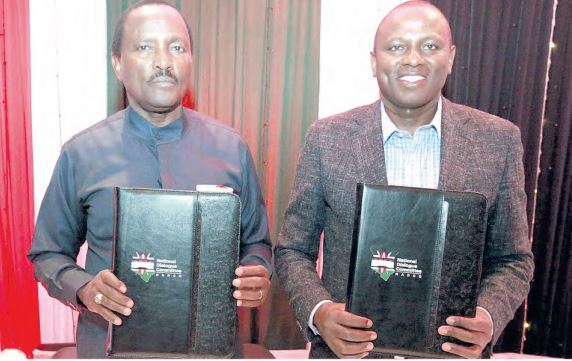 Kalonzo Musyoka and Kimani Ichung’wa hold the National Dialogue Committee report /FILE