In some instances, the Auditor General has revealed, Treasury did not release budgeted money to some agencies, triggering a major crisis.
The revelations come at a time pending bills have been skyrocketing in government, leaving suppliers in financial distress.
In the last financial year, at least 10 per cent of the Sh3.6 trillion budget was not funded .
This is despite the fact that projects had been lined up to take up the cash.
Details show that only Sh3.24 trillion was issued to MDAs, the Consolidated Fund and counties.
This means the entities did not receive Sh377 billion.
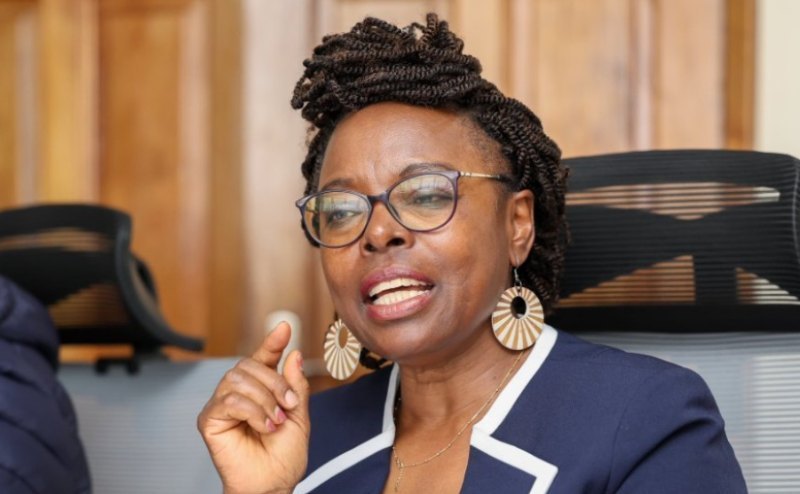
In a brief to Parliament, Auditor General Nancy Gathungu said the trend did not start yesterday.
The 2018-19 budget, for instance, was not funded to the tune of Sh178 billion.
About Sh204 billion was not disbursed in the subsequent financial year, Sh151 billion in the year 2020-21 and Sh256 billion in 2021-22.
“This cuts across both the national and county governments and negatively impacts on programme performance,” Gathungu said.
It has also emerged that more than 30 per cent of exchequer funding is provided in the fourth quarter of the financial year.
This means the financial year could end before the money is spent.
In the last financial year, for instance, Sh1.1 trillion – which is 36 per cent of the budget - was disbursed in the fourth quarter.
At least 21 per cent (Sh679 billion) was disbursed in the first quarter, Sh690 billion in the second and Sh719 billion in quarter three.
In the previous year, state agencies and ministries received Sh944 billion at the tail end of the spending period.
Gathungu, in further shocking revelations, has also unmask a trend where the National Treasury disburses money after the end of financial year.
In what goes against accounting standards, the amounts are backdated to portray they were disbursed within the year.
In the last financial year, Sh34 billion was released way after July 1 and backdated to be part of the Sh1.15 trillion that the exchequer disbursed in quarter four.
In the previous year, the National Treasury disbursed over Sh40 billion to ministries way past the accounting period.
“If there is no significant change from prior years’ disbursements, the budget may not be fully implemented thereby denying citizens essential public goods and services,” Gathungu said.
This financial year is no different after it emerged that only 63 per cent of the budget had been funded as of March 2024.
With three months to the end of the financial year, Gathungu says it would be impractical to fund the rest of the budget within the remaining time.
“To fully implement the budget, and assuming no significant changes in Supplementary II, then we can conclude that 37 per cent of the budget must be funded between April and June,” she said.
Budget experts hold that this is a legal question on how budgets should work.
John Kinuthia of International Budget Partnership – Kenya says the ideal practice is to go back to Parliament and seek fresh approval through supplementary budgets.
“The Appropriations Act, which is the legal instrument for state spending, states that budgets are for July 1 to June 30 of a given financial year. For any spending outside the dates, one has to go back to Parliament for approval,” he said.
Kinuthia also pointed out delayed exchequer releases as exacerbating the problem. “This means the Treasury is hardly allowing entities to spend so that the books can be cleared.”
Treasury data shows that as of March 28, only Sh2.48 trillion of the Sh3.89 trillion budget had been issued to ministries and state agencies.
This means at least Sh1.41 trillion has to be provided in the remaining period, amid concerns that revenues are performing dismally.
Development projects have taken a major hit in the exchequer delays with data showing that almost 50 per cent was yet to be funded three months to the end of the financial year.
A chunk of public debt, pensions and gratuities remained undisbursed, the same being for county governments.
Controller of Budget report for the first half of 2023-24 revealed that the National Treasury has continued to ‘starve’ devolved units of funds due to perennial delays to release the monies.
As of December 31, 2023, the National Treasury had disbursed Sh142.47 billion as equitable share for the 2023-24 financial year.
This represented 37 per cent of the total allocation of Sh385.42 billion for the financial year, deepening the cashflow crisis in counties.
Ideally, the Treasury should have released at least Sh192.71 billion or 50 percent of the annual allocation by December 31, 2023.
“Failure by the National Treasury to release funds to county governments affected budget implementation, as shown by low expenditure on development activities,” the report said.
The irony, though, is that state agencies have on many occasions failed to spend the appropriated amounts.
Controller of Budget Margaret Nyakang’o flagged the anomaly in her latest review after it emerged that state agencies had only spent 36 per cent of the budget in the first half of the year.
“If the trend continues, there is likelihood that the national government will be unable to fully absorb the budget which will affect the rate of development and provision of timely, quality and sustainable service delivery,” Nyakang’o said, also blaming late exchequer releases for the situation.
Billions of shillings were also found lying in bank accounts of many county governments against the backdrop of the noise over delayed cash releases by the National Treasury.
Even as the budget absorptions arise, state agencies are chocking in pending bills running to above Sh700 billion, triggering liquidity concerns in the economy.