This means State House spent an average of Sh4 million daily on hospitality in 2022. Much of it involved campaigning for Azimio presidential candidate Raila Odinga.
The Controller of Budget's report shows State House's budget shot up as executive spending on non-essentials soared.
The report for the financial year ending June 30 paints a grim picture of heavy spending on non-priority areas, including political meetings.
In the lead-up to the August 9 polls, the President increased his delegations at State House and State Lodges as he crafted a succession plan.
Uhuru increased meetings with select delegations from across the country as he aggressively tried to control his succession and lock out then-deputy William Ruto.
The meetings sparked protests from Ruto's Kenya Kwanza, accusing the President of deploying state machinery to block his rise to the presidency.
Uhuru was humbled after his own deputy cruised to power, despite his best efforts and spending.
Overall, the CoB report said government agencies spent 1.41 trillion on recurrent costs, Sh26 billion more than in 2021.
State House was among the top spenders on hospitality as Uhuru's administration defied his own austerity measures to spend millions on entertainment.
The giant Ministry of Interior spent Sh803 million to entertain during the same period, the report shows.
The ministry is at the heart of the presidency as it coordinates all national government functions.
The revelations point to the tough task President William Ruto's team faces to keep the country afloat to meet its obligations.
In his inauguration speech on September 13, Deputy President Rigathi Gachagua said, "The truth of the matter is we have inherited a dilapidated economy that is almost facing an economic shutdown."
Treasury in 2020 slapped Ministries, State Departments and Agencies (MDAs) with restrictions on non-essential expenditure to free cash for essentials such as repaying public debt.
At that time, Treasury CS Ukur Yatani said the spending cuts, targeting travel and advertising, aimed to reduce the budget deficit by Sh100 billion.
But the CoB said a significant change for the better has not come about, citing a shrinking development budget and mounting pending bills.
MDAs, in the year under review, spent Sh6.2 billion on hospitality alone, compared to Sh4.3 billion they spent last year.
Expenditure on foreign trips also went up twofold from the previous Sh3 billion to Sh6.04 billion; domestic travel expenses also rose by Sh3 billion.
Whereas MDAs spent Sh11.2 billion on local travel, the amount rose to Sh14.1 billion in the final year of Uhuru's administration.
Ministries also spent more on rental and rates of properties housing their operations, the amount rising from Sh7.4 billion to Sh9.8 billion.
Vehicle maintenance went up from Sh1.7 billion to Sh2.1 billion, and general maintenance went up by Sh400 million in the year.
Legal fees, however, went down from Sh2.5 billion to Sh1.7 billion. MDAs also spent more on a vote called ‘other expenses’, up from Sh181 billion to Sh344 billion in the reviewed year.
Controller of Budget Margaret Nyakang'o said the situation must change, citing a dangerous decline of the development budget.
“This trend indicates that recurrent expenditure deprived development of resources, resulting in low investment in capital projects that would enhance economic growth,” the budget chief said.
In the just-concluded fiscal year, development expenditure allocation was Sh688 billion, only 19.9 per cent of the total government budget of Sh3.4 trillion.
While the allocations remained low, the Budget controller deplored the low absorption of the amounts after it emerged that 71 per cent of the allocation was utilised.
Government should "focus on growing the development budget to hasten economic development," she said.
The IEBC, which had higher costs because of election preparation, spent Sh648 million on hospitality.
The Judiciary spent Sh425 million, Foreign Affairs Sh386 million, Treasury Sh369 million and National Assembly Sh206 million.
The Judicial Service Commission also spent Sh125 million with its Parliamentary counterpart spending Sh127.8 million, and Sh101 million by the Parliamentary Joint Services.
For travel abroad, the Foreign Affairs ministry spent Sh2.2 billion, followed by the National Assembly at 1.5 billion and the Parliamentary Service Commission Sh1 billion.
The other big spenders on foreign travel were the IEBC at Sh313 million, Parliamentary Joint Services at Sh231 million, the Judiciary at Sh100 million and National Treasury at Sh85 million.
In the year 2021-21, government officers spent Sh20 billion on travel, an increase from Sh14.2 billion the previous year.
President William Ruto, in his inauguration speech, said MDAs were living beyond their means.
"We must stabilise our public finances. This year, we will spend 60 per cent of our revenues to service our debt," he said.
"Clearly, we are living beyond our means. This situation must be corrected."
The Budget controller deplored low absorption, which she argued had a nexus with slow disbursements by the Treasury.
“Treasury should ensure timely release of the disbursements to the MDAs and ensure timely implementation of the planned activities,” she said.
“Greater budget discipline is needed going forward,” Nyakang'o said, citing pending bills, growth in public debt and delayed disbursements as some of the challenges.
The Budget chief also warned of flagrant abuse of Article 223 of the Constitution allowing ministries to spend prior to budget approvals.
Nyakang'o said her analysis revealed some sectors don’t include already known expenditures in the budgets but use the supplementary process to request additional funds.
She said some activities that could have been funded as part of the regular budget estimates ended up in supplementary estimates, saying that points to a lack of budget discipline.
“The use of Article 223 of the Constitution should strictly be applied in accordance with the law. Appropriate budgeting during the budget cycle should be upheld, specifically for multi-year capital projects,” the CoB said.
The report also revealed President Kenyatta’s administration spent Sh81 billion in the year under review, which Nyakang'o cited as high expenses but only reported as “other expenses”.
The high expenditures included Sh62 billion by the Education Ministry in subsidies to Board of Governors-maintained schools to support free education.
Also cited was Sh26 billion spent by the Social Protection department for cash transfers to individuals and households, Sh3.34 billion for emergencies and Sh400 million for the presidential bursary.
The report said the President's Office spent Sh2 billion on contract guards and cleaning services.
The report highlighted some high IEBC expenditures, including Sh4.7 billion for election materials, Sh1.72 billion for the purchase of software, Sh1.7 billion for ICT equipment (additional Kiems), Sh933 million for maintenance of computers, software and networks.
The IEBC further spent Sh126 million on telephone and mobile services, Sh64 million on fuel and Sh58 million on housing and car loans.
(Edited by V. Graham)


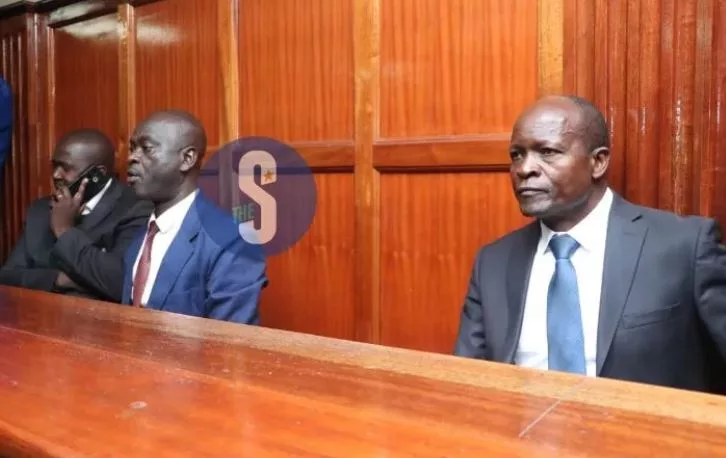
![[PHOTOS] Obado Leaves court in handcuffs](https://cdn.radioafrica.digital/image/2026/07/efc75d55-2eb9-4019-bb24-937dc4fc4f56.webp)