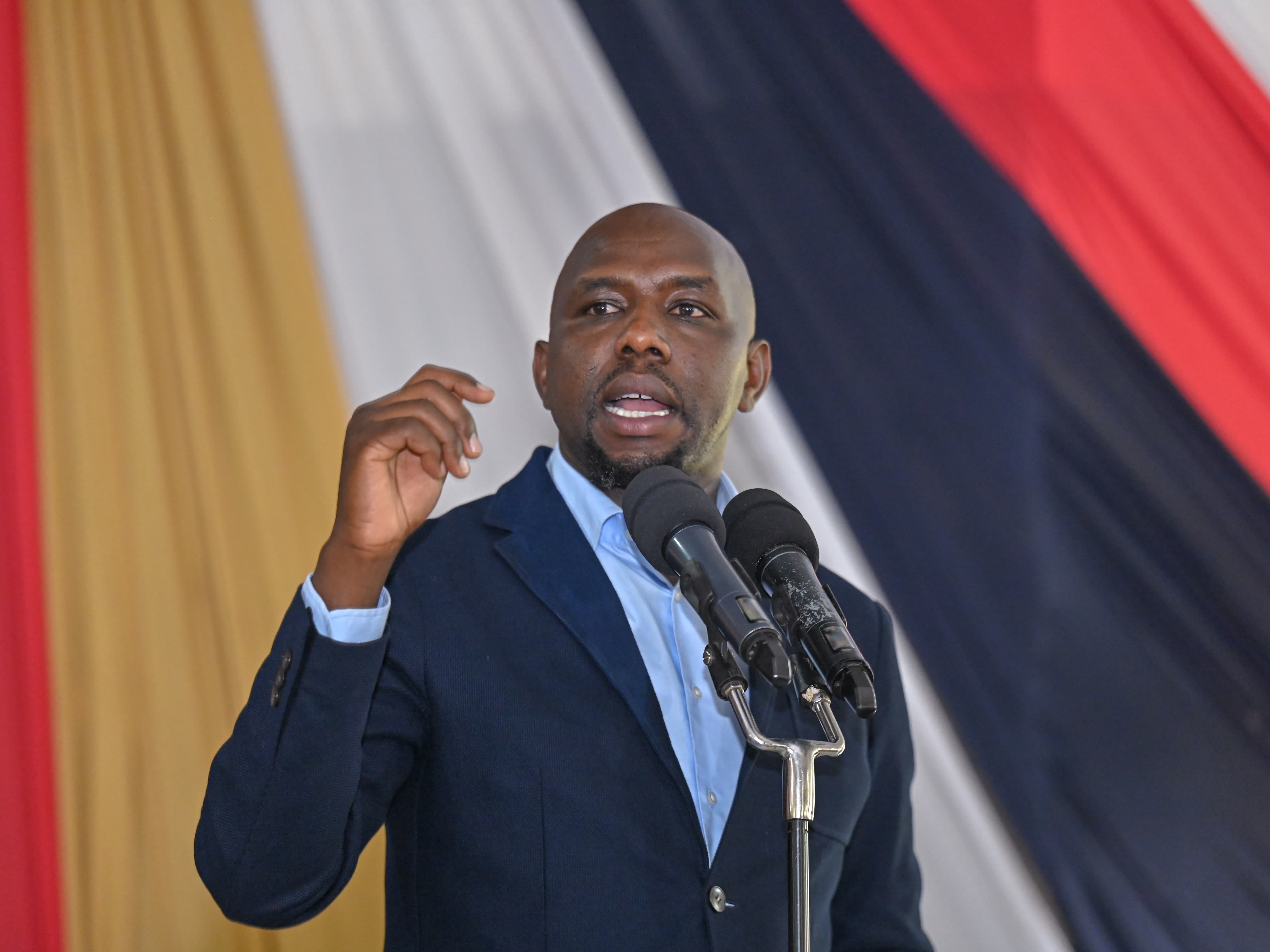
Deputy President William Ruto on Tuesday broke his silence on the Mau Forest eviction controversy and warned against disrupting learning in the water tower.
"Every child is entitled to be in school na sio tafadhali. Hiyo ni jukumu ya serikali (It is the government's mandate to ensure all children access education). Even those in Mau will not be left behind," Ruto said at Moi Girls High School in Kibra, Nairobi.
The Deputy President, who spoke after opening the institution's new 580-bed dormitory, said the government recognises the vital role played by education in the development and transformation of the lives of its citizens.
“Education is the single greatest empowerment that society can give to children. It is against the law for school-going children not to be in school.”
He spoke a day after the government backtracked on an earlier decision to shut down 15 schools targeted in the second phase of the Mau Forest evictions.
According to Nakuru County Commissioner Erastus Mbui, the decision to close the schools was reversed so that learners can continue with their studies and complete the Third Term.
“In the interest of pupils, for now, the government will allow children to go back to school and complete the exams set to be written in Third Term without any disruption,” Mbui said.
The government has been considering three options in the eviction of Mau Forest settlers.
Documents in our possession show that the government wanted to either maintain the status quo by formalising excision, compensate those set to be affected or kick them out without a penny.
After racking the brains, it was decided that there will be no compensation.
Initially, the thinking was that maintaining the status quo will help avoid a humanitarian crisis.
However, this would mean a loss of 42,007.85 acres (17,000 hectares) of forest cover – an equivalent of 37 per cent of the Masai Mau Forest.
The Maasai Mau Forest is one of the forest blocks of MFC and is registered as a trust land under the Trust Land Act.
The forest covers 114,355.2519 acres (46,278ha).
The government said allowing settlers in the forest will have catastrophic consequences to the ecosystem, the communities locally, regionally and internationally.
The forest is the most threatened particularly from human-induced pressure and destruction. The major threat is encroachment, commercial charcoal burning and illegal logging.
"The impact of this human-related degradation has been catastrophic with frequent floods, drought, reduced river flows, food shortage and poor land productivity, among others. This is likely to worsen under the current status of degradation," part of the report says.
Allowing settlers in the forest would have heightened the clamour for excision for all encroached water towers to the detriment of the current and future generations.
"Excision would heighten the already existing tension between communities, with a potential of it degenerating into a security situation," part of the report says.
With the forest cover being 7.2 per cent of landmass, the government dropped the idea altogether.
The impact of this human-related degradation has been catastrophic with frequent floods, drought, reduced river flows, food shortage and poor land productivity, among others. This is likely to worsen under the current status of degradation
This is what made political leaders furious with Environment CS Keriako Tobiko.
A section of Rift Valley leaders suggested that the evictees be re-settled on Kenyatta family land.
The MPs – most of them Ruto allies – also warned that the evictions would be the last straw in the Jubilee political marriage.
The government also considered giving illegal settlers a chance to buy alternative dwelling areas of their choice after being given money or acquiring land and apportioning it to the families who will be moved out of the water tower.
Compensation is an expensive venture.
Further, compensating illegally acquired land does not have a basis in law and would set a bad precedent.
This would encourage formalising illegalities. "Their settlement cannot be validated/formalised because there’s no basis in law and it will be detrimental to the environment and livelihoods," the report says.
According to the document, compensation of the illegal settlers, whether monetary or resettlement, cannot be the burden of the government since that presupposes the validity of titles.
Furthermore, the compensation presupposes that the persons being compensated are innocent victims who were duped to buy forest land.
The government too dropped this option to the chagrin of leaders from the region.
The government believes that the flows in the rivers such as Amalo and Ewaso Nyiro will increase among other benefits. It also believes that human-wildlife conflicts caused by water scarcity will be resolved.
The government also believes that there will be sustainable and increased tourism activities in the Maasai Mara National Reserve as a result of increased water flow.
The last option was the removal of all settlers without compensation through notices that they move out voluntarily.
Failure to move out would lead to evictions.
The government has already given the settlers a 60-day window to start packing and leave the water tower by October 31.
The government said it was clear that there has not been an issue that has had so many task forces, hearings, assessments, studies than the MMF.
It said all the task forces agreed that those who have encroached on the forest must be removed and the boundaries as established by the Ntutu commission implemented.
The government said that having carefully considered all the three options, the only viable option is the removal of all those who have settled in the Maasai Mau.
The 1,029 individuals who initially acquired land in the forest through ballooning of the group ranch boundaries will also be held criminally culpable.
During the first phase evictions which happened in July and August 2018, some 2,400 settlers were targeted in Nkoben and Kass Fm areas.
Some 11,119.725 acres (4,500 ha) were recovered.
Among those set to be prosecuted include companies and businesses associated with the late senior chief Lerionka ole Ntutu’s family.
They are among five group ranches that extended beyond adjudicated boundaries into the forest.
Ilngina Contractors Limited —whose directors are Agens Naropil Ntutu ( 490 shares), Kiteleiki Ntutu ( 490 shares) and Kunini Ntutu (20 shares) — extended their boundaries deep into the forest.
Izmir Enterprises, whose directors are Sahir Mughal and Asiya Mughal, also encroached the forest.
Other companies and business names in the five group ranches that extended beyond their adjudicated boundaries are Kaetoni Enterprises (director Mary Tamooh) and Kesumin Investment ( director Joseph Rotich).
Sanyana Enterprises — whose directors are Nathaniel Getonge (four shares) and Pacifica Nyambongo (one share) — also extended into the forest.