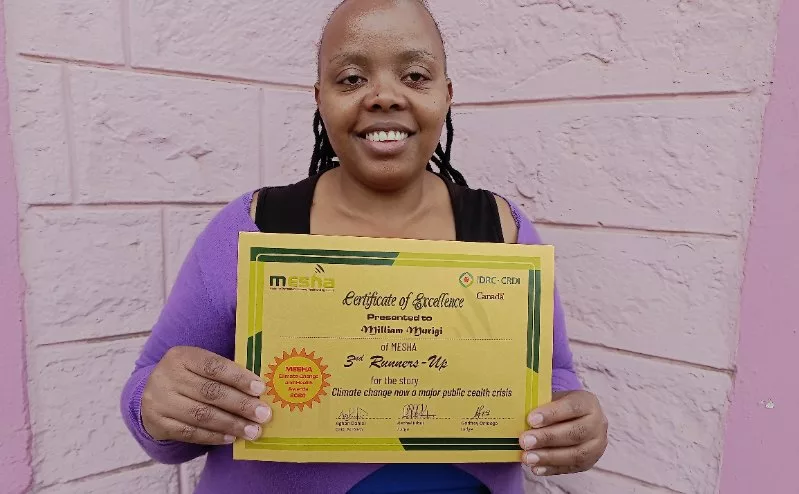
 Milliam Murigi of Mesha. Her story was adjudged the third runner – up.
A Kenyan journalist has won the top prize in a new regional journalism competition recognising outstanding reporting on how climate change is affecting public health across East and Southern Africa.
Jackson Okata was named the overall winner of the inaugural Health and Climate Change Journalism Awards for his story, Sand dams are fighting scarcity and diseases. The awards attracted 54 entries from journalists in Kenya, Uganda, Tanzania, Malawi, Zambia and Zimbabwe.
Tanzania's Mwanaisha Makumbuli of Highlands FM Radio was named first runner-up for Mabadiliko ya Tabia Nchi – Ukataji Miti Holela, while Uganda's Simon Chris Makanga of Athari Media Support Africa took second runner-up for Forced Choices - Climate change rewriting women's reproductive choices in Karamoja Subregion Uganda. Milliam Murigi of Science Africa finished as third runner-up for her feature, Climate change now a major public health crisis.
The awards were organised by the Media for Environment, Science, Health and Agriculture (Mesha) in partnership with the International Development Research Centre (IDRC) Canada to recognise reporting on the links between climate resilience, environmental change and public health.
The top 10 finalists and special mentions included Asha Bekidusa of Willow Health Media, Yvonne Kawira of Willow Health Media, Sammy Waweru of the Daily Nation and Christine Ochogo of Mesha.
Other journalists who received recognition from the judges were Simon Wokorach of Uganda, Philip Muasya of Kenya, Eamon Piringu of Zodiak Broadcasting Station in Malawi and Patrick Soko of the Zambia News and Information Services.
Mesha Chief Executive Officer Aghan Daniel said the awards are intended to encourage more journalists to produce accurate and impactful science reporting.
"These awards aim to incentivise and motivate journalists to attend the Media science cafes, produce accurate, engaging, and impactful research-based stories," Daniel said.
Speaking during the awards ceremony, Information and Broadcasting Secretary Temesi Mukani said science journalists play a critical role in helping the public understand complex issues.
"When journalists accurately translate dense, technical data into clear, human-centered narratives, they dismantle misconceptions, build durable public trust, and equip our citizens with the evidence-based facts necessary to make life-changing decisions," he said.
Mukani urged journalists to give greater attention to the links between gender, health and climate change, saying reporting should show how environmental and health challenges affect men and women differently. He added that coverage should also highlight women's role in strengthening community resilience, while examining inequalities in access to healthcare and the effects of health interventions on different groups.
He also praised Mesha for mentoring and training journalists, saying the organisation has helped members advance professionally both locally and internationally.
The judging panel, represented by media specialists Rachel Kibui and Godfrey Ombogo, commended the entries for exploring the connections between climate change, health, gender and culture through diverse sources and compelling storytelling.
However, Ombogo said that many submissions failed to explain the relationship between climate change and health clearly.
"A recurring concern was that many pieces did not clearly establish the nexus between climate change and health. Judges noted the need for stronger explanations of how climate-related changes directly affect health outcomes, communities, and livelihoods," Ombogo said.
The judges also recommended deeper use of data, more analysis of issues such as carbon emissions and ocean temperatures, and stricter adherence to ethical standards, including protecting the identities of minors.
Closing the event, Mukani warned that the rapid spread of digital information presents both opportunities and risks for health reporting.
"Today, more young Kenyans encounter health information on mobile screens than in physical clinics, meaning the exact same speed that carries life-saving medical data can spread devastating misinformation and social stigma at the exact same velocity. While the state enforces robust legal frameworks to protect citizens in the digital sphere, the law only does half the work; the remaining half relies entirely on your ethical editorial practices to inform without inflaming," he said.
Mesha said it will continue working with partners to support regional newsrooms through open-access institutional support and data verification infrastructure aimed at strengthening public-interest reporting.