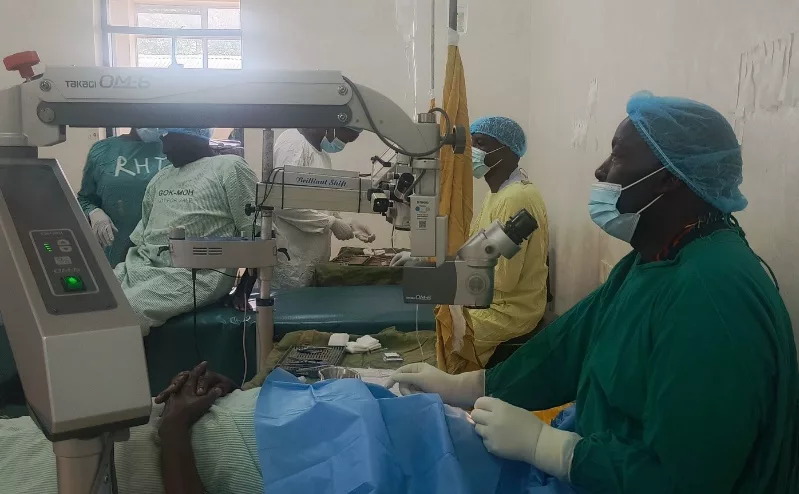
 Medics at work at the Kitale Regional Eye Hospital
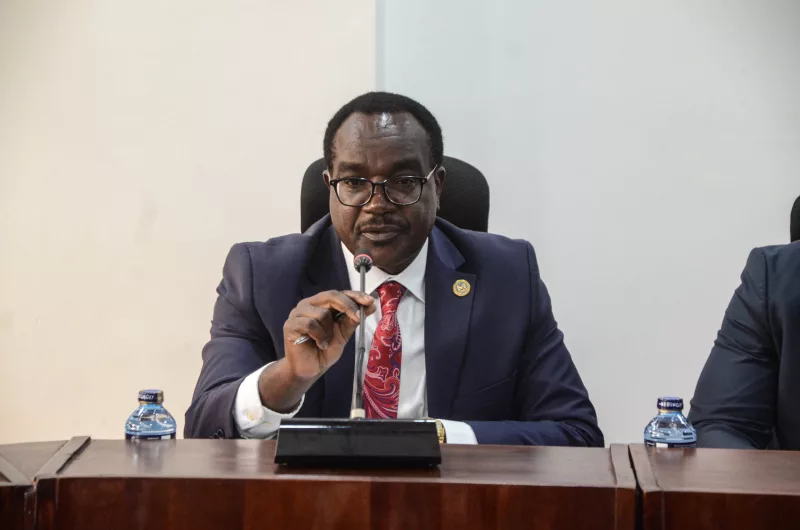
Trans Nzoia Governor George Natembeya has urged public and private hospitals to strengthen partnerships to improve access to specialised healthcare services.
He said stronger collaboration would enable hospitals to maximise existing facilities and expertise, allowing patients to receive specialised treatment closer to home instead of travelling to Eldoret or Nairobi at a higher cost.
"The public and private hospitals serve the same Kenyans and have facilities and services that can be utilised better to ensure our people are treated at affordable costs locally instead of seeking the same services in Eldoret or Nairobi at higher costs," Natembeya said.
The governor spoke during a meeting with Dr Hillary Rono, the lead eye surgeon at Kitale Regional Eye Hospital, which has begun conducting specialised cataract surgeries in a move expected to improve access to advanced eye care across the North Rift.
Rono said the programme is targeting the region's growing burden of preventable blindness, noting that about six per cent of the estimated 1.5 million people served by the facility have eye-related ailments.
He said the surgeries would significantly reduce the backlog of cataract-related blindness.
"We have started conducting cataract surgeries after screening patients at this regional referral hospital. We have now completed the procedures for a second day, with more than 50 patients having their sight successfully restored," Rono said.
He said eye conditions affecting residents include cataracts, glaucoma, diabetic eye disease and refractive errors such as short-sightedness, long-sightedness and astigmatism.
Rono said cataracts are particularly common among people aged 50 years and above and remain one of the leading causes of preventable blindness.
The surgeon thanked Natembeya for supporting eye healthcare initiatives, including surgical outreach camps in Cherang'any, Kiminini, Saboti, Endebess and Kwanza subcounties.
"These collaborations focus on eliminating preventable blindness through free surgical outreaches, where partners and county teams conduct free cataract surgeries, significantly reducing the cost burden on vulnerable patients," he said.
The ongoing surgery camp will continue for another three days at the regional referral facility before being extended to the subcounties.
Rono appealed to residents of Trans Nzoia and neighbouring counties, including West Pokot, Elgeyo Marakwet and Bungoma, to take advantage of the specialised services offered by the hospital.
Eye physician Pauline Matseshe said more than 200 cataract patients are expected to undergo screening and treatment during the outreach.
She said children diagnosed with complex conditions such as congenital cataracts, advanced structural eye abnormalities and retinal diseases would be referred to Sabatia Eye Hospital, the region's specialised referral centre for complicated eye cases.
According to Matseshe, patients at the Kitale facility are receiving specialised treatment that extends beyond routine eye care, including complex squint surgery, low-vision therapy and vitreoretinal surgery.
For many beneficiaries, the procedures have been life-changing.
Wekesa Lusakia from Mitoto in Kiminini subcounty said the operation made him feel as though "the world had been lit up" and that "colours had come alive again".
He jokingly regretted not seeking treatment earlier so he could have continued enjoying reading, watching television and following political events more clearly.
Violet Akisa from Birunda described the surgery as a miracle after regaining her eyesight.
"I am very, very happy and grateful to the sponsors of this surgery camp for helping me discover a clearer vision of how things look," she said.
Akisa said the procedure had restored not only her sight but also her ability to resume her daily responsibilities and provide for her family.
Instant analysis
Natembeya's call for stronger collaboration between public and private hospitals reflects a growing recognition that healthcare challenges cannot be solved by the public sector alone. The launch of specialised cataract surgeries at Kitale Regional Eye Hospital demonstrates how partnerships can decentralise advanced medical care, reducing travel costs and easing pressure on referral hospitals in Eldoret and Nairobi. If sustained, the initiative could significantly reduce preventable blindness and improve access to specialist treatment across the North Rift. The real test, however, will be maintaining skilled personnel, adequate equipment, consistent funding and regular outreach beyond short-term medical camps to ensure a lasting impact.
![[PHOTOS] Obado Leaves court in handcuffs](https://cdn.radioafrica.digital/image/2026/07/efc75d55-2eb9-4019-bb24-937dc4fc4f56.webp)