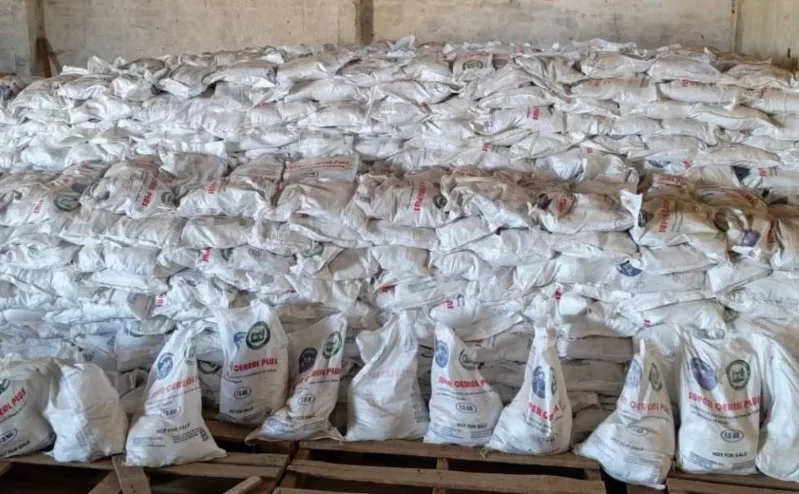
 Part of the consignment of nutrition supplies distributed in Turkana to help treat cases of acute malnutrition among children
Turkana County is taking measures to tackle high levels of malnutrition in five subcounties.
Health and Sanitation executive Dr Joseph Epem said drought remains the main cause of acute malnutrition in the county.
"Our region is largely arid and drought affects access to food, leading to malnutrition. Hence, the action we are taking as a county to mitigate the situation," Epem said.
Ministry of Health said malnutrition in Turkana has reached crisis levels, with Global Acute Malnutrition (GAM) rates persistently exceeding 21 per cent, well above the emergency threshold of 15 per cent.
Statistics indicate more than 80,000 children under the age of five and thousands of pregnant women are affected by severe acute malnutrition, driven by persistent drought and extreme poverty.
Poverty in Turkana affects roughly 83 per cent of the population, alongside localised disruptions to fishing on Lake Turkana.
The severity of malnutrition varies significantly across the county, with Loima subcounty recording GAM rates as high as 54 per cent.
The region largely depends on aid and relief efforts, while recent funding cuts have drastically reduced nutrition services.
Many families are forced to rely on a single meal a day or wild fruits and travel longer distances in search of scarce water sources.
Epem said several organisations and the county government are involved in screening and managing acute malnutrition through local and digital health initiatives.
"However, erratic weather continues to compromise the pastoral and lake-dependent livelihoods in Turkana."
The county has flagged off a two-month consignment of nutrition supplies to treat cases of acute malnutrition among children aged six to 59 months in five subcounties, including Suguta and Kibish.
Epem oversaw the dispatch of 10,133 bags of Corn-Soy Blend (CSB++) to Loima, Lokiriama, Lokichoggio, Kibish and Suguta.
"The commodities will be delivered using the last-mile approach, just like drugs and other health commodities distributed by the county," he said.
The executive said facility managers, nutrition officers and hospital board members had been instructed to receive and properly account for every consignment.
He warned that action would be taken against anyone found diverting the commodities, in accordance with the law.
"We are also asking the target recipients, the mothers, to desist from selling the supplies," he said.
CSB++ is a corn-soya blend fortified with vitamins and minerals used in the treatment of moderate acute malnutrition among children aged six to 59 months.
Epem said the quantities dispatched were informed by the latest assessment of vulnerability to malnutrition, which indicated the situation was deteriorating because of prolonged drought.
"The five subcounties were prioritised because of high caseloads and access challenges," he said.
Epem also confirmed the county is covered through partnerships with other organisations, including the World Food Programme, Save the Children, World Vision and the Kenya Red Cross, among others.